Overview:
-
Facial recognition now supports identity checks, border control, banking, policing, retail security, and access systems.
-
Leading algorithms show strong accuracy, but false matches can create serious consequences at large scale.
-
Privacy rules and responsible safeguards will play a major role in future facial recognition adoption.
Facial recognition has expanded beyond simple phone unlock features into airports, financial institutions, law enforcement operations, border checkpoints, and smart glasses. Although contemporary systems can cross-reference faces against databases containing millions of records, high software accuracy does not eliminate underlying risks. A single incorrect match can impact a criminal investigation, a border entry determination, or an individual’s access to essential services. Consequently, the technology finds itself at a crossroads: while superior software increases its utility, growing privacy regulations and public concern impose strict boundaries on its deployment.
A Fast-Growing Technology Market
Estimates from prominent market research organizations suggest the worldwide facial recognition market could value between USD 8.5 billion and USD 10 billion by 2026. Grand View Research values the 2026 market at USD 8.5 billion and forecasts growth to USD 19.6 billion by 2033, whereas Global Market Insights estimates the 2026 valuation at USD 9.92 billion and projects it will reach USD 31.72 billion by 2035.
North America maintains the largest regional market share, while the Asia-Pacific region demonstrates some of the fastest expansion. Market demand is largely driven by digital verification, border security, physical access control, financial services, retail protection, aviation hubs, and fraud mitigation.
Major Companies Shape the Market
A handful of prominent technology providers dominate distinct segments of the industry. IDEMIA specializes in government biometrics, border management, passport issuance, national identity registries, airport security, and law enforcement tools. Similarly, NEC maintains a robust footprint in policing infrastructure, border checkpoints, aviation security, and identity administration. Thales provides biometric systems tailored for digital credentials, passports, and border operations.
Commercial verification constitutes another significant sector. Jumio assists banking institutions and financial technology firms with remote identity checks, consumer authentication, and fraud prevention. Meanwhile, AWS delivers facial analysis and recognition capabilities via cloud infrastructure, enabling software developers to integrate biometric features without building heavy in-house systems.
Clearview AI follows a more contentious path by catering directly to law enforcement and investigative agencies. The firm asserts that its repository includes over 70 billion images, drawing heavy scrutiny and pushback from privacy advocates and regulators regarding its harvest of public photographs.
Also Read – Top 10 Password Managers with Biometric Login
Real-World Uses Continue to Expand
Digital identity represents a primary application for facial technology. Banks and fintech companies routinely compare customer selfies against official identification documents during the onboarding process to reduce manual verification overhead and spot identity fraud.
Aviation and immigration authorities likewise depend on biometric checks to link travelers directly to their passports or identity profiles, feeding automated border gates. This method accelerates passenger flow through terminals while reinforcing identity verification.
Police organizations deploy facial recognition for tracking suspects, locating missing persons, identifying deceased individuals, and monitoring watchlists. Because the stakes are vastly higher than phone authentication, a biometric match should serve merely as an investigative clue rather than definitive proof of wrongdoing.
Retailers have also experimented with facial software for loss prevention, safety enforcement, age verification, and customer service. Notably, the US Federal Trade Commission intervened against Rite Aid over its deployment practices, issuing a settlement that prohibited the pharmacy chain from using facial recognition for security and surveillance purposes for five years.
Smart Glasses Add a New Privacy Risk
The advent of smart glasses threatens to usher facial recognition into an unprecedented domain. While smartphones require users to deliberately direct a camera at a subject, smart eyewear embeds a camera at eye level throughout ordinary daily activities.
Meta has tested facial recognition functions integrated into its smart-glasses ecosystem, including a 2026-reported feature called NameTag designed to identify individuals via camera feeds. Meta subsequently removed the related code following intense privacy backlash. Rank One Computing has also explored facial recognition adaptations for smart eyewear and government applications.
This technological leap forces lawmakers and manufacturers to confront a difficult question: how should privacy frameworks govern wearable tech capable of identifying citizens in everyday public spaces?
Accuracy Still has Limits
The National Institute of Standards and Technology (NIST) remains a primary independent evaluator of facial recognition software. Through its Face Recognition Technology Evaluation initiative, NIST has tested 695 distinct algorithms submitted by 219 developers in 1:N identification scenarios.
Despite the capability to search multi-million-identity databases, system accuracy relies heavily on image clarity, lighting conditions, camera angles, subject age, demographic variations, and database scale. Even a fractional error rate yields a high volume of false matches when millions of faces are scanned.
A recent field trial conducted by the British Transport Police underscored the gap between laboratory benchmarks and practical efficacy. Over a six-month evaluation costing roughly GBP 320,786, the system scanned more than 500,000 faces, generating a single watchlist alert during its initial phase—which turned out to be false. Later deployments yielded a few confirmed matches, though those individuals were tied to existing court conditions.
Regulation Could Shape the Next Market
The European Union enforces some of the most rigorous restrictions globally. The EU AI Act places severe limitations on real-time remote biometric identification in public spaces by law enforcement agencies, permitting exceptions exclusively for acute threats, missing persons, victims, and specific serious offenses.
Additionally, the legislation restricts certain forms of facial image scraping, biometric categorization, and emotion detection. Conversely, the regulatory landscape in the United States remains decentralized, shaped by a patchwork of state privacy laws, biometric statutes, federal oversight, and municipal policies.
Also Read – The Future of Security: Advancements in AI Facial Recognition Technology
The Real Challenge is Trust
The central dilemma surrounding facial recognition is no longer technical feasibility, but rather governance: where such capabilities should be deployed, who maintains data custody, how erroneous matches are audited, and what safeguards protect individuals.
While the safest commercial prospects reside in digital identity verification, banking, border security, physical access control, and closed authentication, public surveillance and continuous wearable scanning introduce immense social and legal perils. Companies aiming for long-term viability must offer more than just precise algorithms; they require robust safeguards, rigorous testing protocols, ethical data handling, and operational frameworks that treat a biometric match as a lead rather than an absolute truth.
FAQs
1. What is facial recognition technology?
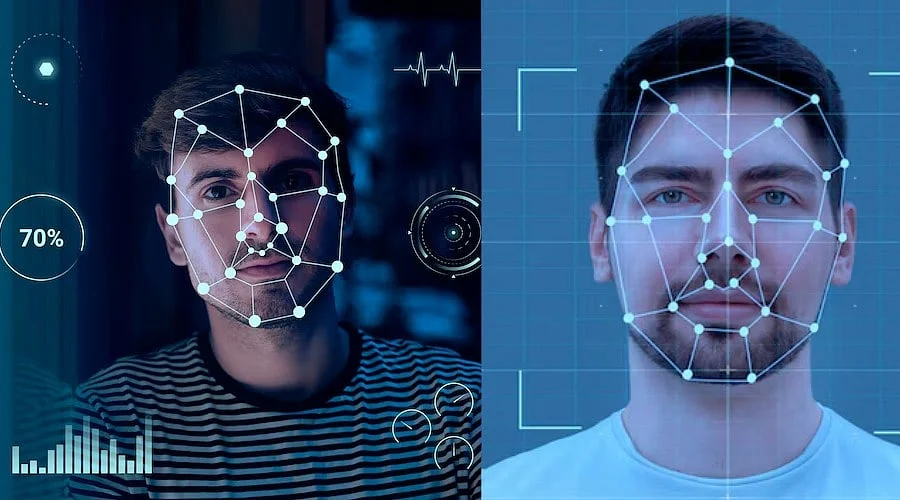
Facial recognition technology compares facial features with stored images to verify or identify a person.
2. Which companies lead the facial recognition market?
IDEMIA, NEC, Thales, Jumio, Clearview AI, AWS, and other specialist firms hold important positions across different applications.
3. Where is facial recognition used?
Common uses include banking, airports, border control, law enforcement, digital identity, smartphones, retail security, and access control.
4. What are the biggest challenges with facial recognition?
False matches, privacy concerns, demographic differences, data collection, surveillance, and regulatory limits remain major challenges.
5. How could smart glasses affect facial recognition?
Smart glasses could make face identification more immediate and widespread, which may create new privacy concerns around recognition in public spaces.