Key Takeaways –
-
Smart glasses: Meta’s AI glasses focus on calls, audio, cameras, translation, navigation, notifications, and hands-free AI assistance.
-
VR Glasses: Meta VR Glasses use displays, eye and hand tracking, spatial audio, and external computing for immersive experiences.
-
Technology gap: Display glasses connect everyday AI eyewear with the deeper virtual environments offered by VR hardware.
Meta’s device lineup now features two distinct categories of wearable technology. AI glasses are designed for calls, music, photos, translation, navigation, and Meta AI. Conversely, Meta VR Glasses emphasize virtual screens, games, movies, spatial audio, eye sensors, hand sensors, and private workspaces. The primary division between the two is the presence of a display.
While standard AI glasses operate without a visual screen, the Meta Ray-Ban Display models incorporate a small visual layer for directions, notifications, calendars, and other data. VR Glasses expand significantly upon this concept by utilizing micro-OLED displays to create an expansive virtual environment.
Meta AI Glasses Put AI into Everyday Eyewear
Meta’s AI glasses now comprise an extensive product family. The company projects that its portfolio will encompass over 100 AI glasses designs across Ray-Ban, Oakley, and Meta brands by the end of 2026. The Ray-Ban Meta Audio has a starting price of USD 349, while the Ray-Ban Meta Gen 3 begins at USD 449. Additionally, the new Meta Adventurer provides an entry-level alternative starting at USD 249.
The Ray-Ban Meta Audio highlights the more minimalist approach of smart glasses. Weighing 43 grams, these glasses omit the camera to concentrate entirely on audio, phone calls, and Meta AI integration. A single charge delivers up to 12 hours of use, and the charging case supplies an additional 48 hours. They support music, podcasts, calls, and hands-free AI interaction, keeping the physical world entirely visible while delivering digital assistance purely through sound rather than a visual screen.
The Ray-Ban Meta Gen 3 introduces a built-in camera alongside advanced control options. Featuring a sleeker build, extended battery life, and a customizable action button dedicated to Meta AI, this generation also enables users to record video accompanied by Dolby Atmos 360-degree spatial sound. This feature enriches captured footage with an immersive audio dimension without transforming the glasses into a traditional VR device.
Positioned halfway between traditional AI eyewear and immersive VR technology, the Meta Ray-Ban Display projects cycling directions, transit schedules, calendar updates, and phone alerts directly into the user’s field of view. Meta has also unveiled a hologram capability for video calls alongside an Explore app, layering visual graphics over the user’s unobstructed view of the physical environment.
Also Read – Best Smart Glasses with AI and AR/VR Features
Meta VR Glasses Create a Different Computer Model
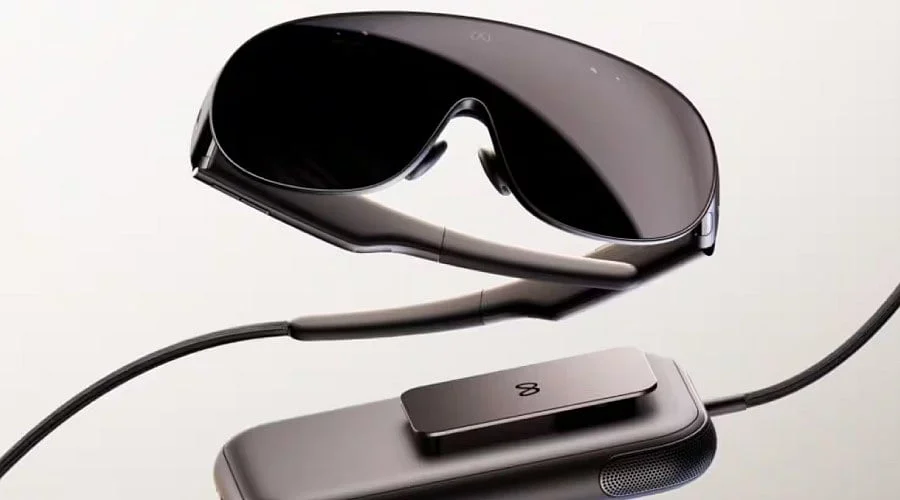
Meta VR Glasses take a distinctly different architectural route by connecting to an external compute puck. This design relocates much of the processing hardware away from the user’s face, allowing the headset itself to weigh roughly 100 grams—comparable to a standard deck of cards.
Meta markets this hardware as a portable cinema, a courtside seat, a private multi-screen office, and a gaming platform. Operating on Meta Horizon OS, the system relies primarily on eye and hand tracking for navigation, though optional Meta Quest Touch Plus controllers are also offered.
The technical specifications demonstrate a notable leap beyond smart glasses. Meta VR Glasses employ micro-OLED panels boasting 2,412 by 2,288 pixels per eye, a 120 Hz refresh rate, and a density of 37 pixels per degree. Powered by a Qualcomm Snapdragon XR2 Gen 3 processor accompanied by 12 GB of RAM, the hardware delivers a field of view measuring 70 degrees horizontally and 66 degrees vertically.
Additional specifications include sensors for head, hand, and eye tracking, color stereoscopic passthrough, depth sensing, Wi-Fi 7, Bluetooth 5.4, and Dolby Atmos audio support. Battery life during media playback runs for approximately three hours.
Different Hardware, Different Jobs
AI glasses are tailored for everyday tasks that demand ongoing awareness of one’s surroundings, including calls, music playback, language translation, quick AI queries, photography, navigation, notifications, and calendar checks. Display-equipped models introduce a subtle visual channel—free from a fully virtual environment—making them practical for receiving directions, messages, appointments, and hands-free data.
In contrast, VR glasses are built for activities requiring an expansive digital workspace. A virtual cinema can substitute for a physical monitor, a multi-window virtual office can handle standard computer workflows, gaming applications can surround the player with digital assets, and sports apps can simulate a courtside seat. Furthermore, Meta notes that the system can turn any flat surface into a functional virtual keyboard and touchpad, eliminating the need for extra input peripherals.
Also Read – EchoVision Smart Glasses: How the AI-Powered Wearable Works
The Core Difference Comes Down to Immersion
Meta’s current hardware roadmap illustrates a clear evolution: audio-focused glasses introduce digital sound to standard frames; camera-equipped AI models add optics and hands-free utility; display variants overlay information onto the real world; and Meta VR Glasses construct deeply immersive virtual spaces utilizing specialized displays, spatial computing, and tethered processing units.
Although both product types are worn on the head, they serve distinct purposes. AI glasses strive to make digital tools unobtrusive in daily life, whereas VR glasses aim to build expansive digital environments for work, gaming, and immersive media. Meta’s lineup for 2026 spans both extremes, with display glasses functioning as the technological bridge connecting everyday AI features to full virtual reality.
FAQs
1. What is the main difference between Meta Smart Glasses and VR Glasses?
Meta Smart Glasses focus on everyday AI, audio, cameras, communication, and real-world information, while VR Glasses create immersive digital environments.
2. Do Meta Smart Glasses have a display?
Some newer Meta glasses, such as Ray-Ban Display, add visual information for navigation, notifications, calendars, and other features.
3. What can Meta VR Glasses do?
Meta VR Glasses support virtual screens, games, movies, spatial experiences, private workspaces, eye tracking, hand tracking, and immersive audio.
4. Why does Meta use an external compute puck for VR Glasses?
The external compute puck keeps major processing hardware away from the face, which helps Meta create a lighter VR glasses design.
5. Which category is designed for everyday use?
Meta Smart Glasses target everyday use, with features such as AI assistance, calls, music, navigation, translation, photos, and notifications.