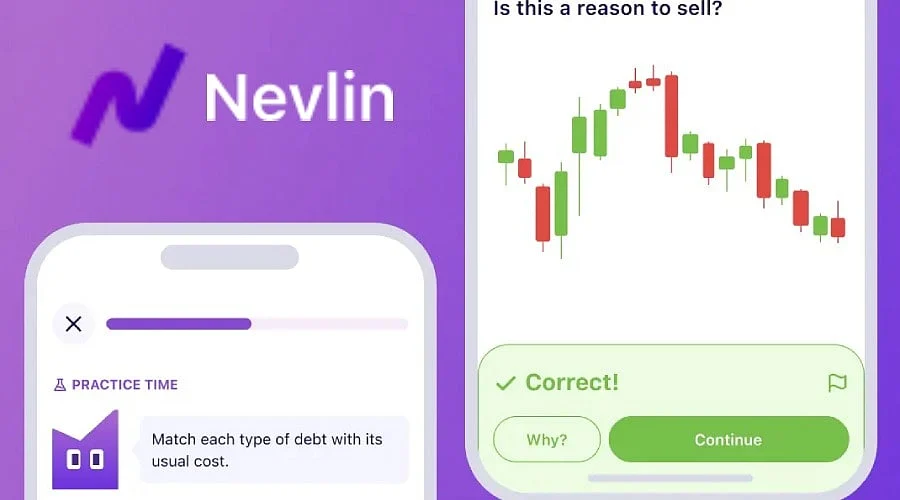
Nevlin charges for financial learning through a structured subscription package. The service also highlights additional learning features like Books and an AI Assistant, meaning buyers should separate the overall course content from the specifics of an individual transaction.
Readers must verify the billing cycle, renewal conditions, and total cost directly on the current offer page. While a general overview can outline what details require attention, it cannot establish a single, universal price or package.
A thorough assessment starts with the purpose of the plan, then moves on to evaluate access levels, bonus resources, payment schedules, and how to manage the subscription.
1. The plan: access to financial learning
Examine the service details to find a clear breakdown of the curriculum, the duration of access, and any auxiliary products. Never assume that every feature mentioned anywhere on the platform comes bundled with the specific package you are evaluating.
The curriculum from Nevlin focuses on financial education. Judge whether these subjects align with the specific questions you hope to answer and if the delivery method matches your preferred learning style.
2. The current offer: where to confirm the price
Nevlin’s pricing page instructs customers to review their specific offer prior to checkout and notes that subscriptions renew automatically until canceled. It also differentiates between introductory access and paid curriculum. Consequently, your specific offer is the definitive place to verify applicable costs.
Take note of the initial fee, the duration of access it secures, the renewal rate, and how often it renews. Treat these as distinct pieces of information. If any detail is unclear or missing, seek clarification before completing your purchase.
3. Billing periods: understanding the interval
For hypothetical comparison only, a $12 fee billed every four weeks results in 13 payments over 52 weeks, totaling $156. Meanwhile, a $12 monthly fee occurs 12 times a year, totaling $144. Neither of these scenarios reflects an actual Nevlin promotion. The underlying takeaway is that billing frequencies matter deeply, even when the per-charge cost appears identical.
This arithmetic demonstrates why every price requires a specified timeframe. Review both the initial payment terms and the ongoing recurring schedule rather than assuming one based on the other.
4. AI Assistant and Books: checking what is included
This consideration is vital when a provider offers a combination of digital reading materials, an AI tool, and a formal course. These items may be bundled together, sold individually, or packaged through varying offers. Your live checkout page will determine how your purchase is structured, as a broad overview cannot resolve this for every individual.
The initial product overview notes that the AI Assistant may be sold separately as an optional add-on. Because public offers can evolve, inspect the current terms of purchase for both reading materials and AI capabilities rather than taking their inclusion for granted.
5. Subscription management: finding the official route
Identify the official support and account management pathways before any issues arise. Keep a record of your purchase confirmation email and the specific account profile linked to the transaction. If the vendor utilizes multiple purchasing platforms, verify which channel governs the exact subscription you intend to buy.
Do not assume that deleting a mobile application or closing a browser window constitutes the termination of a billing contract. Adhere strictly to the platform’s official cancellation procedures and retain proof of confirmation. Direct any questions regarding specific charges to the payment processor or the service provider.
6. Course fit: comparing topics with your questions
Note down two or three core subjects you wish to master, then cross-reference them with the published syllabus. A course can be valuable even if it does not address every conceivable financial scenario. Conversely, a broad list of topics may prove less helpful than a targeted breakdown of the specific problem that led you to the site.
If your goal is to comprehend borrowing terms, look specifically for modules on credit and loans. If you need help parsing a complex contract, educational resources can supply background context, though they cannot interpret or guarantee the legal meaning or suitability of any specific clause.
The same principle applies to investing. Gaining an understanding of how an asset operates is entirely separate from receiving personalized financial advice or a direct recommendation to purchase it.
7. Illustrative ways to judge whether the plan fits
Pick a realistic initial study session and focus on a single topic. This exercise is meant for practical planning, not as a guarantee that a specific time investment will yield financial results. You might conclude that a structured subscription fits neatly into your schedule, or you might find that free resources adequately answer your immediate questions.
Your purchase should make practical sense without relying on unrealistic expectations of self-transformation. A sound decision framework might look like this: “This plan addresses the concepts I want to master, I understand the recurring subscription costs, and I have a clear plan for when I will study.” If you cannot yet describe your purchase with that level of clarity, your next step should be gathering more information rather than rushing to checkout.
Nevlin’s pricing details are most effective when reviewed alongside the specific promotion presented to you. Verify exactly what you are getting and how the billing functions, then determine whether the learning format suits the financial topics you wish to explore.