AI & Gen AI Leader | Responsible AI | Agentic AI | Quantum AI | Decision Science | Research & Digital Transformation
Artificial Intelligence and the Next Era of Enterprise Intelligence
Artificial Intelligence is rapidly transitioning from experimentation and proof-of-concept projects to a broader era of enterprise and societal transformation. As organizations explore Generative AI, Agentic AI, Quantum AI, and increasingly sophisticated digital systems, the core question is no longer just what AI can achieve. The more pressing issue is how intelligence can be designed, governed, and scaled to deliver sustainable value for enterprises, governments, and citizens alike.
For Dr. Indranil Mitra, this inquiry has anchored more than two decades of professional and academic work.
With a career spanning over 27 years across data science, artificial intelligence, advanced analytics, decision science, and emerging digital technologies, Dr. Mitra has operated at the nexus of quantitative rigor, technological innovation, enterprise strategy, and responsible deployment.
His professional trajectory bridges multiple dimensions of modern intelligence: Artificial Intelligence, Generative AI, Responsible AI, Agentic AI, decision science, digital transformation, research, and emerging DARQ technologies—including distributed ledger systems, extended reality, and quantum computing.
Yet his outlook on AI extends beyond the technical boundaries of the discipline itself.
In Dr. Mitra’s view, the future of intelligent systems relies heavily on connecting data, computation, and AI with other scientific fields and real-world environments. Biology, chemistry, pharmaceutical science, marine science, environmental science, geography, and spatial technologies all play vital roles in shaping richer, context-aware intelligence.
This cross-disciplinary perspective becomes critical as AI shifts from standalone enterprise applications to systems that engage directly with cities, industries, ecosystems, and populations.
Today, his work assists organizations in moving past basic AI experimentation toward enterprise-scale adoption and what he terms “AI authority”—the capability to deploy intelligence with strategic clarity, robust governance, trust, and measurable results.
From Quantitative Foundations to Cross-Disciplinary Intelligence
Dr. Mitra’s career stems from a robust background in statistics, data science, decision science, and computational research.
His doctoral research centered on Data Science and AI, featuring applications in Chemical Informatics, Computational Biology, and Pharmaceutical Sciences. His investigations covered drug design and delivery, nanoparticle delivery systems, computational molecular design techniques, and deep-learning-based simulations for pharma.
This scientific grounding shapes his perspective on the evolution of AI.
Rather than treating artificial intelligence as an isolated computing field, Dr. Mitra views it as a convergence point where data serves as the bridge between distinct forms of knowledge. Future intelligent systems will increasingly demand this multidisciplinary synthesis.
For instance, a healthcare AI application may need to integrate biology, chemistry, medicine, human behavior, and economics. A smart city initiative might require AI to process geography, transportation, demographics, climate metrics, energy grids, and spatial technologies. A marine intelligence platform could combine oceanography, environmental science, satellite data, sensor webs, and machine learning.
This convergence spans Life Sciences, Physical Sciences, and Environmental Sciences, with each domain providing unique insights. Life Sciences supply perspectives on biological functions, adaptation, cognition, and complex living systems. Physical Sciences contribute foundational knowledge of matter, energy, materials, chemical reactions, and physical laws. Environmental Sciences help AI interpret ecosystems, climate patterns, natural resources, sustainability, and human-environmental interactions.
Within this framework, cross-disciplinary data is paramount. The efficacy of future systems will depend not only on algorithmic sophistication, but also on the breadth, quality, and contextual richness of the data connecting diverse scientific and human domains. This proves especially crucial for the long-term evolution of advanced and potentially sentient systems, which cannot be comprehended through a single lens.
Consequently, the fusion of scientific research, data science, intellectual property, and business strategy defines Dr. Mitra’s methodology.
Dr. Mitra also investigates the intersection of AI, the circular economy, and ESG, emphasizing how intelligent systems foster sustainable, resource-efficient models. His initiatives explore how data-driven approaches support recycling, resource optimization, environmental accountability, and responsible operations to build a measurable, sustainable economy.
Building Enterprise AI at the Intersection of Strategy and Technology
At the core of Dr. Mitra’s philosophy lies a clear distinction between AI activity and AI authority.
Many organizations currently experiment with large language models, copilots, assistants, and automation. However, experimentation alone does not yield sustainable enterprise value.
Critical questions include:
Can an organization scale AI beyond isolated pilots?
Can AI initiatives generate measurable business outcomes? Can organizations govern AI responsibly?
Do leaders understand the economics and risks tied to AI? Can AI systems be deployed to foster trust?
Can enterprises establish repeatable frameworks rather than one-off demonstrations? His work addresses these exact challenges.
His profile highlights his role in translating executive leadership goals into actionable AI deployments, marrying quantitative rigor, machine learning, and board-level strategy.
This perspective gains urgency as companies transition from siloed AI proofs-of-concept to enterprise-wide transformations.
This shift demands more than model implementation; it requires redesigning processes, rethinking data architectures, instituting governance frameworks, and cultivating the human skills necessary to collaborate with increasingly autonomous systems.
Leading AI and Generative AI
Dr. Mitra’s enterprise AI leadership marks a major phase in his professional path.
As a senior leader in AI, Generative AI, and Advanced Analytics, he has operated across manufacturing, financial services, pharmaceuticals, government, and network sectors.
His remit ranges from enterprise strategy and client relations to AI architecture, commercial leadership, research, and responsible AI oversight.
A consistent objective has been guiding organizations past initial proof-of-concept phases.
His portfolio includes designing and directing cross-domain AI and GenAI engagements, formulating repeatable delivery models, building internal AI competencies, and advising senior leadership on strategic positioning.
He has likewise contributed to academic institutions, national forums, and policy discussions concerning responsible AI.
Earlier in his leadership timeline, he helped build generative AI capabilities during the rapid transition of the technology from experimental innovation to core enterprise priority.
That evolution represents a watershed moment in technology: the shift from traditional analytics and machine learning toward foundation models, generative tools, and autonomous systems.
Responsible AI and Sustainable Intelligence
A prominent pillar of Dr. Mitra’s professional philosophy is Responsible AI.
As AI systems grow more potent and increasingly impact business and societal choices, entities must address fairness, transparency, accountability, security, privacy, and governance.
For Dr. Mitra, Responsible AI is not a mere compliance checkbox; it is a foundational pillar required for sustainable AI transformation.
His work underscores that innovation should be measured not merely by the speed of deployment, but by whether a system is trustworthy, resilient, explainable, economically viable, and scalable.
This principle becomes vital as AI moves out of corporate labs and into public infrastructure.
AI, Smart Cities and the Intelligence of Human Movement
The trajectory of AI will be heavily shaped by the environments where people live.
Smart cities present prime opportunities for AI to generate direct societal value. Yet constructing genuinely intelligent cities requires far more than deploying chatbots or automating isolated services.
Cities function as complex living systems.
They encompass transit, energy, water, housing, healthcare, public safety, employment, education, climate, physical infrastructure, and human mobility.
Spatial technologies add another vital layer of intelligence by enabling AI to understand where events occur, how infrastructure interacts with geography, and how communities evolve over time.
Population migration introduces another variable.
As populations shift across cities, regions, and nations, public services must continuously adapt. AI can assist authorities in understanding migration trends, forecasting infrastructure needs, optimizing transit networks, and planning public utilities.
Achieving this, however, requires integrating AI with demographic data, geospatial intelligence, environmental metrics, economic indicators, and social science.
The goal should not simply be automated cities, but cities that are more responsive to citizens.
This highlights the importance of sustainable AI scaling.
Societal-scale AI must deliver value without exacting prohibitive environmental, economic, or social tolls. Architectures must account for power consumption, infrastructure demands, data governance, accessibility, and long-term upkeep.
For Dr. Mitra, the ultimate opportunity lies in leveraging intelligence to help societies anticipate needs rather than react to them.
AI at the Intersection of Science
Dr. Mitra’s outlook on AI extends into the intersections of multiple scientific and technical fields.
The future of intelligent systems relies on synthesizing insights historically isolated in separate domains. AI’s progression will be driven not just by computing power, but by its capacity to draw and unify insights from diverse disciplines.
Biology and Life Sciences contribute insights into learning, adaptation, biological networks, and complex living systems, inspiring more adaptive technologies.
Chemistry enables AI-driven molecular discovery, advanced materials science, pharmaceutical breakthroughs, and accelerated R&D.
Marine Science generates massive datasets via satellites, sensors, oceanographic tools, and monitors, allowing AI to better comprehend marine ecosystems, ocean dynamics, and climate shifts.
Environmental Science aids intelligent systems in interpreting ecological networks, resource usage, climate trends, and sustainability to tackle environmental hurdles.
Spatial Science and Geography help AI model physical environments, movement, infrastructure, and human-place relationships.
Data Science provides the analytical backbone to convert complex datasets into actionable insights, empowering AI systems to detect patterns, forecast trends, and elevate decision-making.
Mathematics remains core to AI, supplying frameworks for modeling, optimization, probability, statistics, and algorithms.
Concurrently, Emerging Technologies like advanced computing, robotics, quantum tech, and edge computing unlock new paradigms for AI development.
This convergence signals a broader evolution: future innovation will emerge from the intersection of science, data, mathematics, technology, and real-world systems rather than isolated silos.
These disciplines offer distinct worldviews, not merely extra training data.
Such cross-domain convergence may define the nature of future intelligence.
As AI systems mature, boundaries between computer science, natural sciences, social sciences, and decision science will blur.
The metric of success will cease to be model intelligence alone, evaluating instead whether systems can integrate diverse knowledge to reason within complex real-world settings.
ISO/IEC 42001 and the Architecture of AI Governance
Dr. Mitra’s dedication to responsible AI is mirrored in his engagement with formal governance standards.
He completed the requirements and examination to earn the ISO/IEC 42001:2023 Artificial Intelligence Management Systems Lead Auditor certification.
ISO 42001 establishes an organizational structure for managing AI systems, addressing risk, accountability, and responsible rollout.
For Dr. Mitra, governance is crucial because AI introduces risks distinct from legacy IT systems.
Algorithmic bias, data provenance, model drift, dynamic system behavior, and ethical concerns escalate into major enterprise risks at scale.
His approach embeds governance directly into AI architecture rather than treating it as an afterthought.
The foundational principle is simple: intelligent systems must be built resiliently to endure.
From Generative AI to Agentic AI
The rise of Agentic AI marks another frontier in Dr. Mitra’s portfolio.
While Generative AI creates text, images, code, and media, agentic systems build on this by enabling AI to utilize tools, execute workflows, and manage multi-step processes.
This transforms enterprise AI.
Organizations must look beyond whether an AI model can answer a query to determine whether it can safely participate in business operations.
This introduces new considerations surrounding autonomy, oversight, governance, decision rights, and accountability. Dr. Mitra’s work navigates this exact transition.
His professional positioning couples Generative AI, Responsible AI, and Agentic AI, maintaining that expanded capabilities must be matched by rigorous governance and strategic discipline.
For enterprises, this means building architectures where AI agents manage complex workflows while remaining observable, governed, and aligned with company goals.
The AI “Salt” of Business Strategy
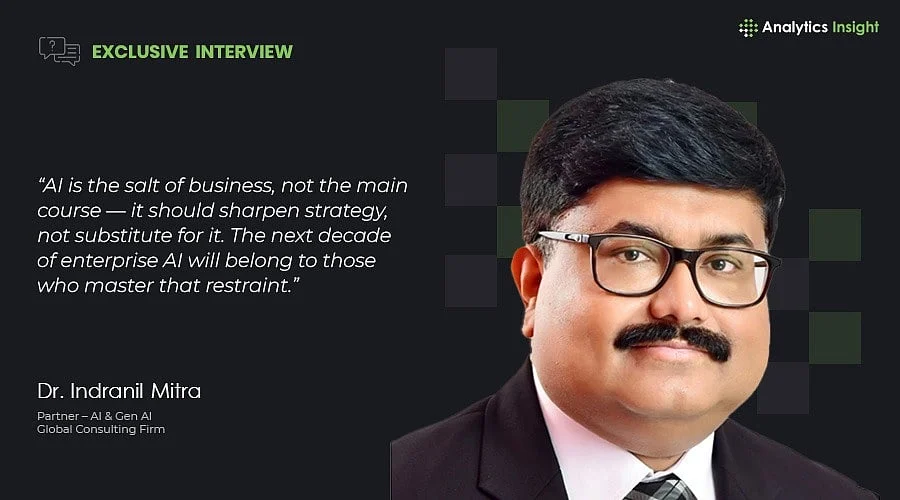
Dr. Mitra frequently distills complex technical concepts using accessible business analogies, such as comparing AI to salt in business strategy.
The concept is straightforward: AI should enhance the core ingredients driving an organization’s success rather than become its entire identity.
Businesses should bake AI into processes and data foundations from inception, select AI methods suited to specific business hurdles, and avoid tech adoption driven solely by novelty.
This metaphor captures a fundamental rule of enterprise transformation:
AI creates value when it makes the business better, not merely when the business uses AI.
This shifts the focus from hype to metrics like productivity, decision quality, speed, accuracy, personalization, and customer value.
It also underscores restraint.
The most successful AI leaders may not be those fielding the highest volume of models, but those identifying where intelligence drives true advantage—and where human judgment remains paramount.
Decision Science Meets Artificial Intelligence
Another hallmark of Dr. Mitra’s work is the synergy between AI and decision science.
Machine learning spots patterns, generative AI synthesizes information, and agents execute tasks.
However, organizations still require frameworks to decide what choices to make, how to execute them, and who bears accountability.
Decision science bridges computational intelligence and corporate governance, proving indispensable as AI impacts high-stakes decisions.
The challenge transcends prediction or generation.
It involves engineering systems that support sound decisions within the bounds of business objectives, human values, constraints, and uncertainty.
Dr. Mitra’s career maps this evolution in enterprise analytics—from descriptive and predictive models to intelligent decision systems driving strategic action.
Research, Academia and the Development of AI Talent
Dr. Mitra’s endeavors extend beyond corporate advisory roles.
He serves as a Visiting Industry Faculty member at the Indian Institute of Management Calcutta while advancing research and academic programs.
His profile highlights supervision of doctoral candidates researching hybrid AI frameworks.
This academic footprint connects cutting-edge research with practical execution.
He has also contributed to designing AI literacy curricula for diverse audiences, including engineering students and learners in India’s northeast.
This mirrors his conviction that AI transformation relies as heavily on people capable of understanding, deploying, and governing technologies as it does on models and infrastructure.
Future AI leadership will demand multidisciplinary talent capable of navigating technology, science, commerce, ethics, and society.
Beyond Statistics: Data as the Foundation of Intelligence
While Dr. Mitra’s quantitative background remains a core pillar, his broader scope transcends any single field.
At the epicenter is data.
AI systems rely on data, but future intelligence demands diverse, contextual, and interconnected data pools.
Biological data can inform chemical models. Geospatial data can intersect with demographics.
Marine metrics can merge with climate logs.
Economic indicators can couple with population shifts.
Enterprise records can interact with consumer behavior and operational workflows. True value emerges from the relational fabric connecting these datasets.
This cross-disciplinary data architecture may prove vital for scaling intelligent systems.
As AI matures, organizations capable of responsibly linking disparate forms of knowledge will outpace those treating data as isolated assets.
For Dr. Mitra, quantitative rigor provides the foundation—while multidisciplinary intelligence charts the horizon.
The DARQ Perspective: Looking Beyond Today’s AI
Dr. Mitra’s expertise reaches beyond standard AI and generative models.
His profile details experience across DARQ technologies—Distributed Ledger tech, AI, Extended Reality, and Quantum Computing—alongside the wider Digital 2.0 ecosystem.
This macroscopic view is vital because enterprise transformation rarely happens via a single technology.
Artificial Intelligence increasingly converges with cloud infrastructure, blockchain, robotics, IoT devices, extended reality, and quantum hardware.
The same logic applies to societal transformation.
While AI provides intelligence, spatial technologies supply context, sensors capture real-world signals, connectivity ensures access, and advanced computing delivers scale.
Recognizing these tools as components of a unified ecosystem allows organizations to plan for long-term transformation rather than chasing isolated tools.
AI, National Resilience and Intelligent Infrastructure
Dr. Mitra’s thought leadership also investigates the role of emerging tech in national security and resilience.
In analyzing the Sentinel Grid, he explored how AI and DARQ applications bolster border surveillance, autonomous anti-drone defense, flood prediction, cognitive city monitoring, and cyber defense.
The broader takeaway extends beyond security.
Intelligent infrastructure fosters predictive, resilient societies.
Flood forecasting, for instance, requires environmental data, spatial intelligence, meteorological inputs, and computational models.
Similarly, smart cities demand the synthesis of transit, civic assets, demographics, and environmental metrics.
While applications vary, the underlying principle holds true: intelligence grows exponentially more potent when anchored in context.
Unchecked by ethical guardrails, however, technology risks becoming a hazard rather than a fix.
This is why governance, transparency, and responsible rollout remain central to Dr. Mitra’s philosophy.
Making AI Understandable to Business Leaders
A critical facet of Dr. Mitra’s identity is his role as a translator.
Described in his profile as an “AI Whisperer,” he bridges the gap between executive ambitions and the pragmatic hurdles of AI execution.
This translation skill is increasingly vital.
AI nomenclature can easily alienate business leadership. Large language models, foundation models, RAG, agents, multimodal architectures, governance protocols, and quantum computing form a dense technical landscape.
Yet executives must navigate these technologies without necessarily becoming engineers. An effective AI strategist must explain technical implications in terms of business value, risk, economics, governance, organizational readiness, and long-term impact.
This translation layer sits at the core of Dr. Mitra’s positioning.
A Leadership Philosophy Built on Trust and Long-Term Value
Throughout his academic and professional path, several guiding principles remain constant.
First, AI must tie directly to business strategy. Adopting technology without a clear business objective yields expensive experiments devoid of lasting value.
Second, governance must be architected into AI systems. Responsible AI cannot be treated as an afterthought.
Third, data forms the bedrock of intelligence. The future necessitates interconnected data bridging industries, sciences, and societal systems.
Fourth, multidisciplinary thinking is indispensable. AI intersects with biology, chemistry, marine science, environmental science, spatial tech, economics, and social sciences.
Fifth, people matter as much as technology. AI literacy, research, education, and leadership development are prerequisites for sustainable transformation.
Finally, innovation must be engineered to last. The goal is not a flashy demo, but resilient, responsible intelligence delivering measurable outcomes over time.
From AI Activity to AI Authority
Dr. Mitra’s journey mirrors the broader evolution of enterprise technology itself.
Starting from quantitative and computational research roots, his career expanded across data science, digital transformation, advanced analytics, and emerging fields.
It now centers on enterprise AI strategy, Generative AI, Responsible AI, Agentic AI, and AI governance, while pointing toward an even broader horizon.
Next-generation AI will inhabit the intersection of disciplines, industries, and societal systems.
It will bind algorithms to biology, data to geography, intelligence to cities, computation to science, and AI systems to citizen needs.
Consequently, leaders must master more than just technology.
They must comprehend strategy, economics, governance, research, ethics, organizational dynamics, science, and deployment realities.
They must guide organizations to address not only:
“Can we build this AI system?” but also:
“Should we build it, how should we govern it, what knowledge should it incorporate, and how can we ensure that it creates lasting value?”
That is the operational domain of Dr. Indranil Mitra.
Backed by over 27 years of experience, a foundation in data science and decision science, deep expertise in Responsible AI, leadership in generative and agentic systems, academic research, and a panoramic view of emerging tech, his work offers a distinct paradigm for enterprise transformation.
The journey ultimately transcends AI for its own sake.
It is about building organizations, cities, and intelligent ecosystems that leverage human and machine intelligence to make sound decisions, fortify systems, empower citizens, and generate enduring value.
Moving from AI activity to AI authority, Dr. Indranil Mitra’s work embodies an artificial intelligence vision that is simultaneously potent, multidisciplinary, responsible, strategic, and enduring.