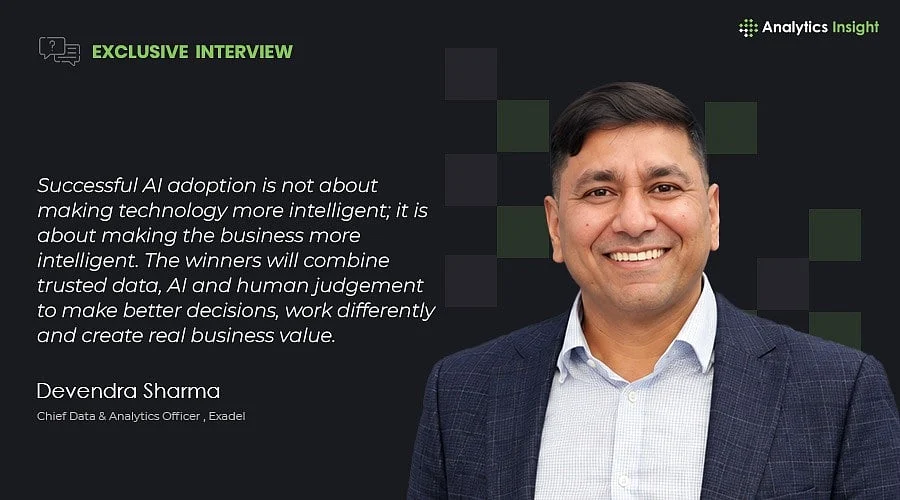
Devendra Sharma is a global AI and data executive, C-suite advisor, and transformation leader serving as the Chief Data & AI Officer at Exadel, following previous leadership roles at BCG and HSBC.
My career spans more than 20 years at the intersection of technology, business transformation, and enterprise value creation driven by data and AI. I have worked with organizations such as HSBC, BCG, Royal Mail, and Samsung, where I helped shape strategies to turn technological evolution into business objectives for the people they serve.
I began in telecoms engineering and technology, designing complex 3G and 4G systems and architectures. Over time, I realized that difficult digital and business transformation challenges are rarely technology problems alone; they are business problems requiring the proper strategy, operating model, leadership, investment, and talent to deliver objectives.
At HSBC, I led data, analytics, AI, and cloud transformation at a global scale, navigating complexity, regulations, and legacy environments across more than 20 markets. At BCG, as Global Head of Data, GenAI, and Governance, my perspective on measurable business value broadened as I worked with clients to translate investments into tangible outcomes.
Today, as Chief Data & AI Officer at Exadel, my focus is centered on a fundamental question: where and how will AI genuinely create enterprise value? I work with organizations to connect AI strategy with growth, productivity, decision-making, and new operating methods.
One principle remains constant: technology is an enabler and part of the strategy, but it should never become the strategy itself.
We are entering a phase focused on achieving greater effectiveness and efficiency, though organizations still struggle to find AI initiatives with measurable business value.
What inspired your journey into Data and AI leadership, and how has your perspective evolved across BCG, HSBC, and Exadel?
I started my career in telecoms and developed a keen interest in communication tech, data, and architecture during the third year of my engineering degree. Early on at Samsung, I was fascinated by how technology changes lives and delivers business value.
HSBC was a defining chapter where I managed transformations across more than 20 markets, learning the realities of scale, legacy tech, regulation, fragmented data, and competing priorities. It proved that successful transformation relies as much on leadership, trust, and operating models as it does on architecture.
At BCG, my perspective expanded from transformation to value. Leading Data, GenAI, and Governance globally reinforced a core belief: AI investment without a clear path to business value is simply expensive experimentation.
At Exadel, that thinking has evolved into AI-led value creation—moving beyond pilots and productivity tools to fundamentally rethink processes, decisions, products, and business models.
My journey has been an evolution from building technology, to transforming enterprises, to creating value through AI.
How do you approach building a data strategy that is closely aligned with business goals?
Data strategy must start with business objectives—what the organization is trying to achieve regarding revenue, growth, customer experience, risk reduction, or new business models. Only then do I determine the role data and AI will play in reaching those goals.
It is easy to create an impressive technology roadmap that delivers little business value. I work backwards from a small number of measurable business outcomes and connect them to the required data, AI capabilities, architecture, governance, and operating models.
I believe strongly in measurable business value and tracking it from day one. Every initiative must have a clear line of sight to an outcome owned by the business. Data teams should showcase who delivered value through the platform and code, rather than celebrating platforms built or datasets migrated.
Ultimately, a good data strategy should not feel like a separate technology strategy; it should simply be the business strategy, enabled by data and AI.
What are the biggest challenges organizations face when modernizing their data and technology environments?
While people often point to legacy technology as the primary challenge, I believe the true hurdle is legacy thinking and the complexity of change management.
Organizations often invest heavily in cloud, data platforms, and AI while retaining fragmented processes, operating models, and ownership structures. Moving legacy workloads to the cloud and adding AI on top of fragmented data does not make an organization modern or AI-ready.
Across HSBC, BCG, and Exadel, modernization works when you address technology, data, business and IT processes, operating models, and people together.
Another challenge is balancing transformation with business continuity, as large enterprises cannot stop operating while modernizing. The art is creating value incrementally while removing legacy complexity.
My principle is simple: don’t modernize technology for the sake of being modern. Modernize what prevents the business from moving faster, making better decisions, and creating value.
How can organizations turn complex and disconnected data into meaningful business insights and outcomes?
Most large organizations have enormous amounts of data, but it sits across different platforms, functions, and definitions. Centralizing data alone does not solve the problem. True value is realized when data is discoverable, consumable, connected, and supported by clear business meanings, definitions, and context.
The real opportunity is building a trusted and connected data foundation with common business semantics, clear ownership, and governance so people and AI agents understand both what the data says and what it means in a business context.
Insights alone are not the end goal. An insight only creates value when it changes a decision or triggers an action. Successful organizations connect data, analytics, and AI directly into business workflows to shorten the distance between data, insight, decision, and action.
What role do strong data foundations and data products play in driving better business decisions?
Data foundations mean a well-defined enterprise data and AI platform with the right tools, a north-star architecture, and a clear roadmap for building trusted data products. These foundations are crucial in the age of AI because you cannot build intelligent applications or autonomous agents on data the organization cannot trust, understand, or access.
We must move beyond building raw platforms toward data products that connect structured and unstructured data with knowledge graphs designed around specific decisions and outcomes. A customer data product, for example, should provide a consistent understanding of a customer that is reusable across sales, service, risk, analytics, and AI.
From your experience at HSBC and BCG, what are the key lessons you have learned from leading large-scale transformation initiatives?
One major lesson is that transformation is not a technology program; it is an organizational change program driven by business goals and enabled by technology.
At HSBC, leading transformation across 20+ markets highlighted the importance of executive sponsorship, long-term investment, and strong foundations within a regulated environment. At BCG, I saw that transformation only succeeds with absolute clarity on target business outcomes.
WHAT, WHY, and HOW form a simple mantra: start with WHAT you want to change and WHY it matters, then decide HOW technology, data, and AI enable it. Too often, organizations start with the HOW and look for a problem to solve.
Transformation cannot be something technology teams do to the business. The business must own the outcome while technology enables it. Success is measured by how much better, faster, and more effectively the business operates.
How can organizations balance innovation with data quality, security, governance, and compliance?
Governance is often viewed as a handbrake on innovation, but I see it differently. Good governance provides trusted data, appropriate security and access controls, and the confidence to innovate faster.
At HSBC, I learned that implementing governance after technology has scaled is difficult, expensive, and often too late. Data quality, security, privacy, and Responsible AI must be built in from the start.
Governance must also be practical and proportionate, as not every dataset or AI model carries the same risk.
The future relies on governance by design, with controls embedded into technology alongside automated guardrails and continuous monitoring to give organizations the confidence to move fast and safely at scale.
What does it take to build a scalable technology and data architecture that can support long-term business growth?
Strategic architecture cannot be designed solely for today’s requirements; it must accommodate tomorrow’s changes. Business priorities shift, technologies evolve, and AI creates new opportunities.
Architecture must be modular, interoperable, and built around reusable capabilities rather than isolated applications. At HSBC and BCG, value was unlocked when foundational cloud, data, and AI platforms could be reused across markets and functions without rebuilding everything.
The real meaning of scalability is how quickly a business can respond to new opportunities without rebuilding its technology stack every time.
How can leaders create a culture that encourages data-driven decision-making and technology adoption across an organization?
Culture changes when people experience clear results delivered by data and AI and see an improved way of working, rather than when leaders merely announce a new strategy.
Technology adoption cannot be pushed solely by the tech function. Leaders must make data discoverable, accessible, and trusted, while providing tools, skills, and personal examples of data-driven decisions.
The same applies to AI: employees must understand how AI makes their work effective and efficient by removing repetitive tasks or solving previously impossible problems. Furthermore, leaders should encourage experimentation by giving teams the freedom to try, learn, and fail within clear guardrails.
You don’t create a data and AI culture by telling people to use data and AI. You create it by making it the easiest and most valuable way to get their work done.
Looking ahead, what is your vision for the future of enterprise data, technology, and intelligent business systems?
With agentic AI, we are entering an era that shifts toward understanding context, reasoning across data, making recommendations, and executing parts of business processes. This changes technology from supporting how a business operates to actively participating in operations.
This future requires the right foundations. AI agents need trusted data, business context, semantic understanding, secure access, and clear governance—in summary, AI-ready data.
Boundaries between data, applications, and AI are beginning to disappear, leading to intelligent business systems where capabilities work together as a unified layer. For leaders, the opportunity is to reimagine how decisions are made, how work gets done, and how the enterprise operates.