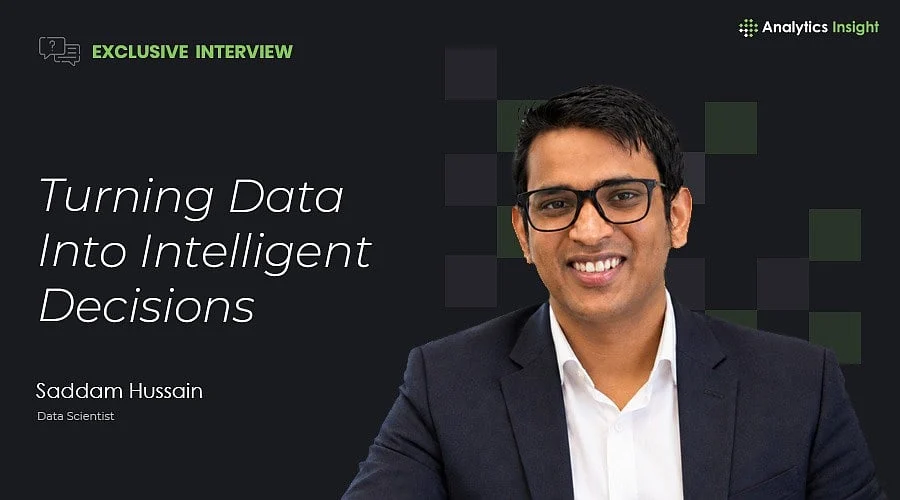
Artificial intelligence is expanding rapidly across sectors, but for Saddam Hussain, its true value lies in addressing practical challenges, establishing reliable data foundations, and deploying systems that users can rely on. Working as a Data Scientist across industrial AI, data engineering, manufacturing, electric vehicles, healthcare analytics, computer vision, and MLOps, Hussain integrates expertise in engineering, analytics, machine learning, and operations.
In addition to his professional work, he contributes to the academic and research community as a keynote and invited speaker, session chair, Best Paper Award winner, and reviewer for more than 40 research papers. His portfolio covers large-scale EV telemetry, industrial optimization, computer vision for workplace safety, machine-learning deployment, and data-driven decision-making systems.
Could you tell us about your journey into data science, AI, and intelligent systems?
My journey began with Electrical and Electronics Engineering, which provided a solid grounding in systems, automation, and engineering workflows. Over time, I grew increasingly curious about the data generated by those systems and how it could enhance decision-making and solve practical issues.
That curiosity naturally guided me into analytics, data engineering, machine learning, and artificial intelligence. Later, I earned graduate qualifications in Business Analytics and Decision Analytics and am currently pursuing a Master of Science in Artificial Intelligence.
My career has spanned manufacturing, automotive, healthcare, and industrial operations. Despite the different industries, the core question has stayed the same: What is the actual problem, and how can data and technology solve it?
At Carmeuse Lime & Stone, my responsibilities involve industrial data pipelines, machine-learning models, operational dashboards, KPI development, time-series analytics, automated reporting, and model deployment. Past experience includes EV battery health management, vehicle data, healthcare analytics, machine-failure prediction, aerospace defect classification, enterprise data integration, and vehicle-tracking systems.
This background reinforces my belief that data science cannot function in a vacuum. The most robust solutions combine domain expertise, data engineering, analytics, machine learning, deployment, and a clear understanding of the end users.
Why do you consider data engineering the foundation of successful AI, particularly in industrial environments?
I view data engineering as a pillar of successful AI. Before constructing any model, we must verify whether the data is complete, timely, consistent, and dependable.
In actual industrial settings, information seldom originates from a single, pristine source. It might arrive via SQL databases, SAP, process historians, sensors, APIs, InfluxDB, Excel spreadsheets, equipment systems, and streaming platforms. These diverse sources must be connected, validated, aligned, and transformed before they can reliably back any analytics or machine learning.
At Carmeuse, I have managed data from SQL, SAP, InfluxDB, process historians, and various plant systems. Data engineering renders that information usable, while data science utilizes it for machine learning, optimization, anomaly detection, forecasting, and analysis.
One instance involved automated quality-data collection. The resulting pipeline reduced manual errors by roughly 95% and boosted operator efficiency by about 20%. These gains illustrate why the data layer is vital. When the underlying information is flawed, even an advanced model can yield untrustworthy results.
Rather than treating data engineering and data science as separate disciplines, I view them as components of a unified solution. The caliber of an AI system ultimately relies on the quality and dependability of the information behind it.
You worked with around 35 million EV telemetry messages every day. What did that experience teach you about data engineering at scale?
My collaboration with General Motors on Vehicle Health Management and EV battery data offered hands-on exposure to the hurdles of operating at massive data scales. The platform handled roughly 35 million telemetry messages daily while serving about 8,000 customers each day.
At that scale, data engineering grows significantly more intricate. Messages may arrive late or out of sequence, yet they still need proper association with the correct vehicle and event time. Furthermore, the platform must process this information reliably to power diagnostics and AI-driven alerts.
Our stack included Databricks, Azure Event Hubs, Spark Structured Streaming, ETL pipelines, and Medallion architecture. This work helped achieve a 30–40% decrease in EV battery downtime while supporting battery diagnostics and AI-driven alerts. Migrating the Vehicle Health Management platform to Databricks also cut code complexity by about 60%, reduced infrastructure costs by roughly 20%, and improved algorithm performance by approximately 30%.
The Medallion architecture proved especially beneficial by establishing a structured flow from raw data to trusted, analytics-ready information. Raw data remains preserved while succeeding layers clean, validate, and prepare it for downstream consumption.
That experience later served as the basis for my research paper, “Medallion-Based Data Engineering for EV Battery Health Monitoring: Managing 35M Daily Telemetry Messages at Scale.”
The primary takeaway from that project is that scalable AI begins long before a model undergoes training—it starts with how data is captured, processed, validated, governed, and distributed.
How are you applying machine learning and AI to improve industrial operations and decision-making?
Industrial settings are uniquely fascinating because numerous variables interact simultaneously. In lime production, for instance, elements like fuel conditions, airflow, temperatures, oxygen levels, kiln speed, feed parameters, and material characteristics all impact product quality and process efficiency.
At Carmeuse, I have worked on machine-learning models addressing quality metrics such as residual CO₂ and sulfur. The goal is to comprehend how process conditions relate to quality outcomes and to identify operational parameters tied to superior performance.
Portions of this work contributed to an approximate 3–4% enhancement in lime quality.
The value of industrial AI stems from the interconnected nature of these improvements. A modification in one area can influence quality, output, process stability, energy use, emissions, and operational choices alike.
Additionally, I have designed centralized operational dashboards in Grafana that support over 10 U.S. plants and two Canadian facilities. These dashboards aggregate production, quality, energy, equipment performance, and operational KPIs into a single interface. Automation eliminated close to a week of manual monthly reporting, while standardized KPIs enabled teams to spot deviations earlier, driving roughly a 5% drop in plant downtime.
For me, the purpose of industrial AI goes beyond merely building another model. It is about equipping teams with superior information and decision support that translates into measurable operational gains.
Your work also includes computer vision and industrial safety. How can AI contribute to safer workplaces?
AI extends far beyond production efficiency, and workplace safety provides a prime example.
I engineered a computer-vision solution for Personal Protective Equipment compliance in heavy-machinery environments. The system monitored safety across multiple facilities and contributed to a reported 70% decrease in safety infractions.
I also created a facial-recognition access-control system for a secure server-room environment. This setup was built to verify authorized personnel, flag unauthorized entry attempts, and log corresponding images and event metadata.
These initiatives demonstrated how computer vision solves real operational obstacles. Rather than treating AI as a theoretical concept, we can tie it directly to precise safety requirements and organizational workflows.
This effort also led to my invited presentation at TIC 2026, titled “Computer Vision Applications for Industrial Safety and Smart Workplace Monitoring,” where I explored the role of AI in fostering zero-injury workplaces. I additionally acted as a Session Chair.
A key consideration with such technologies is that they must back well-defined safety protocols and organizational targets. AI delivers monitoring and alerts, but successful deployment ultimately relies on integrating those insights into daily operational routines.
Why has MLOps become increasingly important as AI moves from experimentation into production?
Constructing a machine-learning model represents only a fraction of the journey. Once a model enters production, deployment, monitoring, versioning, governance, maintenance, and reuse become equally critical.
I have contributed to automated CI/CD pipelines for machine-learning applications that cut deployment duration by about 75% and enabled model reuse across multiple sites.
This is especially vital in industrial contexts because different plants often feature varying equipment, infrastructure, operating conditions, and data patterns. If every facility demands a completely custom implementation, scaling AI becomes costly and difficult to maintain.
My work in this domain formed the foundation of the paper “End-to-End MLOps for Multi-Plant Industrial AI: Deployment Automation, Model Reuse, and Governance,” which I presented at EAMCON 2026.
The broader lesson is that organizations require repeatable methods for deploying and maintaining AI. Monitoring, validation, configuration management, governance, and version control are all essential to making production AI dependable.
I am particularly focused on how successful solutions can be leveraged across locations without rebuilding entire systems from scratch. MLOps offers a vital framework for achieving that goal.
How does your research and academic work complement your industry experience?
My research is closely tied to the hurdles I encounter in the industrial sector. I believe practical problems inspire meaningful research questions, while academic study helps establish structured methodologies for resolving those very problems.
My EV battery data-engineering research serves as a prime example. The paper, “Medallion-Based Data Engineering for EV Battery Health Monitoring: Managing 35M Daily Telemetry Messages at Scale,” tackled issues surrounding streaming data, late and out-of-order messages, data quality, scalable architecture, and trusted data tiers. I presented this work at an IEEE conference hosted at MAHSA University in Kuala Lumpur in 2026, where it earned the Best Paper Award.
At ICNCDA 2026, I also delivered a keynote address on simultaneously optimizing industrial quality and emissions via machine learning. My current research explores time-series analysis and residual CO₂ prediction within rotary-kiln operations.
Another key aspect of my academic contributions is peer review. Over the course of 2026, I evaluated more than 50 research manuscripts for publications including ACIS, Arabian Journal for Science and Engineering, ARIIA, GICITE, ICIEEE, ICSPCRE, and WISE. These submissions spanned machine learning, computer vision, healthcare, biomedical applications, data science, AI, and AI agents.
Reviewing has sharpened my critical evaluation of technical work, including my own. It prompts fundamental questions: Is the question significant? Does the methodology substantiate the claims? Are the conclusions backed by solid evidence?
Those identical questions remain critical in industry prior to pushing any model into a production setting.
What advice would you give to people entering AI and data engineering, and where do you see your own work heading next?
I advise newcomers to AI and data engineering against learning these fields in isolation. They should grasp databases, ETL pipelines, APIs, streaming architectures, cloud platforms, data quality principles, machine learning, visualization, and MLOps.
Above all, understand the problem before picking the technology.
It is simple to declare, “I built a model.” A far more compelling explanation addresses: Why was the model built? Who used it? What decision did it facilitate? What changed as a result?
I also encourage individuals to build both technical depth and domain insight. AI becomes vastly more powerful when practitioners understand the operational environment where their systems run.
Looking forward, I aim to keep working at the intersection of data engineering, industrial AI, computer vision, time-series analytics, MLOps, and intelligent decision systems. I am particularly drawn to systems that help teams anticipate upcoming trends and determine the most effective next actions.
Additionally, I intend to maintain my contributions through research, publications, speaking engagements, and peer review.
For me, the future of AI is not merely about increasingly complex models. It centers on building dependable systems that convert intricate data into actionable intelligence and drive tangible improvements that people can observe, measure, and utilize. The true opportunity lies in linking robust data foundations with intelligent systems that solve real-world problems.