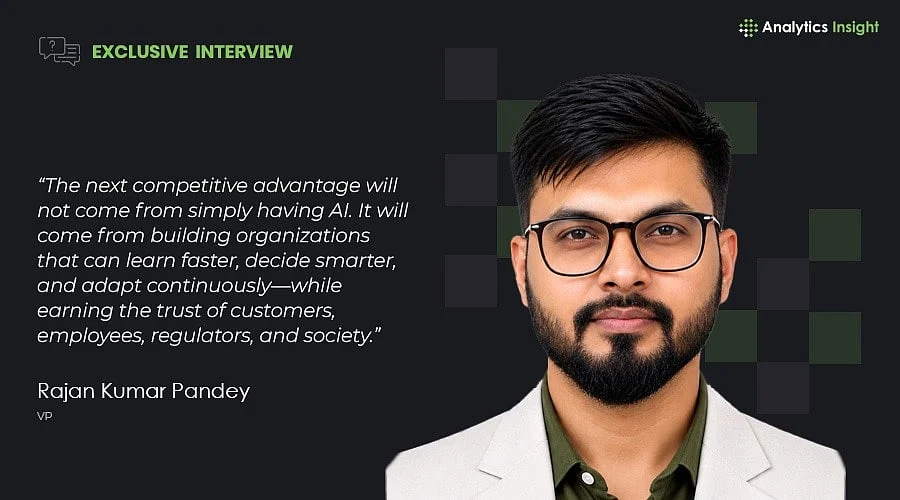
Rajan Kumar Pandey is an analytics and transformation leader boasting over 12 years of experience at the intersection of data, technology, operations, business strategy, and emerging artificial intelligence. His professional background spans BFSI, supply chain, digital operations, analytics, automation, entrepreneurship, and data-driven transformation. His overarching vision is to guide organizations as they transition from data-driven decision-making toward intelligent, responsible, and AI-enabled operating models.
Currently stationed at Wells Fargo, Rajan collaborates closely with senior stakeholders on analytics governance, operational intelligence, and technology-enabled business transformation. His day-to-day work increasingly centers on constructing scalable solutions that refine how enterprises access information, make critical choices, and execute operations.
During an earlier chapter of his career at Johnson Controls, Rajan tackled analytics and reporting hurdles within global supply chain operations. A primary area of emphasis for him involved establishing a more centralized perspective of inventory and operational details through a global inventory command center, effectively combatting fragmented reporting and limited operational visibility.
At Wipro, Rajan spent nearly five years cultivating analytics capabilities across supply chain, sales, marketing, and digital operations. Rising from an individual contributor role, he eventually led and mentored a team of analysts, spearheading automation and analytics projects that shifted teams away from repetitive operational tasks toward high-value analysis and decision-making.
His professional path also features entrepreneurship. As a co-founder of Crato, Rajan encountered the realities of enterprise-building, steering a concept from its inception through commercialization and revenue generation. The eventual choice to shutter the venture delivered a critical leadership lesson: transformation and leadership are not exclusively about chasing growth at all costs; they demand the discipline to recognize shifting circumstances and make deliberate, calculated decisions.
These accumulated experiences underpin Rajan’s philosophy that technology generates peak value when it reshapes how an enterprise thinks and operates, rather than merely automating a pre-existing task.
His contemporary focus on AI targets the upcoming horizon of enterprise intelligence: shifting from static dashboards to intelligent decision support, transitioning from standard automation to intelligent orchestration, and moving away from isolated AI tests toward responsible, AI-driven operating models.
He maintains that AI’s premier potential rests in linking data, institutional knowledge, workflows, and human expertise so personnel can instantly access the right data and reserve their judgment for decisions requiring genuine human intellect.
This philosophy seamlessly extends to corporate governance. Operating as an IICA-certified Independent Director, Rajan is formulating a broader outlook on governance, risk oversight, accountability, and the duties of leadership within an increasingly tech-centric business landscape.
He views the convergence of artificial intelligence, data governance, cybersecurity, risk management, and corporate governance as a core leadership hurdle for the coming decade.
His primary objective is helping enterprises evolve past simple data-driven practices to become intelligent, adaptive, and responsibly AI-enabled organizations—where technology does more than just automate tasks, fundamentally enhancing how companies learn, choose, and generate long-term value.
What does AI innovation mean to you today?
AI innovation, to me, is the transition from using technology as a tool to designing organizations that can learn, adapt, and make better decisions continuously.
The initial wave of enterprise analytics aided companies in understanding historical events. The subsequent wave helped forecast prospective outcomes. AI is now propelling us toward systems capable of parsing context, reasoning across datasets, recommending actions, and increasingly orchestrating segments of a workflow.
Yet, true innovation does not lie in the model itself. It is found in what enterprises construct around it.
The most impactful AI applications will intertwine data, knowledge, workflows, people, and governance into a cohesive operating framework. That is precisely where AI graduates from mere experimentation to enterprise-wide transformation.
Biggest shift in how organizations use technology for decision-making
The foremost shift centers on the move from information availability to intelligence availability.
Organizations historically competed on the sheer volume of data they could collect and report. Moving forward, competitive edges will belong to those capable of transforming information into insight, and insight into action, with maximum speed and responsibility.
Having witnessed analytics evolve from fundamental reporting and dashboards into automation, predictive methodologies, self-service intelligence, and generative AI, I see the next phase as even more profound: intelligent systems will embed themselves directly inside business workflows instead of waiting for employees to solicit information.
Ultimately, the future of analytics points not toward superior dashboards, but toward a fundamentally more intelligent organization.
Common misconception about enterprise AI
One prevalent misconception I actively challenge is the notion that an AI transformation kicks off with selecting an AI technology.
Instead, I contend it starts by reimagining the business process itself.
Simply layering AI over an inefficient process merely accelerates activity without guaranteeing better outcomes. The strategic inquiry should not be “Where can we deploy AI?” but rather “What could this process look like if intelligence were accessible at every single critical juncture?”
That exact pivot—from deploying technology to redesigning operating models—delineates mere AI experimentation from genuine AI transformation.
How do you determine whether AI solves a real business problem?
I initiate the process by examining the desired outcome and working backward.
I pose several questions: Which specific decision or workflow are we trying to refine? Where does current friction lie? What is the cost in terms of time, capital, risk, or customer experience? What constitutes success? And is AI genuinely the optimal intervention?
Additionally, I analyze the broader system rather than focusing on isolated tasks.
For instance, if multiple staff members independently comb through identical documents and databases to answer similar queries, the opportunity stretches far beyond automating a single person’s routine. It might open the door to overhauling the entire research workflow around centralized intelligence, reusable data retrieval, business rules, automation, and human exception management.
That is the true starting point for transformation.
How important is data quality to AI strategy?
Data serves as the foundational bedrock for all enterprise intelligence.
The future will bypass organizations simply boasting the largest AI models. It will belong to enterprises featuring trusted, accessible, well-governed data paired with the capability to merge that information with core business context.
From my viewpoint, comprehensive data quality encompasses accuracy, lineage, ownership, definitions, freshness, accessibility, and context. Within regulated sectors, traceability scales in importance.
If an AI system delivers an answer, leadership must be able to trace its origins, identify the influencing data points, and recognize precisely where human oversight remains vital.
Consequently, AI maturity will continually mirror data maturity.
How do you build AI systems that are efficient, transparent, auditable, and responsible?
I firmly believe that responsible AI must be architected directly into the operating model from day one.
One core principle I advocate is separating data retrieval, logical reasoning, deterministic business rules, and final decision ownership.
While AI proves immensely powerful for parsing unstructured data, linking relevant evidence, summarizing findings, and assisting personnel, whenever a deterministic business rule exists, that rule—not a probabilistic model—should retain ultimate decision authority.
Surrounding that foundation, organizations must implement clear data lineage, source citations, strict access controls, audit logs, continuous monitoring, human escalation paths, and distinct accountability.
The objective must not be autonomous AI at all costs, but rather trusted intelligence coupled with an appropriate degree of autonomy proportional to business risk.
Most valuable leadership lesson
My transformation experiences have proven that the toughest hurdles are rarely technical.
Technology can always be engineered. The trickier challenge lies in uniting people around a novel working methodology.
A transformation leader must forge a shared vision, navigate competing incentives, articulate concrete business value, establish clear ownership, and assure teams that the updated operating model will genuinely empower them—rather than merely complicating their jobs.
I have also learned the necessity of optimizing entire systems rather than isolated activities. Enhancing the speed of one individual can inadvertently generate bottlenecks or friction points elsewhere.
Effective leadership ultimately means viewing the entire value chain and tailoring it for optimal outcomes.
Balancing AI speed with risk, compliance, security, and governance
I view governance not as an emergency brake on AI innovation, but as the essential infrastructure allowing innovation to scale securely.
Organizations ought to establish risk-based guardrails instead of subjecting every single AI use case to identical oversight. The level of scrutiny must mirror data sensitivity, business impact, autonomy levels, regulatory exposure, and potential repercussions for customers.
Leaders should explicitly outline what AI is permitted to recommend, what it is authorized to execute, and where mandatory human sign-off is required.
The winning formula is responsible acceleration: establishing enough structure to safeguard the enterprise while granting innovators the freedom to execute swiftly.
Greatest untapped potential for AI and analytics
I consider knowledge-intensive operations to harbor some of the most exciting opportunities.
Across various industries, highly skilled professionals still forfeit massive amounts of time combing through documents, databases, policies, transaction logs, emails, and reports prior to making a call.
AI holds the capacity to fundamentally transform this operational model.
Rather than merely deploying another chatbot, enterprises can construct an intelligence layer unifying structured data, unstructured knowledge repositories, analytics engines, business rules, and workflow orchestration.
Such an approach can revolutionize sectors spanning banking operations, risk assessment, compliance, customer service, supply chain logistics, and financial operations.
The primary advantage does not necessarily involve replacing personnel; rather, it equips every single employee with comprehensive organizational intelligence, enabling human expertise to concentrate where judgment matters most.
What will distinguish successful AI organizations, and what advice would you give future AI leaders?
Victorious organizations will transcend isolated pilot projects, cementing AI as a core organizational competency.
They will institute repeatable mechanics for surfacing high-value problems, quantifying ROI, preparing data, governing algorithms, deploying solutions, tracking performance, and scaling successful initiatives.
More critically, they will discard the mindset of treating AI as an isolated technology silo. Artificial intelligence will instead fuse directly into corporate strategy, day-to-day operations, risk management, customer experience design, and workforce planning.
My guidance for emerging AI leaders is simple: become bilingual. Understand technology deeply enough to grasp what is technically feasible, yet understand business thoroughly enough to discern what is actually worth executing.
Ultimately, the most valuable AI leaders will not merely build intelligent systems; they will help construct intelligent organizations.