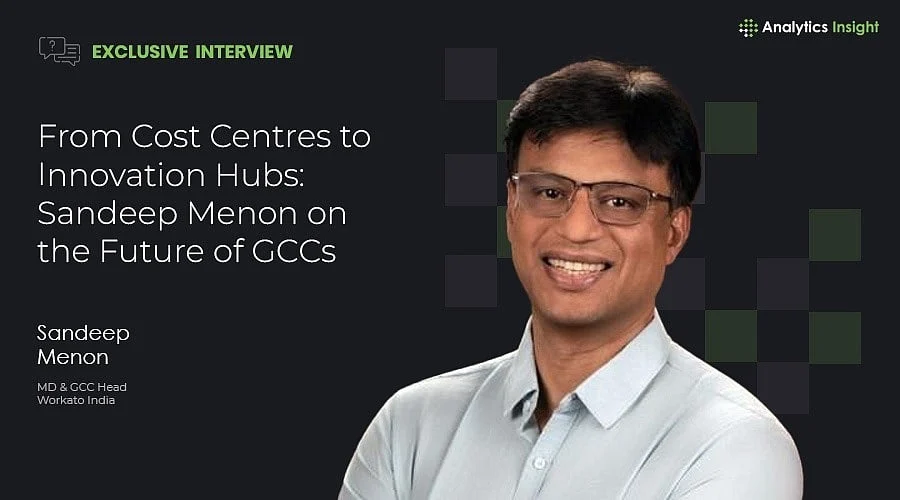
Sandeep Menon, Managing Director and GCC Head of Workato India, offers insights into how India’s Global Capability Centre (GCC) ecosystem is transforming from basic delivery hubs into strategic powerhouses focused on innovation, AI engineering, and global leadership. He highlights the impact of AI-driven automation, the rise of talent in Tier 2 and Tier 3 cities, the scarcity of AI Architect-level skills, and Workato’s initiatives to foster India’s AI landscape via developer networks and university partnerships.
How do you see India’s GCC landscape evolving from traditional delivery centres into strategic hubs for product innovation, AI engineering, and enterprise leadership? What are the key characteristics that distinguish the next generation of high-impact GCCs?
I believe this shift was inevitable the moment global companies moved away from outsourced operations to establish GCCs. Having previously worked on the IT services side, I have always maintained that international companies may initially arrive for cost savings, but they remain for the underlying capabilities. As GCCs evolved, their skills and capabilities were showcased directly to corporate headquarters, which eagerly embraced them. Despite initial doubts, everyone now recognizes that India offers far more than just low costs; it provides the ability to deliver specialized skills at the scale required for today’s fast-moving development cycles.
AI is fundamentally reshaping how organisations operate. How is AI influencing GCC operating models, organisational structures, and talent strategies, and what changes do you believe GCC leaders need to make to remain competitive?
AI-driven automation and the orchestration of diverse business processes are essential for GCCs looking to maintain their competitive edge. I advise GCC leaders who remain overly focused on operational efficiency to take a broader, more strategic view. While manual execution might still be cheaper in certain isolated cases today, that misses the point. The experience and knowledge gained by being an early adopter of AI automation will yield long-term, sustainable advantages well into the future.
India’s talent ecosystem is expanding beyond the major metropolitan cities. What role do Tier 2 and Tier 3 cities play in Workato’s talent strategy, and how can GCCs create greater access to skilled professionals across these emerging talent hubs?
Workato hires top-tier talent regardless of geographic origin. That said, a substantial portion of our current workforce originates from Tier 2 and Tier 3 cities, a trend echoed across many organizations. A great deal of technical talent now hails from smaller towns; these professionals are diligent, technically proficient, and highly receptive to ongoing training.
This naturally raises the question of why GCCs do not simply open hubs directly in those smaller cities. The answer is complex. Having advised government panels in smaller states on policy matters, I frequently observe that merely constructing a flagship “IT park” fails to resolve the underlying issue. Policymakers must focus on building comprehensive ecosystems to retain highly mobile tech talent. Factors like international schooling, robust healthcare, public services, entertainment, and nightlife are vital to this workforce. Employees and their families need a vibrant life outside the workplace. Without modernizing local infrastructure and culture, an IT park alone will not succeed, and companies will continue facing an exodus of staff migrating to major urban centers—a challenge we must solve collectively.
As GCCs take on increasingly complex global mandates, how is Workato building leadership depth and specialised AI capabilities in India to support evolving business priorities? What skills and leadership qualities will define the GCC workforce of the future?
As a product company operating in the AI solutions space, Workato is in the unique position of “eating our own cooking.” We continually evaluate our processes for AI-driven automation, utilizing AI genies and chatbots extensively. All employees receive AI training and are granted enterprise-grade access to AI tools. Furthermore, Hyderabad houses one of the primary nodes in our global network of AI labs and research facilities. The Workato AI Hub in Hyderabad operates on the front lines by capturing real-world customer requirements for AI solutions and integrating them directly into our product development cycle. Although it remains our fastest-growing unit, sourcing AI Architect-level talent continues to be a global challenge. Today, attracting such talent depends not only on compensation but also on the technical edge a company offers and its proximity to AI product development. Fortunately, we meet all these criteria, making it relatively straightforward to secure the right people.
Workato has been investing in India’s broader AI ecosystem through university collaborations, talent development initiatives, and a community of more than 11,000 members. What is your vision for these initiatives, and how can industry-academia collaboration help strengthen India’s position as a global AI and innovation hub?
We have always maintained that cutting-edge technologies require direct engagement between the corporate sector and academia. Given the inherent time required to update curricula, academic institutions naturally experience a slight lag behind emerging technology waves. However, when forward-thinking companies collaborate with universities to establish labs, early training, and certifications, that lag is significantly reduced—creating a mutually beneficial scenario for both sides. Consequently, we partner with a select group of top-tier universities, providing them with guidance, content, practical exercises, training, and certifications.
The same principle applies to developer communities. Enhancing their learning improves the quality of talent available to our customers and partners. In an era of rapid technological advancement, launching a great product without a sufficiently trained user base is a major risk. To mitigate this, we maintain a robust program featuring local city chapters and ambassadors, dedicating substantial time to solving real-world customer challenges and offering beta access to our newest tools. Workato views both of these areas as strategically vital and will maintain ongoing investments in them.