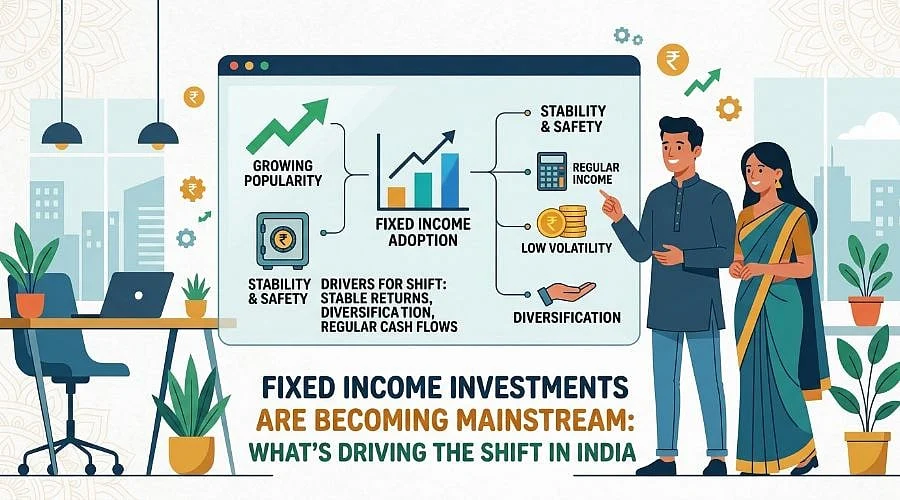
Fixed income investments have quietly emerged as a compelling area of the market for investors. While equities once dominated the spotlight—with bonds and similar instruments relegated to the background mostly for capital preservation—that dynamic is evolving. A growing number of investors now prioritize steady returns and portfolios that avoid wild fluctuations during rough market weeks. Consequently, bonds, government securities, and other debt products are receiving renewed attention, driven by shifting interest rates, changing market conditions, and simplified access via digital platforms.
Changing Investor Focus Towards Fixed Income
As investors rethink portfolio construction, fixed income frequently enters the conversation. Sticking to a single asset class is becoming less common, and most individuals now weigh their options across both equities and debt before allocating capital.
Fixed income holds widespread appeal for a straightforward reason: it offers structured cash flows and clear payment schedules. Corporate bonds, government securities, and alternative debt-linked products all share this characteristic.
Furthermore, investors increasingly recognize the value of spreading capital across different asset types. This growing awareness has brought fixed income into everyday investment planning rather than treating it as an afterthought.
What Is Driving the Shift in Fixed Income Investing
Several distinct factors underpin the rising popularity of fixed income.
Changing Interest Rate Environment
Interest rates move in cycles dictated by the broader economy. As these rates shift, newly issued fixed income instruments feature varying coupon rates and yields that reflect current market conditions, prompting investors to reevaluate their asset allocation strategies.
Search for Relatively Stable Cash Flows
Because fixed income instruments make payouts at predetermined intervals, they naturally appeal to investors who prefer knowing roughly when funds will arrive in their accounts instead of relying on market sentiment.
Increased Access Through Digital Platforms
Online platforms have simplified the process of acquiring bonds. Investors can now view multiple bond listings, issuer details, and credit ratings on a single screen, eliminating hours of exhaustive research when comparing options.
How Fixed Income Instruments May Support Portfolio Balance
Fixed income plays an active role in maintaining portfolio stability across varying market environments.
Diversification Across Asset Classes
-
While equities experience market-driven volatility, fixed income often behaves differently when conditions change.
-
Combining both asset types distributes risk more evenly throughout a portfolio instead of concentrating exposure in a single category.
Visibility of Structured Payments
Fixed income instruments follow schedules established by their issuers. While the ultimate outcome still relies on the issuer’s financial performance, investors gain a reasonable expectation of when to anticipate their funds.
Range of Instrument Types
Common fixed income options include:
-
Corporate bonds
-
Government securities
-
Other debt instruments
Every option carries a distinct credit profile and level of risk.
Role of Corporate Bonds in the Growing Fixed Income Market
Corporate bonds in India are infusing new energy into the fixed income sector. Companies issue these instruments to secure capital, and each bond’s credit rating reflects the financial strength of the issuing firm.
Credit Rating Diversity
Corporate bonds encompass a broad spectrum of credit categories:
-
AAA: relatively higher credit quality
-
AA and A: high to moderate credit quality
-
BBB: adequate credit quality with some risk factors
-
BB and below: higher speculative characteristics
-
D: default or expected default
This wide range allows investors to evaluate different risk thresholds within the exact same asset class instead of treating all bonds uniformly.
Access Through Organised Platforms
Digital marketplaces now present corporate bonds alongside issuer details, ratings, and tenures directly to investors, cutting down the legwork previously required to evaluate bonds individually.
Improved Accessibility and Market Participation
-
Platform-based investing has greatly lowered the barrier to entry for fixed income.
-
Bond information is now centralized rather than dispersed across multiple sources.
-
Issuer data and credit ratings appear side-by-side.
-
The majority of the investment workflow now takes place online.
Risks That Continue to Exist in Fixed Income Investments
Despite expanding participation, fixed income assets still entail inherent risks.
Credit Risk
An issuer’s capacity to fulfill interest payments and return principal hinges on its financial health. Financial hardship within a company can disrupt scheduled distributions.
Market Risk
Fluctuations in interest rates can influence secondary market bond prices, altering an instrument’s valuation prior to its maturity date.
Liquidity Variation
Depending on demand and issuer reputation, certain fixed income instruments trade more actively than others, creating disparities in how fast an investor can buy or sell when needed.
Conclusion
Fixed income investments are capturing wider attention as market conditions evolve and participants reevaluate their strategies. Shifting interest rate cycles, a demand for reliable cash flows, and enhanced digital access are all accelerating this movement. Specifically, corporate bonds have created pathways for more retail investors to engage with India’s debt market. Platforms such as Altifi offer structured environments where investors can research, compare, and assess fixed income opportunities prior to deploying capital.