

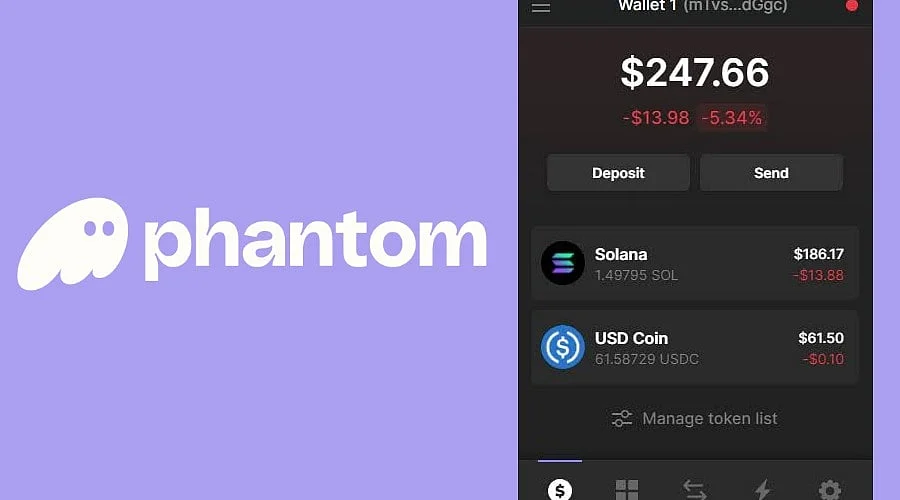
Phantom has grown from its origins as a Solana-centric wallet into a comprehensive multichain cryptocurrency platform. By 2026, it merges self-custodial asset management, token exchanges, NFT tools, and decentralized application access across both mobile applications and browser extensions. While its Solana capabilities stay at the core, users are now able to handle assets spread across multiple networks.
Phantom Expands Beyond Solana
At present, Phantom supports Solana, Ethereum, Bitcoin, Base, Polygon, HyperEVM, Arc, and Robinhood Chain. Within these networks, users can inspect tokens and NFTs alongside connecting to supported applications without needing to manually switch networks.
Solana continues to be one of the platform’s premier integrations. Members can transfer tokens, engage with Solana-based applications, and execute direct swaps inside the wallet interface. Furthermore, Phantom accommodates qualifying gasless Solana transactions.
According to the platform, gasless transactions deduct network expenses straight from the transferred or swapped token if the user lacks sufficient SOL balances. To qualify, transactions typically must have a minimum value of USD 0.30. Standard gasless fees can drop as low as USD 0.001, whereas account creation can require about USD 0.20 to USD 0.30, and periods of heavy network congestion can elevate expenses to between USD 0.50 and USD 1.00.
How Much Does Phantom Cost?
Setting up and utilizing Phantom does not require a subscription fee. Nevertheless, executing blockchain transactions involves network fees paid directly to validators instead of the platform.
For smooth operations, Phantom suggests keeping roughly 0.02 SOL accessible for Solana network costs and near 0.002 ETH for Ethereum activities, though exact rates fluctuate.
Conducting trades directly in the wallet can introduce extra expenses. Phantom levies a 0.85% charge on most token swaps, which applies alongside standard blockchain fees and price impact. Additionally, cross-chain transfers may entail liquidity-provider or bridge costs.
Security and Self-Custody
Because Phantom operates as a self-custodial tool, users maintain absolute authority over the credentials required to access their funds. Recovery options permit the use of a Secret Recovery Phrase, a PIN code, or an Apple or Google account.
The platform cautions that anyone who gains access to a private key or recovery phrase can take control of the wallet. Consequently, account holders bear full accountability for safeguarding their login credentials and steering clear of phishing attempts.
To bolster security, Phantom integrates with a variety of Ledger hardware wallets. Depending on whether users access the platform via mobile apps or browser add-ons, supported models encompass the Ledger Nano X, Nano S, Nano S Plus, Stax, and Flex.
What are Phantom’s Limitations?
Even with its expanding multichain footprint, Phantom does not accommodate every prominent blockchain. Official documentation notes that networks like BNB Smart Chain, Arbitrum, Optimism, Avalanche, Unichain, and Linea remain unsupported.
Swap charges warrant close attention as well. The 0.85% wallet fee can grow quite substantial during larger trades, and overall totals climb further when factoring in network expenses and price impact.
Final Thoughts
Phantom retains deep integration with Solana while successfully branching out into a broader multichain application. Its built-in swaps, non-fungible token capabilities, and gasless transactions streamline routine on-chain tasks. Even so, participants should weigh swap fees, missing network integrations, and the inherent duties of self-custody.
Also Read: Crypto Exchange vs Crypto Wallet: What is the Difference?
FAQs:
1. Is Phantom Wallet only for Solana?
No. The platform has moved beyond just Solana and currently accommodates networks such as Ethereum, Bitcoin, Base, Polygon, HyperEVM, Arc, and Robinhood Chain, alongside its deep Solana feature set.
2. How much does Phantom Wallet charge for swaps?
Phantom applies a 0.85% fee to the majority of internal swaps. Depending on the transaction, users might also incur blockchain network costs, price impact, and liquidity-provider or bridge fees.
3. Is Phantom Wallet self-custodial?
Yes. Phantom functions as a self-custodial wallet, granting individuals full control over the authorization credentials for their crypto assets. Users must independently secure their recovery credentials, private keys, and account access.
4. Does Phantom support gasless Solana transactions?
Yes, qualified Solana transactions can process without requiring a separate SOL reserve for gas fees. Network expenses get drawn from the asset being traded instead, provided they meet Phantom’s criteria.
5. Does Phantom support hardware wallets?
Yes. The wallet works with select Ledger hardware devices, including chosen models from the Nano, Stax, and Flex series. Using a hardware wallet keeps signing keys isolated while interacting with Phantom’s mobile and browser environments.


