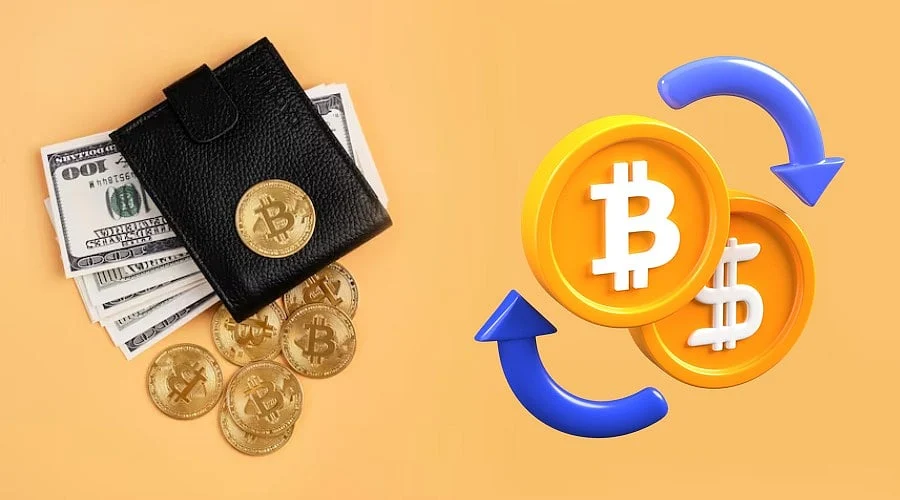
While crypto exchanges and crypto wallets are both foundational components of the digital-asset ecosystem, they fulfill distinct roles. Exchanges are designed primarily to facilitate the purchase and sale of cryptocurrencies, whereas wallets manage the credentials needed to access and move assets on the blockchain.
Crypto Exchanges are Built for Trading
A centralized exchange acts as a marketplace where participants can deposit fiat currency or digital assets to trade tokens like Bitcoin, Ethereum, and XRP. Many of these centralized platforms also extend additional financial services, such as staking and derivatives.
According to CoinGecko, centralized exchanges recorded roughly USD 80 trillion in spot trading volume during 2025. Even as decentralized exchanges (DEXs) gained traction, CEX monthly trading volumes consistently stayed above USD 1 trillion.
Regarding spot trading specifically, the volume handled by DEXs grew from 6.9% in January 2024 to 13.6% in January 2026, demonstrating that while on-chain activity expanded, it remained below the volume levels of centralized platforms.
Crypto Wallets Control Blockchain Access
Digital currencies are not physically housed inside a wallet like paper money in a billfold. Instead, assets stay permanently recorded on the blockchain, while wallets manage the credentials needed to interact with them.
The primary distinction lies in custody. On an exchange or via a custodial wallet, a third-party platform manages the private keys on behalf of the customer. Conversely, self-custody wallets empower users to hold their own keys and independently authorize blockchain transactions.
Self-custody options span mobile applications, browser extensions, and physical hardware devices. They can additionally grant direct entry to decentralized exchanges and various other blockchain protocols.
Security Risks Differ
Neither approach eliminates security vulnerabilities; rather, the risks manifest in different ways. CoinGecko reported that crypto exchanges experienced over USD 2.4 billion in losses from security breaches and exploits over a period slightly exceeding one year, with compromised private keys continuing to serve as a primary attack vector.
In a separate estimate, Chainalysis indicated that more than USD 3.4 billion in digital assets was stolen throughout 2025—a figure that includes roughly USD 1.5 billion from the Bybit security incident. Meanwhile, individual wallet compromises accounted for 158,000 separate incidents impacting approximately 80,000 victims, leading to about USD 713 million in stolen funds.
Consequently, utilizing a self-custody setup does not automatically guarantee safety. Users assume full responsibility for safeguarding private keys and recovery information. Misplacing the data needed to restore a wallet can result in permanent loss of access to the funds.
Exchange or Wallet?
These two tools can be used in tandem. For example, an investor might buy Bitcoin on an exchange, move the funds into a self-custody wallet for long-term safekeeping, and later deposit them back onto an exchange when ready to sell.
Ultimately, the choice involves a trade-off between convenience and control. Exchanges simplify trading, account recovery, and fiat conversions, but they require trusting a custodian. Self-custody eliminates that reliance while placing the burden of security squarely on the individual.
Final Thoughts
Crypto exchanges function primarily as trading hubs, whereas wallets oversee access to blockchain-based funds. Centralized exchanges offer convenience alongside custodial risk, whereas self-custody offers enhanced control alongside the duty of securely managing private keys and recovery credentials.
Also Read: How Government, Exchanges are Building a Global Crypto Intelligence Network
FAQs:
1. What is the main difference between a crypto exchange and a crypto wallet?
A crypto exchange is primarily used to buy, sell and trade digital assets. A wallet manages the credentials required to access and transfer blockchain assets.
2. Is it safer to keep cryptocurrency in a wallet or on an exchange?
Both have different risks. Exchanges introduce custodial and counterparty risks, while self-custody requires users to securely protect their private keys and recovery credentials.
3. Does a crypto wallet actually store cryptocurrency?
No. Cryptocurrency remains recorded on the blockchain, while the wallet manages the private keys or credentials required to access and transfer those assets.
4. What happens if I lose my crypto wallet’s private key?
With self-custody, losing the credentials required to recover the wallet can permanently prevent access to the cryptocurrency. There may be no central provider capable of restoring access.
5. Can I use both a crypto exchange and a crypto wallet?
Yes. Users can buy cryptocurrency through an exchange, transfer it to a self-custody wallet and later send it back to an exchange when they want to trade or sell.