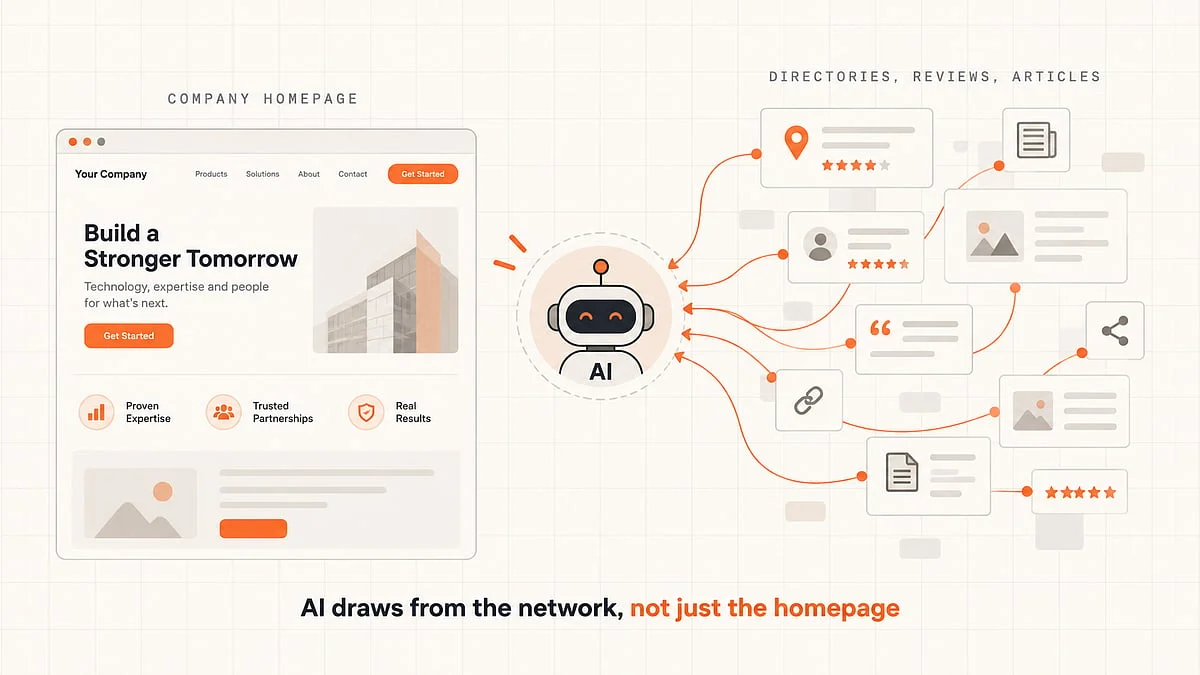
When companies wonder why an AI assistant leaves them out, they usually look at their own website. That approach typically points to the wrong place.
Platforms like ChatGPT, Gemini, Copilot, and AI Overviews aggregate numerous sources prior to selecting a provider or defining a category. Although a homepage serves as one of those inputs, it is rarely the decisive factor.
Overview:
-
AI platforms reference external sources far more frequently than owned domains. Independent reviews of millions of citations indicate that earned media accounts for 80% to 90% of references.
-
A homepage can be completely accurate and still be ignored, as algorithms prioritize external validation over self-published statements.
-
Auditing current mentions must precede the creation of new ones. Identifying the discrepancy between present coverage and missing gaps generally forms the core strategy.
-
Third-party validation follows a specific hierarchy. Foundational directories and customer feedback build trust before press coverage and comparative articles can take effect.
Why Your Own Word Isn’t Enough
Because a brand describing itself represents an interested party, an AI model cannot verify those assertions using the page alone. A directory profile, an authentic review, a local news mention, or a comparison piece conveys the identical message from an unbiased origin. Models assign greater weight to these stronger, objective signals.
Data supports this pattern. Muck Rack’s 2026 analysis of more than 25 million links found earned media responsible for 84 percent of all citations utilized by AI engines, remaining steady between 82 and 89 percent across three iterations of the research. Brand-owned sites comprise the remainder. While first-party properties perform well for specific informational queries like pricing, independent platforms dominate the broader “who should I use” searches that influence purchasing choices.
This dynamic differs from conventional search engine optimization. A webpage can achieve strong rankings yet never surface in an AI-generated response, because ranking evaluates query relevance, whereas citation measures corroboration. That practice, getting your brand cited by AI answer engines, relies on evidence distributed across the internet rather than any single destination.
Auditing Your Existing Footprint
Examine your current online presence before generating new material. Test typical buyer prompts across ChatGPT, Gemini, Perplexity, and Copilot to observe if and where the brand appears. Afterward, search the brand name directly, as the algorithm might already pull from outdated reviews or unrecognized directory listings.
A standard audit encompasses four key areas: industry directories, independent review websites, local or trade publications, and comparison features that include the brand. Comparing current visibility against missing coverage typically highlights the necessary next steps.
The Homepage That Did Everything Right
Consider a Western Australian water filtration company, a family-owned enterprise providing and maintaining systems statewide. Its homepage addressed everything a customer might seek: the installed systems, specific problems addressed, coverage zones, and operational experience. The site made a compelling case.
Nonetheless, AI assistants remained silent. Inquiries regarding water filtration services in Western Australia cited alternative providers because the broader web largely overlooked this business. Aside from a few basic directory entries, independent write-ups and comparisons were absent, leaving the model with no external material to verify the homepage claims.
Resolving this deficiency did not require a website overhaul. Instead, it involved establishing the missing corroboration: finishing local directory profiles, securing authentic independent media coverage, and ensuring reviews existed where algorithms could detect them. The underlying homepage copy remained untouched throughout.
The Proof Worth Building First
Different categories of third-party validation carry varying degrees of influence and availability. The following table outlines the primary formats based on their typical implementation sequence.
Build Order and Early Signals
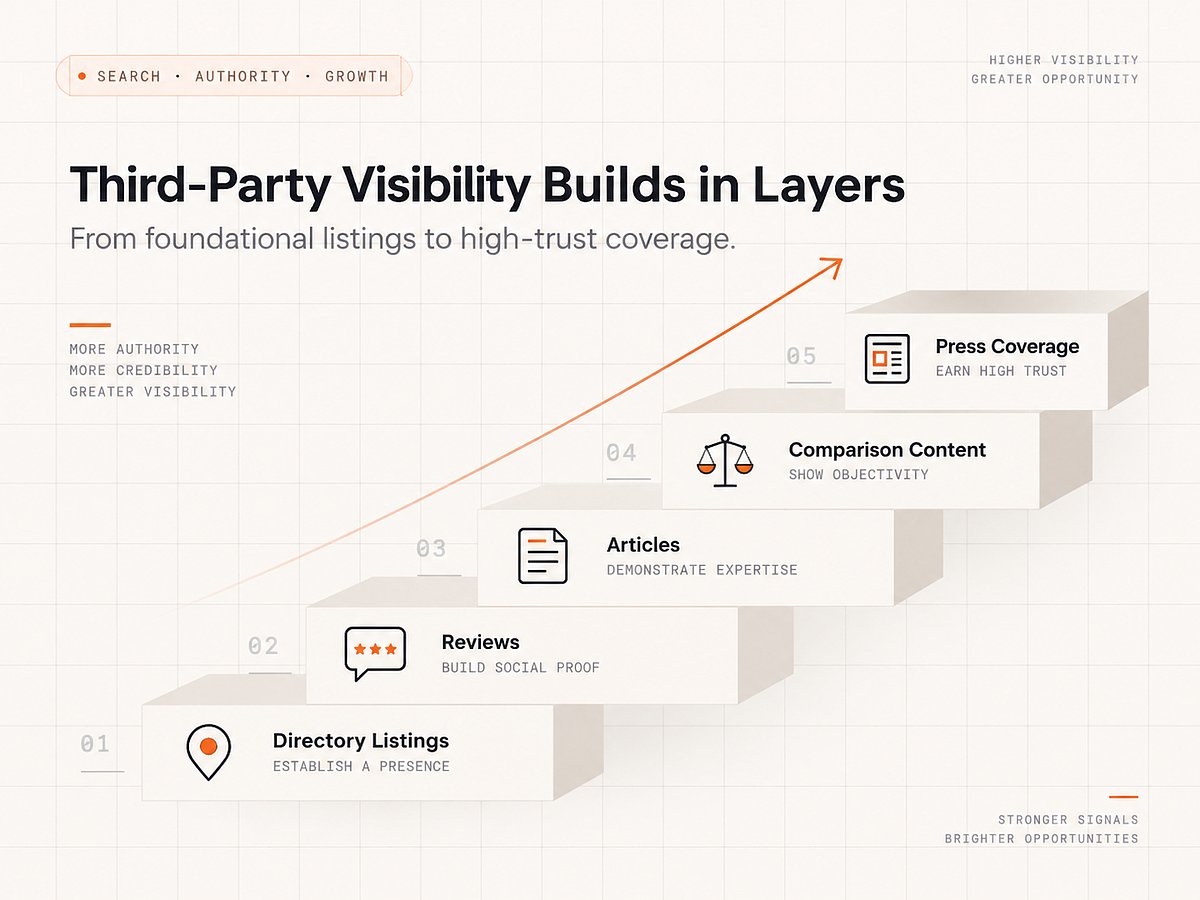
Begin with the most cost-effective, foundational layer: claimed directory profiles alongside consistent name, address, and service details wherever the company is listed. Next, incorporate customer reviews to directly substantiate service claims. Press coverage and profiles should follow once a solid operational foundation exists. Comparative features work best at the final stage, as they require an established track record to evaluate fairly against competitors.
Attempting comparison content before laying this groundwork generally fails due to a lack of underlying data for models to corroborate.
To evaluate progress, repeat the same buyer inquiries across two or three AI systems every few weeks to monitor whether the business begins to surface, even before it dominates the response. Initial visibility typically manifests as a mention alongside competitors rather than an exclusive recommendation, yet this serves as the earliest practical metric.
The homepage was never the root of the problem; the surrounding web presence was. Address that gap, and citations generally follow.
Individuals monitoring this wider industry shift can access further reporting regarding AI search and answer engines via Analytics Insight.
FAQs on Third-Party Proof and AI Citations
Does this mean homepage content does not matter for AI visibility? No. Homepage material must remain clear and precise since AI models analyze it directly. However, it is insufficient on its own. Third-party validation transforms website claims into citable facts.
How long does it take before third-party proof shows up in AI answers? Timelines fluctuate depending on the specific platform and pre-existing digital footprint. Foundational directories and reviews frequently register within weeks, whereas feature articles and comparison pieces require more time to acquire and index.
Can a small local business compete with larger, better-known competitors? Yes, particularly for localized or niche queries where AI models rely heavily on directories, reviews, and local publications rather than corporate scale.
Should paid or affiliate content be part of a third-party proof strategy? Genuine independent coverage carries significantly more weight than sponsored placements. Any paid partnerships should be clearly disclosed, as both algorithms and consumers discount undisclosed promotions.
Is auditing existing mentions something a business can do itself? Basic assessments are manageable independently. Entering standard buyer questions into multiple AI assistants and searching the brand name offers a general overview. A comprehensive review, however, requires a structured methodology to capture insights that manual checks miss.