Key Takeaways –
-
Smart purifiers add water-quality checks, filter alerts, service support, and usage data beyond basic RO treatment.
-
TDS alone cannot confirm water safety, so broader quality checks and proper source assessment matter.
-
Newer systems place greater focus on water recovery, maintenance, and long-term purifier performance.
A basic reverse osmosis, or RO, purifier successfully extracts numerous dissolved impurities from residential water. However, a widening gap currently exists between standard purification and the broader demands of contemporary households.
Connected water systems are capable of monitoring water quality, filter lifespan, water consumption, maintenance requirements, and overall device status through a single integrated unit. This evolution defines 2026 within the purifier industry, shifting the priority from simple clean water toward enhanced oversight, practical insights, and simplified maintenance.
Basic RO has Reached a New Limit
Conventional RO devices continue to serve an important function in residences dealing with high levels of total dissolved solids or specific chemical contaminants. Complications arise when a purifier supplies minimal information post-installation. A standard unit may operate for months while filter efficiency drops, wastewater output increases, or necessary servicing is delayed. Conversely, a smart appliance offers residents greater transparency into all these factors.
Current market metrics reinforce this trend. An industry analysis from 2026 values the worldwide water purifier sector at USD 50.8 billion, anticipating a compound annual growth rate of 7.5% through 2035. This report likewise highlights intelligent and Internet of Things (IoT) architectures as a primary expansion zone.
An alternative market projection estimates the Indian water purifier sector at USD 2.54 billion for 2025, forecasting an increase to USD 7.72 billion by 2032. That publication similarly identifies smart and IoT appliances among the catalysts driving market expansion.
Smart Systems Add More Than an App
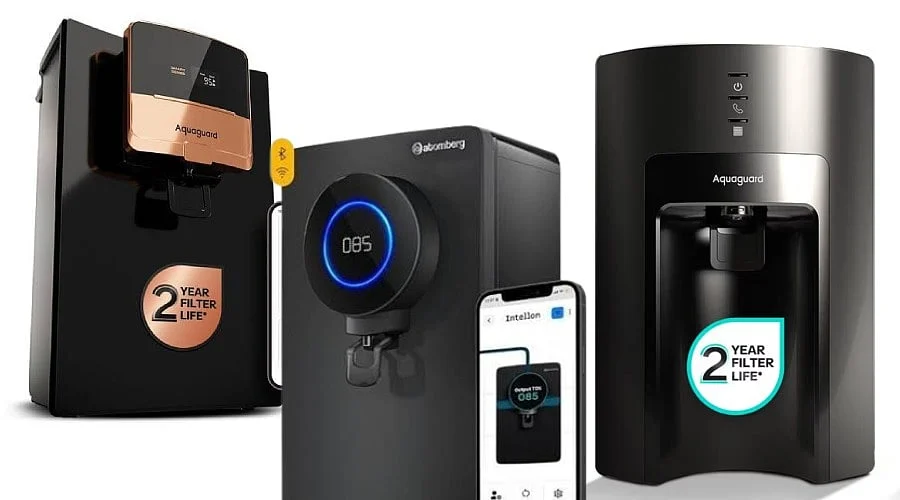
The primary innovation extends well beyond a simple mobile application. Modern systems can combine reverse osmosis with ultraviolet (UV) disinfection, live water-quality evaluations, expiration warnings for filters, consumption analytics, and technical assistance. Certain variants additionally incorporate mineral or copper enhancement alongside stainless-steel reservoirs.
For instance, Eureka Forbes features the Aquaguard Enrich Ritz Pro 2X Life RO+UV Stainless Steel Smart IoT Water Purifier, which boasts real-time water assessment, filter-status warnings, automated maintenance assistance, and a manufacturer-stated 40% improvement in water recovery. Because this 40% figure originates directly from the producer, it applies specifically to that item rather than defining smart purifiers collectively.
Such capabilities prove valuable during daily household routines. A filter notification can curtail prolonged delays prior to component substitution. A consumption log reveals the volume of water directed to the drain. A maintenance prompt diminishes the necessity for manual inspections. Ultimately, the outcome is a purification device that communicates more effectively regarding its operational state.
Also Read – RO vs UV Purifiers: Features, Performance & Top 10 Picks
TDS Alone Cannot Tell the Whole Story
Total dissolved solids, or TDS, remains a widespread metric throughout the purification sector, yet a TDS figure fails to guarantee that water is entirely safe for consumption. A health publication released in September 2026 by the Indian Express noted that TDS measurements do not disclose microbial safety or the existence of particular chemical pollutants.
This insight is critical for smart purifier engineering. A display screen presenting a single numerical value can induce a misplaced sense of security. Superior platforms integrate water-quality metrics alongside filter conditions and multiple treatment phases. Nonetheless, no digital feature can substitute for comprehensive laboratory evaluations when a water source presents a recognized contamination hazard.
The Bureau of Indian Standards (BIS) RO specifications outline performance benchmarks concerning TDS, arsenic, cadmium, chromium, fluoride, lead, mercury, nitrate, pesticides, and microbiological markers, while also addressing water conservation. This broader regulatory framework illustrates why selection criteria should rely on actual water conditions rather than a solitary TDS objective.
Water Quality Needs a Wider View
Government water initiatives likewise emphasize the magnitude of quality concerns. Under the Jal Jeevan Mission, BIS 10500 serves as the baseline for supplied drinking water standards. Official statistics indicate that millions of water specimens have undergone evaluation via laboratories and field diagnostic kits.
Furthermore, the World Health Organization elevated its focus on risk management within its 2026 drinking-water guidelines. The most recent revisions underscore proactive hazard mitigation, ongoing surveillance, and microbial risk management in lieu of depending upon a single metric or singular treatment approach.
This perspective assigns a more functional role to intelligent filtration. While analytical data assists residents in identifying filter malfunctions, service requirements, and usage tendencies, foundational source evaluation remains indispensable.
Water Efficiency Now Matters More
Water wastage has historically been a central component of the RO discourse. Contemporary systems place heightened emphasis on recovery percentages, providing consumers with an additional decision-making criterion independent of taste, tank capacity, or filter quantity.
Intelligent controls also simplify monitoring consumption habits. Households can review operational frequency and the exact volume processed by the device. Such insights expose inefficiencies that standard appliances might conceal, simultaneously offering manufacturers a direct pathway toward optimized system engineering.
Also Read – Top-Rated Water Purifiers Under Rs. 25,000 You Can Buy in India
A Smarter Upgrade, Not an Automatic Replacement
Transitioning toward intelligent filtration does not imply that every legacy RO purifier demands immediate substitution. A properly maintained appliance equipped with appropriate treatment stages can continue fulfilling a household’s requirements. A compelling justification for upgrading typically arises when an older apparatus lacks filter notifications, quality diagnostics, maintenance reminders, or efficient water-recovery capabilities.
The broader shift is straightforward: RO remains the foundational treatment mechanism for numerous properties, but contemporary filtration systems fulfill an expanded mandate. They deliver purification alongside actionable insights, maintenance coordination, efficiency tracking, and enhanced operational control. Consequently, investing in a smart upgrade focuses less on flashy connectivity and more on achieving comprehensive awareness regarding post-filtration performance in the kitchen.
FAQs
1. Why consider a smart water filter instead of a basic RO purifier?
Smart models can provide water-quality data, filter-life alerts, service reminders, usage information, and other features that basic RO units may lack.
2. Does a high TDS level always mean unsafe water?
No. TDS measures dissolved material but cannot confirm microbial safety or identify every specific contaminant.
3. Can smart water filters reduce RO water waste?
Some newer models offer higher water-recovery rates and provide data that helps track purifier water use.
4. Does every home need an advanced smart purifier?
No. A well-maintained RO system may still meet household needs when its treatment stages suit the local water source.
5. What should matter most when choosing a smart purifier?
Water-source quality, certified performance, suitable treatment stages, filter quality, water recovery, maintenance support, and useful monitoring features should guide the choice.