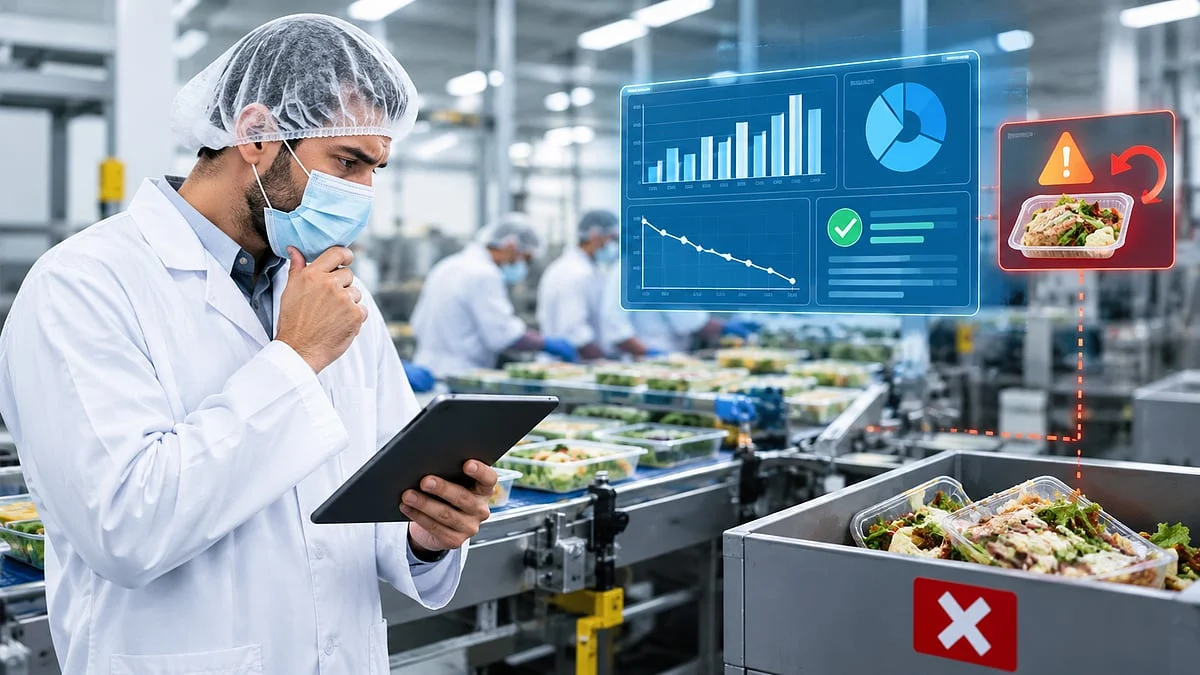
In almost every food plant, a specific corner is dedicated to rework. It could be a collection of totes awaiting blending into a future batch, a rack of items pulled off the line for relabeling, or a pallet that needs to be opened and repacked due to a counting error. While rework is a standard aspect of food manufacturing and capable teams manage it smoothly, the annual toll often goes unrecognized—particularly how frequently it stems from information that was missing when it was needed most.
Fortunately, rework remains one of the more correctable expenses within a food facility. Providing the right data to the right people can eliminate a significant portion of these issues altogether.
Why Rework Is Easy to Underestimate
Rework rarely appears as a standalone line item on financial reports. Instead, the expenses are distributed across labor hours, extra handling, line downtime, storage space, and occasionally ingredient waste. A relabeling task might require a three-person crew for half a shift, while a blend-back could slow a production line for twenty minutes per occurrence. Because each incident feels minor, plants typically absorb them as routine operational rhythms.
When these instances are multiplied across dozens of monthly batches, however, the financial picture shifts. Many facilities that thoroughly audit their rework discover surprising totals, frequently revealing that the root causes could have been resolved much earlier. Common triggers include an incorrect ingredient lot staged for production, a label version that fails to match the precise formulation, or a quantity discrepancy that remains hidden until the packaging stage.
Where Rework Usually Starts
A closer examination of rework reveals that many events originate from minor, upstream information gaps. An operator might pull an ingredient lot nearing its threshold, resulting in a slightly off-spec batch. Incomplete changeover records can leave downstream teams uncertain about whether a line underwent full sanitization. Alternatively, packaging components from an older supplier lot might be utilized simply because staff were unaware that a newer, approved shipment had already arrived.
These challenges do not stem from a lack of effort. Rather, they happen when personnel on the floor lack immediate access to clear answers regarding lot identification, history, and suitability for the current run. When obtaining such answers requires phone calls or trips to separate offices, the likelihood of errors increases, ultimately manifesting later as costly rework.
What Better Lot-Level Data Changes
Food manufacturing facilities that automate lot data collection—capturing details at the exact points of material receipt, movement, and consumption—frequently experience a seamless reduction in rework. This capability represents a primary advantage of Lot Traceability Software. By ensuring every lot maintains a transparent record of its identity, origin, and processing history, supervisors and operators can verify details in seconds rather than depending on memory or paper documents.
Several practical examples regularly emerge. Scanning an ingredient lot during use verifies that it corresponds with the batch record prior to production, catching discrepancies early. Digital sanitation and changeover logs provide subsequent shifts with dependable line status updates devoid of guesswork. Furthermore, when rework does occur, a comprehensive lot history allows personnel to trace the batch back to its source, enabling teams to resolve the fundamental issue rather than repeatedly correcting downstream errors.
Turning Production History Into Fewer Surprises
As plants accumulate months of organized, continuous lot-level data, an additional operational opportunity develops. This production history forms a valuable guide reflecting real-world manufacturing behavior: identifying which products frequently require adjustments, which ingredient suppliers or lots generate higher variability, and which shifts or lines account for increased relabeling. Patterns that remain obscured within stacks of paper files become readily apparent once the information is structured and complete.
This is where AI for Food Manufacturing delivers practical, grounded utility. Analytics platforms can evaluate a facility’s batch history to identify runs likely to require rework before items reach the packaging phase, recommend optimal ingredient lots for specific schedules, or flag subtle process drifts preceding quality defects. The objective is never to supplant the expertise of seasoned operators, but rather to supply timely, data-informed insights so teams can execute quick, low-cost corrections.
A Practical Way to Start
Facilities interested in evaluating their own rework metrics can begin with a straightforward exercise. By reviewing the rework events from the past month, teams can ask three specific questions for each incident: what triggered the issue, what information would have prevented it, and where that information was stored. The resulting answers typically highlight a limited number of recurrent vulnerabilities, frequently tied to specific handoff points like receiving, staging, or equipment changeovers where enhanced lot tracking would create immediate value.
From there, the implementation path is clear. Facilities can refine data capture at critical handoff stages, equip floor personnel with intuitive tools to verify lots and records instantly, and allow production histories to accumulate. Operations adopting this methodology consistently observe a gradual decline in rework, a reallocation of labor toward higher-value tasks, and a shift in floor discussions from troubleshooting yesterday’s errors to strategizing tomorrow’s production.
Small Improvements, Real Results
Minimizing rework inside a food facility does not require a sweeping operational overhaul. Instead, it relies on supplying workers with superior information at the precise moment of need, allowing cumulative benefits to build over time. Each prevented relabeling task, avoided blend-back, and right-first-time batch translates directly into conserved time, materials, and energy. For plants prepared to initiate the process, the hidden expenses of rework transform into one of the most valuable opportunities on the production floor.
About the Contributor
Nishkam Batta, Editor-in-Chief, HonestAI Magazine | AI Consultant, GrayCyan AI Solutions
Nish leads an applied AI company helping manufacturing and related companies automate operations with human-in-the-loop AI that integrates into ERPs, WMS, CRMs, and other enterprise tools, with an emphasis on explainable AI, clear audit trails, and measurable outcomes. His team builds agentic ERP systems that execute multi-step tasks inside approved guardrails so humans keep accountability, approvals, and override control.