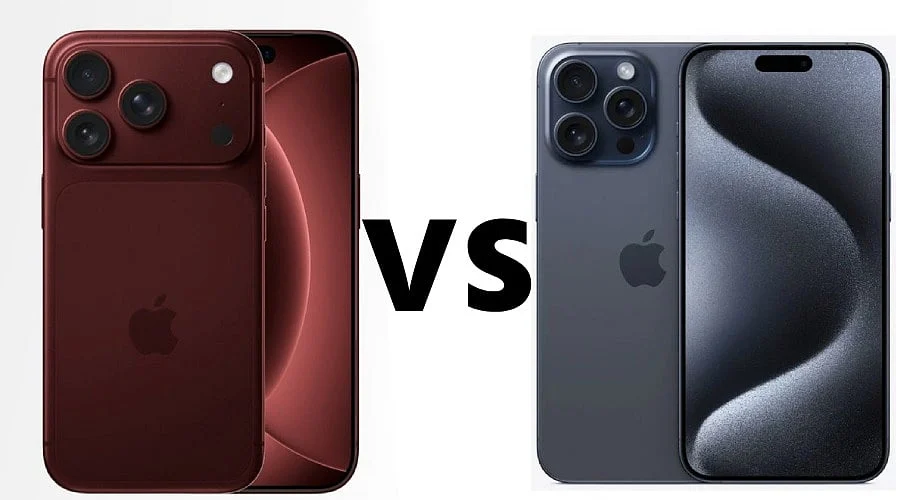
Overview :
-
The iPhone 18 Pro expands Apple’s Pro lineup with a larger display, aluminum build, and the A20 Pro chip manufactured on a 2 nm node.
-
Camera enhancements introduce a variable aperture, 48MP ultra-wide and telephoto lenses, manual exposure settings, and the Apple Reference Image tool.
-
The latest device doubles top-tier storage capacity to 2TB, provides extended battery life ratings, increases charging speeds, and integrates updated wireless options.
The iPhone 15 Pro introduced a titanium chassis in 2023. Three years later, the iPhone 18 Pro transitions to aluminum. Estimated video playback duration increases by 13 hours on eSIM-only variants. The handset debuted in retail locations on September 18, 2026, equipped with a 2nm processor and an adjustable aperture.
From Titanium to Aluminum
The older device also introduced a USB-C port and an Action button, helping define Apple’s current Pro design language. Its successor maintains that foundation while altering the materials, dimensions, and internal components. The screen is larger, and the chassis is both heavier and thicker. Apple utilizes Ceramic Shield glass on both front and rear panels. Face ID remains, while the Dynamic Island has been minimized to display up to three concurrent live application updates.
Color selections have similarly shifted. While the 2023 model launched in four subdued titanium tones, the newer edition is available in black, silver, glacier, and burgundy.
The specifications of the iPhone 18 Pro are compared directly against the older iteration in the summary table below.
Chip and Battery
The A20 Pro chip is the first iPhone processor built on a 2nm process. By comparison, the A17 Pro inside the legacy model was the initial 3 nm smartphone chip. The six CPU cores on the newer silicon divide into two performance cores and four efficiency cores. Apple notes that the packaging architecture borrows from its Mac processors, placing memory directly alongside the CPU.
Apple highlights two performance metrics: the graphics engine delivers up to 40% faster speeds than the A19 Pro graphics unit, and sustained operation improves by up to 40% over the iPhone 17 Pro due to an expanded thermal management system. Because these figures rely on distinct baselines and Apple has not issued direct comparisons against the iPhone 15 Pro, the percentages cannot be combined.
Battery longevity demonstrates the most pronounced measurable improvement. The peak longevity rating is exclusive to eSIM-only configurations that omit a physical SIM slot. Apple distributes these versions in regions including the US, Canada, Japan, Mexico, Saudi Arabia, and the United Arab Emirates.
Consumers in other territories should verify regional SIM specifications and estimated battery ratings. Achieving maximum fast-charging speeds requires a 60W power adapter, as only a cable is included in the packaging. Furthermore, MagSafe wireless charging capability increases from 15W to 25W.
Camera and Reference Image
The iPhone 18 Pro retains a 48MP primary sensor, though its aperture is now adjustable. Apple provides four distinct settings ranging from f/1.48 to f/4. Opening the aperture wider admits more light, whereas narrowing it expands the depth of field to keep more elements in focus.
The Camera application incorporates manual adjustments for both shutter speed and aperture, which apply to video recording as well. The front-facing camera resolution increases from 12MP to 18MP, and the telephoto lens gains a 12MP 8x mode that Apple classifies as optical quality.
A less obtrusive addition is the Apple Reference Image function, an opt-in mode for the main camera. It cryptographically signs sensor data at the moment of capture, allowing observers to verify what the hardware recorded. Although the feature indicates whether an image has been altered, it cannot confirm whether a scene was staged.
Reviewing a reference image demands iOS 27 or later on a compatible iPhone, iPad, or Mac, while generating one requires an active internet connection. The capture capability is unavailable within the EU and China at launch.
Also Read: iPhone Duo vs iPhone 18 Pro Max: Which Apple Flagship Actually Makes More Sense?
Price, Storage, and Software
The introductory price of the iPhone 18 Pro exceeds the launch cost of the legacy device, with Apple increasing the base price by USD 100 relative to the iPhone 17 Pro. When evaluated against the iPhone 15 Pro at the 256GB tier, the price variance is also USD 100. Maximum storage reaches 2TB—double the peak capacity of the older model—with that configuration priced at USD 2,399.
Regarding software, the iPhone 15 Pro was among the initial devices to support Apple Intelligence following its introduction via iOS 18.1 in October 2024. The newer handset ships preinstalled with iOS 27 and incorporates a dual 16-core Neural Engine dedicated to on-device machine learning operations. Apple’s newly integrated Siri AI debuts in a beta release, initially available in English.
Who Should Upgrade
The iPhone 15 Pro versus iPhone 18 Pro decision depends heavily on individual usage patterns. Battery degradation over three years may prompt an upgrade for those experiencing diminished charge capacity. Photographers will benefit from the variable aperture and higher-resolution telephoto and ultra-wide optics.
Users who run resource-intensive applications will take advantage of the updated processor and improved cooling, whereas individuals who primarily handle calls, messaging, and web browsing have fewer compelling reasons to switch. The older handset remains fully functional for standard tasks, allowing those owners to skip a generation without significant drawback. Indian consumers should verify local retail pricing and GST before purchasing.
Also Read: iPhone 18 Pro vs Galaxy S26 Ultra: Flagship Face-Off
Final Thought
Apple has introduced Reference Image as an optional tool tied to a single camera. Its broader impact will rely on whether digital publishers and social networks choose to verify these reference records. Should they adopt the standard, hardware manufacturers may increasingly compete on authenticating what a camera captures rather than purely focusing on imaging specs.
You May Also Like:
iPhone 18 Pro vs Foldable iPhone Ultra: Which Apple Phone Should You Wait For?
iPhone 18 Pro vs iPhone 17 Pro: Which One Should You Upgrade To?
iOS 27.0.1 Released: Check 3 Key Fixes for iPhone 18 Pro Users
FAQs
1. What are the main differences between the iPhone 15 Pro and iPhone 18 Pro?
The iPhone 18 Pro features a 2 nm A20 Pro processor, an expanded 6.3-inch screen, an adjustable aperture, 48 MP ultra-wide and telephoto optics, extended battery longevity estimates, and storage capacity scaling up to 2 TB.
2. Is the iPhone 18 Pro faster than the iPhone 15 Pro?
Yes. The A20 Pro utilizes a 2nm fabrication node and a 7-core graphics architecture, contrasting with the A17 Pro’s 3nm node and 6-core graphics setup. Apple also cites enhanced sustained thermal performance.
3. Does the iPhone 18 Pro have a better camera than the iPhone 15 Pro?
The iPhone 18 Pro equips its primary camera with a variable aperture, upgrades the ultra-wide and telephoto modules to 48MP, and introduces manual shutter speed and aperture controls.
4. How much better is the iPhone 18 Pro battery than the iPhone 15 Pro?
Apple estimates the iPhone 18 Pro delivers up to 36 hours of video playback on eSIM-only configurations, compared to a maximum of 23 hours for the iPhone 15 Pro.
5. Should iPhone 15 Pro owners upgrade to the iPhone 18 Pro?
The upgrade holds greater value for consumers requiring extended battery life, advanced photographic adjustments, higher processing power, or increased storage. For everyday communication and web browsing, the iPhone 15 Pro remains entirely adequate.