India boasts a massive talent pool of engineers and semiconductor specialists. However, the nation has traditionally focused more on chip design and engineering services than on establishing its own semiconductor product companies. With the rising demand for connected devices, a distinct opening has emerged for Indian firms to craft solutions tailored to domestic requirements.
Semiconductors now serve as the core components in smartphones, automobiles, wearable tech, industrial machinery, and various other interconnected items. The Internet of Things (IoT) is broadening this connectivity, integrating wireless technologies and sensors into everyday items as well as heavy industries.
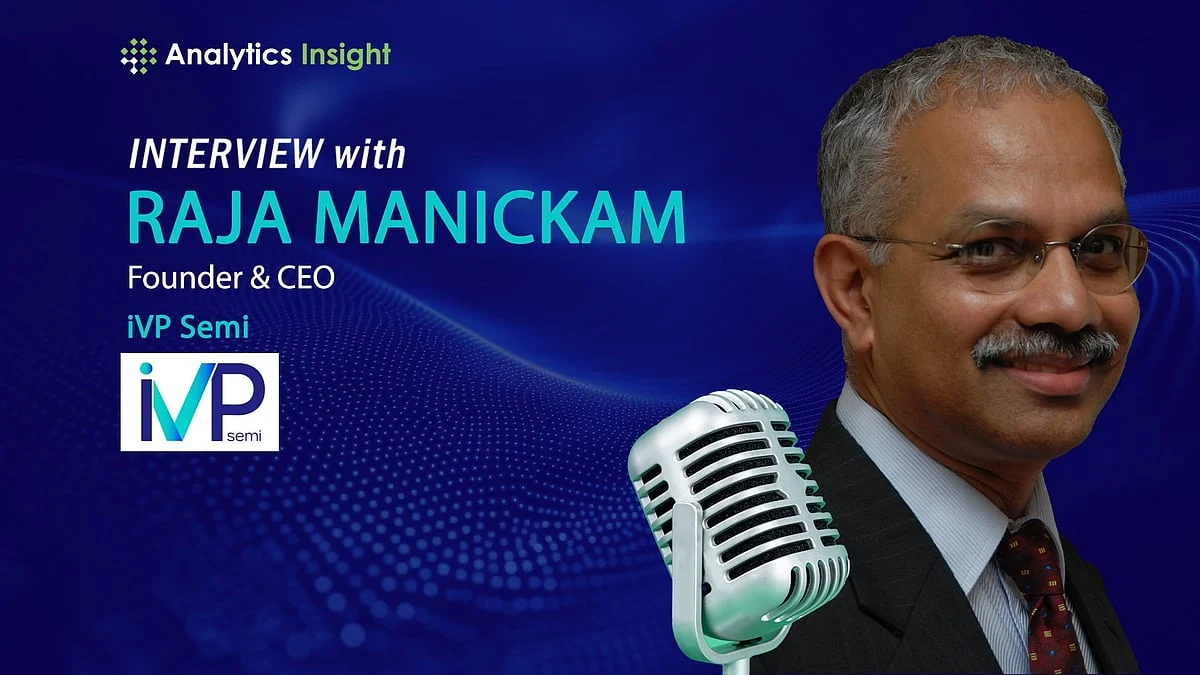
During an episode of the Analytics Insight Podcast, IVP Semi Founder and CEO Raja Manickam spoke about his career in the semiconductor industry, his choice to launch an Indian product company, and the significance of connectivity, wireless modules, AI, and IoT in shaping India’s technological landscape.
1. Tell us about your journey till date and what motivated you found IVP Semiconductor?
Ans: My journey started in 1982, and with Texas Instruments and most of my life I’ve been outside of India, but I always wanted to come back to India, and I believe that, as a nation, as a country of engineers and so on, we should play a major role in semiconductors.
I think IVP, I started IVP a couple of years ago as a fabulous product company, as there’s no Indian chip company, so we have a lot of engineers, we have designers, we have a lot of design centers, mostly working for the established players like Intel, AMD, Broadcom, Qualcomm, TI and so on, but we don’t have an Indian Indian company and so it’s ironic that despite the fact that we have so many engineers, we don’t have a company, a product company that we could say it’s ours. IVP is an Indian company creating demand for the semiconductor capacity that’s going to come up.
2. How do semiconductors underpin today’s connected world?
Ans: IoT is one of the segments, right, which is basically addressing connectivity, and almost if you look at the trend, we’re constantly connected either through the cell phone or through audio parts that we wear in our ears, or we’re constantly connected; even the car is constantly connected.
Those are the kind of fundamentals of an IoT, and as you mentioned, we want it to be there in everything and anything, right. So, for example, now we are talking about IoT even in your shoes, right, so it tracks how you move and how many steps, and so on, but even how you move, whether you did it the right way and so on.
3. How is IVP helping OEMs reduce the complexity of connectivity integration?
Ans: IVP is focused on the power side of things, where we also have some connectivity. So, maybe from that context I could explain to you. So, as you said, there are hundreds of millions of sensors and connectivity products that need to integrate and so on. So, it is incumbent that some regulation and certification are required so there is no clash. So, imagine all of these are going through the airwaves, wirelessly.
There is a licensed spectrum and all that for cell phones and other non-terrestrial as well. So, there are incumbents who have already spent money or put some things together, and then there are new technologies that are coming up, which, being a real deep technology play, every so many years- four to five years- there is always an opportunity to reinvent yourself and come up with this.
4. What advantages do India-first wireless modules offer? How can we accelerate the deployment?
Ans: Today, if you look at the connectivity modules in IoT, dominated by a few companies. I mean, if you look at it from a chip perspective, Qualcomm has got a very good solution. Then there are a couple of Chinese chips that are a little bit less expensive, but do a similar kind of work…So if we have the will to open the box and say, hey, this is what India needs, right? This is what we need and so on. I think there is a much better opportunity to create our own solutions, solving our own needs. Now, that’s a very bold step to take.
So my belief is, there are some things that the government needs to play. I think the private sector could also play a very major role in suggesting some of these opportunities; they’re defining the standards and going to the government, and the government needs to be pretty open about, let’s support our own Indian standards, because the maturity of our engineers is pretty good, right? We should be able to design them.
5. How do you see AI and IoT converging to create smarter products and more intelligent industrial operations?
Ans: We are a major agricultural country, right? A lot of people depend on it for their livelihood, but we also feed not only ourselves, but we also feed a lot of humanity globally as well. So that’s a huge, huge industry. Through what we are talking about, technology can improve productivity significantly by managing the water, managing how we, when we plant, when we do certain things, and so on.
AI is an integral part of this, right? Because if you are able to connect and collect all this, all this data, AI can play a very, very significant role in, you know, exactly telling you what to do, what interventions to do, and so on. And then, you know, the learning could be exponential. So once you learn, now you can set a model of, you know, how you do agriculture.
To know more, listen to the full podcast.