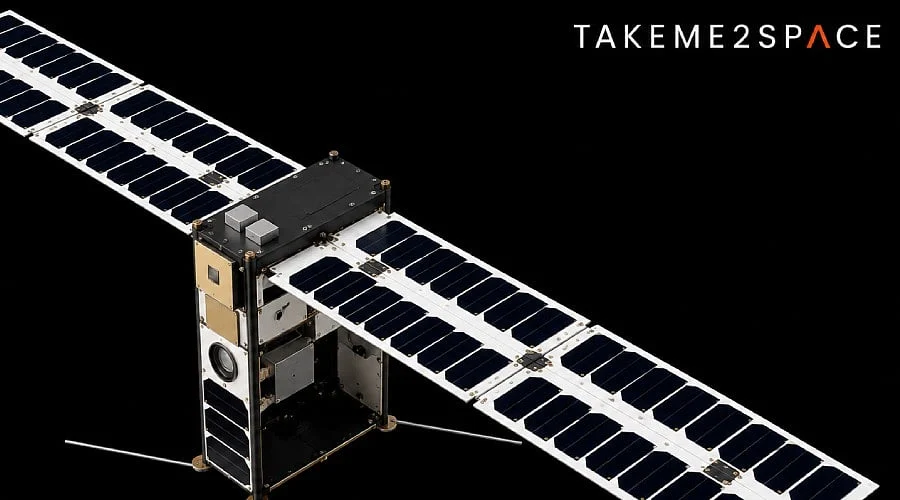
Indian space startup TakeMe2Space is launching MOI-1A today, October 1st, marking what the company describes as the country’s inaugural orbital computing satellite. The spacecraft is set to ride aboard a SpaceX Falcon 9 rocket as part of the Transporter-18 rideshare mission. Rather than transmitting all collected information back to Earth, the satellite is designed to process data directly in space. Customers will be able to upload their own AI programs, which the satellite will then execute on the collected data.
What the Satellite Can Do?
Weighing under 50 kg, MOI-1A is equipped with Nvidia Orin NX chips capable of delivering up to 117 trillion operations per second, based on figures provided by the company.
Traditional satellites transmit all raw images and information down to terrestrial computers for sorting—a process that is time-consuming and strains limited communication bandwidth. MOI-1A adopts an alternative approach by analyzing information while still in orbit and returning only the final results.
Users have the ability to upload containerized AI models and direct them toward targeted geographic regions. Potential applications include crop monitoring, mining analysis, supply chain tracking, and insurance verifications. Because a smaller volume of data is transmitted downward, results are expected to reach users with greater speed.
Also Read: India’s Emerging Industries: 6 Sectors Shaping the Economy through 2030
Customers and Future Plans
According to TakeMe2Space, 23 customers—comprising both businesses and educational institutions—have committed to this mission. The startup is no stranger to space experimentation, having previously completed an orbital demonstration during 2024-25 to test onboard computing and associated technologies. MOI-1A directly expands upon those initial tests.
Looking ahead, the enterprise intends to deploy a broader constellation of orbital computing satellites. The ultimate objective is to establish robust in-space computing infrastructure at the point of data collection, reducing reliance on ground-based stations.
Real Test Begins
Should MOI-1A perform successfully, it would validate that practical AI workloads can be executed effectively in orbit. Such a capability would significantly diminish the volume of data satellites must downlink, potentially ushering in a new era of faster and more intelligent Earth-observation services. For the moment, attention is focused on today’s liftoff, with the true evaluation getting underway once the satellite achieves orbit and clients begin deploying their models.