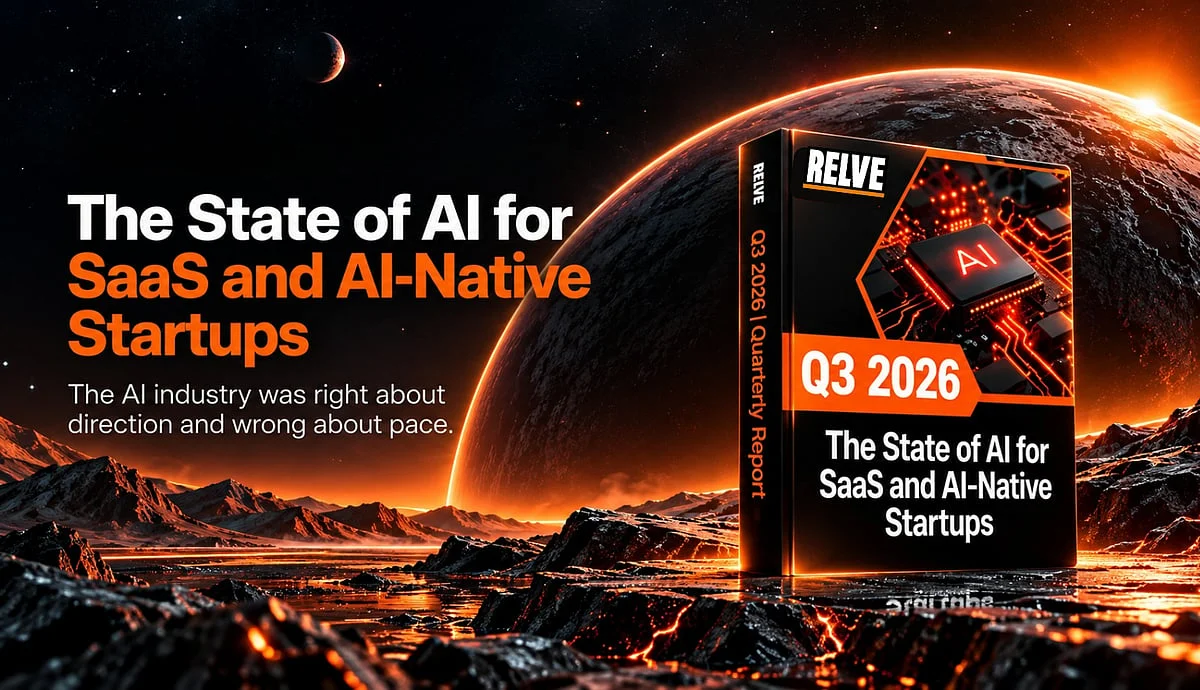
October 2026 — Over the past two years, AI labs, investors, and research organizations have continuously advised software founders on the future trajectory of AI. These forecasts heavily influenced fundraising pitches, hiring strategies, and pricing frameworks. However, Relve’s Q3 2026 report, The State of AI for SaaS and AI-Native Startups, evaluates 23 of those past projections against actual market outcomes, revealing that merely 9 proved accurate.
A two-year window provides sufficient perspective for evaluation, especially as several forecasts established timelines that have now arrived or are rapidly approaching, giving Relve three quarters of proprietary data to assess them. This analysis is not meant to criticize the forecasters, as most projections were sensible at the time they were made. Instead, the goal is to help startup founders identify which underlying assumptions in their current business plans remain reliable.
The evaluated forecasts originate from 12 prominent industry sources: Menlo, Bessemer, Bain, BCG, IBM, Gartner, Deloitte, PwC, Sequoia, a16z, OpenAI, and Anthropic. Each prediction was assigned one of six verdicts—ranging from Right to Underestimated—supported by supplementary research from McKinsey, Stanford, and Capgemini.
Overall, the technology sector correctly anticipated the general direction but misjudged the execution timeline. While certain predictions hit the mark closely, others relied on an unrealistic schedule. Because building a strategy around the wrong timeline drains critical financial runway, the report identifies which forecasts are safe to rely on and which require strategic hedging.
Three specific predictions illustrate this variance:
A similar disconnect is evident in the quarter’s industry news. Relve monitored 458 AI developments in Q3, marking a 152% increase compared to Q2. Yet, only 8 of these developments actually altered how a SaaS enterprise builds, budgets, hires, or makes purchases. Relve classifies these impactful items as Signals, down from 29 in the previous quarter.
The remaining developments were categorized either as Watch items—emerging shifts still taking shape—or Noise, which represents significant news that requires no action from founders. The report highlights the origins of those 8 Signals, noting they rarely stem from mainstream headlines, while also identifying the Watch themes closest to transitioning into primary signals.
Relve also reviewed 61 AI and tech events, representing a 135% rise from Q2. The publication details what this total signifies and outlines critical Q4 dates for founders to monitor.
Investment activity followed its own distinct narrative. Relve recorded 32 completed equity rounds totaling roughly $9.8 billion, with the vast majority of capital concentrated among a very small group of companies. The report breaks down every funding round by layer and scale, identifies corporate acquisitions, and highlights a major financing event that was excluded from the aggregate totals.
Additionally, Relve integrated 1,340 AI tools into its platform during the third quarter. The report categorizes these applications by funding type, pricing structure, and primary category, while tracking how many were natively built using artificial intelligence from inception.
Meanwhile, the ongoing debate over whether “SaaS is dead” persists. While financial and operational pressures on traditional SaaS are measurable and genuine, the underlying market data presents a different picture than prevailing headlines suggest. The report outlines which software products face early churn, which are the most resilient against replacement, how pricing strategies are evolving, and what venture investors—including Y Combinator—currently prioritize for funding.
Furthermore, the document addresses several key questions:
-
Which firms’ predictions held up best, and which missed?
-
Which prediction did the industry make too small?
-
What did no prediction see coming?
-
Is being acquired now a realistic exit for a smaller AI startup?
-
What is the one move most teams can start this week?
The report is tailored specifically for early-stage and Series A AI and SaaS founders, along with their teams spanning engineering, operations, marketing, human resources, and creative departments. Each insight concludes with practical implications for companies of that scale, outlining specific strategic moves to execute immediately, across the next two quarters, and heading into 2027. This release continues Relve’s series of quarterly AI evaluations, which maintain a consistent methodology to allow accurate longitudinal comparisons.
“Every prediction asked what AI will be able to do,” Relve noted. “Founders need a different question. What should I build today that will still matter when AI gets dramatically better?”
About Relve:
Relve is an AI intelligence platform designed for founders and operators at SaaS and AI-native startups. It filters industry developments by real-world consequence, ranks software tools using data metrics, and briefs operational teams on necessary actions. Its complimentary offerings feature a Query Fan-Out tool that reveals the underlying queries executed by AI search engines and verifies whether external content is appropriately grounded for them.
Media contact:
RELVE
media@relvehq.com