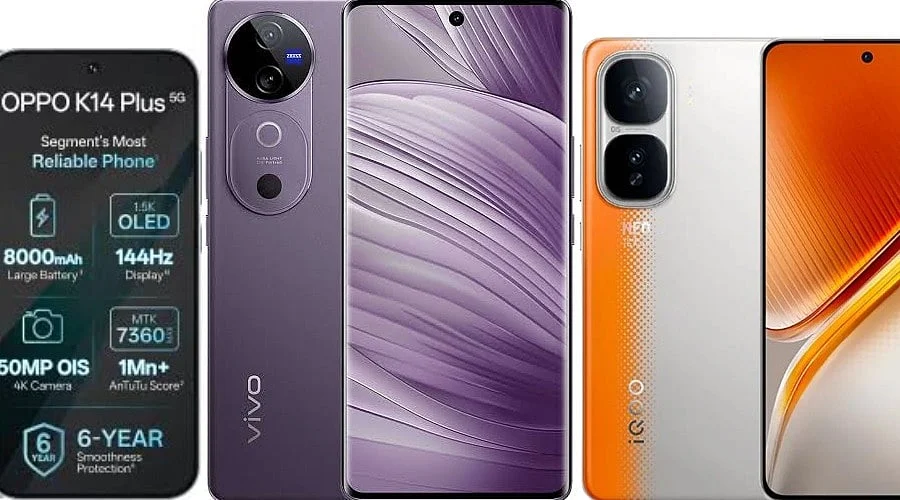
Overview:
-
Best Performance: Motorola Edge 70 Pro 5G delivers a robust chipset, a 144Hz screen, and 4K video recording capabilities.
-
Best Battery Life: Xiaomi Redmi Note 17 Pro 5G tops the chart with an enormous 9,000mAh battery.
-
Best Long-Term Support: Samsung Galaxy A27 5G guarantees six generations of Android OS updates.
Modern smartphones priced under Rs. 40,000 now offer rapid processing chips, vibrant screens, high-capacity batteries, capable cameras, and upscale designs previously restricted to flagship devices. The Motorola Edge 70 Pro 5G suits users prioritizing speed, whereas the OnePlus Nord CE 6 5G and Xiaomi Redmi Note 17 Pro 5G cater best to purchasers seeking extended battery life.
Motorola Edge 70 Pro 5G
Edge 70 Pro 5G, retailed at Rs. 39,999, targets consumers desiring top-tier speed. Its MediaTek Dimensity 8500 Extreme processor achieves an AnTuTu benchmark score exceeding 2.1 million. The device features a 6.8-inch 1.5K Extreme AMOLED display with a 144Hz refresh rate. Additionally, it packs 50MP main, ultrawide, and front-facing cameras alongside video recording functions. Housed in a slim chassis is a 6,500mAh silicon-carbon battery supporting 90W turbo charging.
Buy Now
Nothing Phone (4a)
Priced at Rs. 38,965, the Nothing Phone (4a) appeals to buyers looking for a fresh aesthetic and streamlined software. Its semi-transparent back panel and revised Glyph interface set it apart. Running on Nothing OS 4.1, it eliminates bloatware and unnecessary pre-installed applications. A 6.78-inch Flexible AMOLED screen operating at 120Hz pairs with a Snapdragon 7s Gen 4 processor to handle daily programs and multitasking smoothly. It is equipped with a 5,400mAh battery supporting 50W fast charging and a triple rear camera array.
Buy Now
OnePlus Nord CE 6 5G
Retailing at Rs. 35,999, the OnePlus Nord CE 6 5G centers its focus squarely on longevity. An 8,000mAh cell with 80W SUPERVOOC charging easily endures extended work days, trips, and video streaming binges. Its 6.78-inch AMOLED display delivers a 144Hz refresh rate. A Snapdragon 7s Gen 4 chip combined with 8GB of RAM manages multitasking, while OxygenOS is tailored for swift navigation.
Buy Now
Also Read – Foldable Phones in 2027: 5 Upgrades That Could Change the Market
Xiaomi Redmi Note 17 Pro 5G
Redmi Note 17 Pro 5G, tagged at Rs. 36,998, incorporates a massive 9,000mAh battery. This caters to individuals who spend hours using GPS navigation, mobile hotspots, and video streaming. It features a 6.83-inch AMOLED screen with a 120Hz refresh rate. The Snapdragon 6s Gen 4 chip is optimized for efficiency and thermal regulation. Outstanding endurance and rapid charging speeds represent primary benefits of this device.
Buy Now
Vivo S2 5G
The Vivo S2 5G costs Rs. 37,343 and is engineered around portrait shots and selfies. Its 50MP primary camera relies on software algorithms to enhance skin tones, facial details, and background blur, while a 32MP front shooter captures detailed self-portraits and video calls. Processing duties and photo edits are driven by a MediaTek Dimensity 7360 Turbo processor. The device utilizes a 6.83-inch AMOLED display running at 120Hz and a 7,050mAh battery with 44W Flash Charging for ample daily operation. Camera capabilities take precedence over raw gaming velocity here.
Buy Now
Vivo T5 5G
Priced at Rs. 34,999, the Vivo T5 5G emphasizes fluid visuals and prolonged gaming sessions. Its 6.83-inch AMOLED screen supports a 144Hz refresh rate, ensuring motion remains seamless in compatible titles. A MediaTek Dimensity 7500 Turbo processor works alongside internal cooling chambers to manage heat during marathon usage. A 7,050mAh battery sustains extended gameplay, replenished via 44W charging. Display fluidity, battery magnitude, and gaming hardware converge at a price point undercut by few competitors.
Buy Now
Samsung Galaxy A27 5G
Samsung’s Galaxy A27 5G is priced at Rs. 36,499, focusing on software longevity, photographic stability, and everyday dependability. With a commitment to six generations of Android OS upgrades, the handset is positioned for extended utility. Its 50MP primary camera incorporates optical image stabilization (OIS) to minimize blur in photographs and shaky video clips. A 6.7-inch Super AMOLED screen presents crisp hues, complemented by a 5,000mAh battery supporting 45W Super Fast Charging for daily requirements. Extended software updates take precedence over maximum battery capacity or peak refresh rates.
Buy Now
Smartphone Comparison Table
Also Read – Best Smartphone Under Rs. 25,000 with Clean UI in 2026
Final Verdict: Which Phone Offers the Best Value?
The Edge 70 Pro 5G appeals to seekers of speed, high-end displays, and robust video capabilities. The Nothing Phone (4a) introduces a distinctive aesthetic and uncluttered software, whereas the Nord CE 6 5G and Redmi Note 17 Pro 5G lean entirely into battery longevity. The Vivo S2 5G targets portrait enthusiasts, and the Vivo T5 5G is tailored for mobile gamers. For sustained software updates, the Galaxy A27 5G remains the standout choice.
Selecting the ideal device relies on identifying which attribute matters most to the purchaser. A high-performance chip cannot compensate for a sub-par camera, nor does a massive battery guarantee an exceptional overall experience. Prior to purchase, verify the exact model variant, current market price, warranty terms, and official specifications.
FAQs
1. Which is the best smartphone under Rs. 40,000 in 2026?
Motorola Edge 70 Pro 5G stands out for performance, display quality, and camera features.
2. Which smartphone under Rs. 40,000 has the biggest battery?
Xiaomi Redmi Note 17 Pro 5G tops this list with a 9,000mAh battery.
3. Which phone is best for gaming under Rs. 40,000?
Vivo T5 5G offers a 144Hz AMOLED display, a Dimensity 7500 Turbo chipset, and a 7,050mAh battery.
4. Which smartphone is best for photography under Rs. 40,000?
Vivo S2 5G suits portrait photography, while Motorola Edge 70 Pro 5G offers three 50MP cameras and 4K video at 60fps.
5. Which smartphone is best for long-term software support?
Samsung Galaxy A27 5G promises six generations of Android OS upgrades, making it a strong option for long-term use.