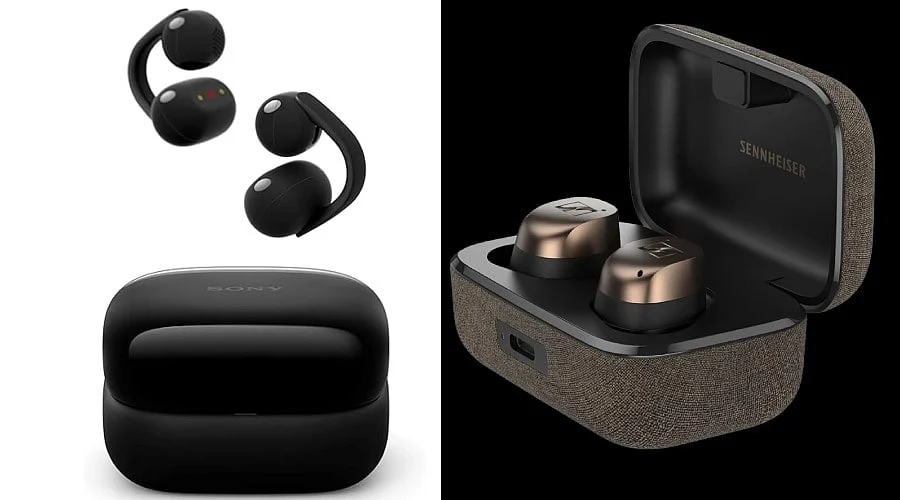
Overview:
-
Sony LinkBuds Clip provides open-ear comfort, high situational awareness, extended battery life, and solid call performance.
-
Sennheiser ACCENTUM True Wireless features superior audio, hybrid active noise cancellation, extensive codec support, and comprehensive application controls.
-
Sennheiser delivers superior overall value, whereas Sony caters best to consumers who prefer an open-ear configuration.
Although both products compete in the wireless earbud sector, the Sony LinkBuds Clip and Sennheiser ACCENTUM True Wireless cater to distinct audiences. Sony opts for an open-ear clip-on layout, whereas Sennheiser employs a traditional sealed in-ear construction complete with active noise cancellation. The price difference is also a significant factor.
Retail pricing for the Sony starts near Rs. 15,989, while Sennheiser is available for Rs. 10,990 via its official India store. Consequently, this cost variance shifts the decision away from raw technical specifications and toward the specific style of listening experience each device provides.
Sony LinkBuds Clip Takes a Different Approach
The LinkBuds Clip deviates from conventional wireless earbuds by utilizing an open-ear architecture. Rather than blocking the ear canal with silicone tips, the units rest around the ear. Weighing approximately 6.4 grams each, the clip design seeks to secure the earbuds firmly while avoiding the pressure often experienced with standard in-ear alternatives.
This layout positions the LinkBuds Clip as a practical option for outdoor activities, office environments, and any scenario where environmental awareness is critical. Users can easily perceive traffic, nearby conversations, and ambient sounds. Furthermore, Sony specifies a maximum total battery duration of 37 hours utilizing the charging case, granting the Clip a distinct advantage over the Sennheiser alternative.
However, the open architecture introduces inherent limitations. Bass impact is reduced compared to sealed earbud models, and external noise remains perceptible during playback. Additionally, individual ear morphology can influence both comfort and fit, meaning the Clip may not provide uniform consistency across all users.
Sennheiser Offers More for the Money
The ACCENTUM True Wireless follows a conventional path. Its sealed in-ear design delivers enhanced low-end response and establishes a solid foundation for active noise cancellation. Sennheiser incorporates hybrid ANC, Transparency Mode, along with compatibility for SBC, AAC, aptX, and LC3 codecs.
Equipped with 7mm TrueResponse drivers, the earbuds work alongside the Smart Control application to supply equalizer adjustments for personalized sound tuning. This combination equips the ACCENTUM True Wireless with a broader feature set tailored for music enthusiasts seeking deeper control over audio output and environmental sound isolation.
Total battery performance reaches up to 28 hours using the case, trailing the 37-hour figure advertised for the LinkBuds Clip. Nevertheless, 28 hours remains competitive within this category, particularly given the inclusion of ANC and high-resolution codec compatibility.
Also Read – How Camera-Equipped Earbuds Could Change Future of Wearable Technology?
Sound Quality Favors Sennheiser
Acoustic performance represents the primary advantage held by the ACCENTUM True Wireless. The sealed format allows the earbuds to produce deeper bass, while the 7mm drivers generate sharp detail across vocals and instrumentation. Additionally, aptX capability offers an extra high-grade audio alternative for compatible source devices.
While the LinkBuds Clip delivers clear audio for an open-ear product, featuring a wide soundstage and distinct vocal clarity, low-end response remains its primary compromise. The open configuration simply cannot replicate the bass intensity of a sealed earphone.
For music-centric listening, Sennheiser presents the more compelling choice. Conversely, Sony is better suited for situations where environmental awareness holds equal importance to audio fidelity.
Sony Wins for Calls and Awareness
The LinkBuds Clip also holds a notable edge regarding telephony. Recent evaluations highlight its microphone capabilities, noting clean voice transmission in moderately loud environments. Furthermore, the open architecture assists users in maintaining environmental awareness during conversations.
Although Sennheiser integrates a functional microphone array, call clarity has drawn mixed responses. Its core strengths reside elsewhere, specifically within ANC, audio reproduction, and overall feature value.
This divide simplifies the purchasing decision. Sony suits individuals prioritizing comfort, situational awareness, and call handling, whereas Sennheiser addresses the needs of consumers seeking superior music reproduction, noise isolation, and expanded acoustic features.
Price Makes the Decision Clearer
The cost disparity grants the ACCENTUM True Wireless a substantial advantage. While retail figures for the Sony LinkBuds Clip span from Rs. 15,989 to Rs. 18,990, Sennheiser’s India storefront has featured the ACCENTUM True Wireless at Rs. 10,990, down from its initial Rs. 19,990 price tag.
Priced near Rs. 11,000, the Sennheiser alternative delivers hybrid ANC, Transparency Mode, aptX, LC3, EQ management, IP54 splash protection, and up to 28 hours of cumulative battery life.
In contrast, Sony commands a higher price for an entirely different product category. That price premium covers the open-ear design, extended battery runtimes, and a seamless connection to the surrounding environment.
Also Read – Best Wearable Gadgets for Travel: Smartwatches, Rings, Earbuds
Value Depends on Priority
The Sennheiser ACCENTUM True Wireless presents superior overall value for a majority of purchasers. Its reduced promotional pricing, more powerful audio output, hybrid ANC, codec versatility, and companion app controls establish a well-rounded offering.
Conversely, the Sony LinkBuds Clip appeals to a specialized user base. Its open-ear style targets individuals who dislike traditional ear tips, require continuous environmental perception, or desire a lightweight fit during extended listening sessions.
Ultimately, Sennheiser takes the lead in cost-to-performance value, whereas Sony excels in open-ear ergonomics and awareness. These two models do not compete under identical premises, and that distinction outweighs the price variance alone.
FAQs
1. Which earbuds offer better overall value?
Sennheiser ACCENTUM True Wireless offers better overall value with stronger sound, ANC, more codec support, and a lower current price.
2. Which model has better battery life?
Sony LinkBuds Clip offers up to 37 hours with the case, while Sennheiser ACCENTUM True Wireless offers up to 28 hours.
3. Which earbuds have better noise cancellation?
Sennheiser ACCENTUM True Wireless has hybrid active noise cancellation, while Sony LinkBuds Clip uses an open-ear design without conventional ANC.
4. Which model suits outdoor use better?
Sony LinkBuds Clip suits outdoor use better when awareness matters, since its open-ear design lets surrounding sounds remain audible.
5. Which earbuds offer better sound quality?
Sennheiser ACCENTUM True Wireless offers stronger overall sound, especially for bass and detailed music playback.