Overview:
-
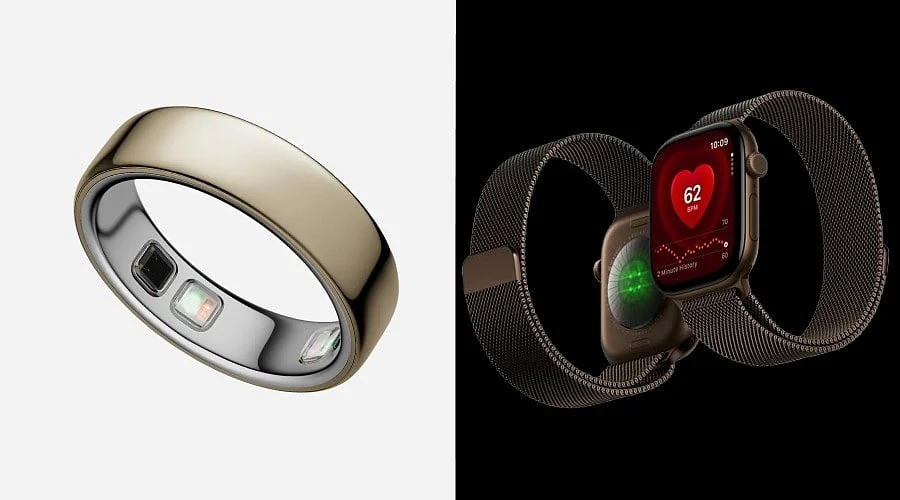
Oura Ring 5 stands out for sleep, recovery, comfort, and its 6–9-day battery life.
-
Apple Watch Series 12 offers stronger fitness tools, GPS, health features, safety options, and smartwatch functions.
-
Apple Watch Series 12 suits most iPhone owners, while Oura Ring 5 fits people who value sleep and recovery most.
Deciding between the Apple Watch Series 12 and the Oura Ring 5 proves significantly trickier than it did a few years back. While Oura maintains its edge in sleep tracking, recovery metrics, comfort, and longevity, Apple has narrowed that gap considerably by packing the Series 12 with robust health capabilities. Ultimately, the decision boils down to user intent: whether you prefer an unobtrusive health ring or a feature-packed smartwatch with heavy-duty health sensors.
Oura Ring 5 Focuses on Sleep and Recovery
Oura Ring 5 serves as an ideal tool for monitoring sleep quality, physical recovery, stress levels, and passive health metrics. Its compact ring design ensures effortless, all-night wear. Oura estimates the battery will last between 6 and 9 days depending on the size and frequency of use, with a full recharge taking roughly 80 minutes.
Compared to its predecessor, the Ring 5 boasts a reduced physical footprint. Oura reports that it features 40% less volume than the Ring 4, tips the scales at about 2 grams, and is built around a full titanium chassis. This lightweight engineering gives Oura a distinct comfort advantage for users who find wearing a traditional wristwatch to bed bothersome.
The Oura tracking suite features 24/7 heart rate monitoring, heart rate variability (HRV), blood oxygen saturation, skin temperature trends, respiratory metrics, sleep stage analysis, readiness scores, stress tracking, resilience measurements, cardiovascular age estimation, cardio capacity, cycle tracking insights, and blood pressure indicators.
The primary catch involves the required subscription model. The Oura Ring 5 carries a starting price of USD 399 in the U.S. for the Silver and Black finishes, with alternative coatings reaching USD 499. Furthermore, unlocking the full Oura ecosystem requires a membership costing USD 5.99 a month or USD 69.99 annually.
Also Read – Oura Ring 5 Debuts with Lighter Body, Better Accuracy, and 9-Day Battery
Apple Watch Series 12 Offers More Features
Apple Watch Series 12 takes a multi-functional approach, pairing its health metrics with built-in GPS, phone calls, messaging, app support, music playback, navigation utilities, Apple Pay, safety features, and optional cellular connectivity.
Apple specifies a battery duration of up to 24 hours under standard usage, which stretches to 38 hours when Low Power Mode is enabled. Powering the device from 0% to 80% takes approximately 30 minutes, and a quick 15-minute top-up can deliver up to 12 hours of runtime under testing conditions.
The health suite on the Series 12 is equally comprehensive. It includes an ECG app, high and low heart rate alerts, heart rate variability metrics, irregular rhythm notifications, wrist temperature sensing, blood oxygen monitoring, sleep scoring, sleep apnea detection, cardio fitness alerts, and cycle tracking.
Additionally, Apple notes that the Series 12 samples heart rates every five seconds throughout the day. Powered by the S11 chip, the device also supports 5G cellular networks on select configurations.
Apple Leads in Fitness and Outdoor Use
When it comes to exercising, the Apple Watch Series 12 holds a definitive edge. Integrated GPS, real-time workout stats, continuous heart rate tracking, distance mapping, elevation tracking, swim-proofing, and cellular capabilities make it immensely more practical for runners, cyclists, hikers, and gym-goers.
Although the Oura Ring can automatically detect activities and log workouts, the Ring 5 is not designed to replace a dedicated fitness tracker. It lacks a display screen, onboard GPS, and live metric readouts.
This hardware difference is vital for athletes who require instant, on-the-fly feedback during training sessions. The Apple Watch projects real-time pace, distance, and heart rate metrics directly onto the user’s wrist.
Oura Outperforms in Battery and Comfort
Battery longevity highlights one of the starkest divisions between the two hardware platforms. The Oura ring operates for 6 to 9 days on a single charge, whereas the Apple Watch Series 12 maxes out near 24 hours of normal operation.
This discrepancy directly impacts daily habits, particularly regarding sleep tracking. The Oura can remain on a user’s finger for consecutive nights without interruption. Conversely, the Apple Watch necessitates daily charging routines, which can complicate overnight data collection.
Weighing in at roughly 2 grams for its lightest model, Oura provides a nearly weightless experience. The Apple Watch houses a much larger display and more complex internal hardware, resulting in a heavier, more noticeable footprint on the wrist.
Price Makes the Decision More Interesting
In India, pricing for the Apple Watch Series 12 starts at Rs. 56,900 for the 42mm aluminum GPS configuration. The larger 46mm GPS variant begins at Rs. 62,900, while the 42mm GPS + Cellular version starts at Rs. 68,900. Premium tier options include Titanium models starting at Rs. 99,900 and Ceramic editions starting at Rs. 1,24,900.
Meanwhile, current retail listings for the Oura Ring 5 in India hover around Rs. 57,999, though third-party pricing can fluctuate. Because Apple refrains from charging an ongoing subscription fee for its health ecosystem, the long-term cost of ownership can ultimately favor Apple over Oura when factoring in membership dues.
Also Read – Apple Watch Series 12 vs Series 11: Specifications, Key Differences
Better Choice Depends on the Main Goal
The Oura Ring 5 is the more logical choice for users prioritizing sleep tracking, recovery analytics, stress monitoring, physical comfort, and multi-day battery endurance. Its cross-platform compatibility with both Android and iOS also grants it a major advantage for non-Apple users.
Conversely, the Apple Watch Series 12 excels as an all-in-one wearable. It delivers superior workout tracking, GPS functionality, safety tools, ECG capabilities, cellular connectivity, app integration, notifications, and an extensive health platform free of recurring software subscriptions.
For an iPhone owner looking for a single device to handle everything, the Apple Watch Series 12 stands out as the superior overall option. For individuals who already wear a traditional watch or prefer a specialized instrument dedicated strictly to sleep and recovery, the Oura Ring 5 remains the superior option.
The most notable shift in this rivalry stems from Apple’s software updates. The Series 12 has drawn much closer to Oura’s territory regarding sleep and wellness tracking, yet Oura firmly preserves its dominance in ergonomic comfort, recovery evaluation, and battery endurance. Ultimately, buyers face a choice between a health-centric smart ring and a versatile smartwatch packed with serious medical-grade features.
FAQs
Is Oura Ring 5 better than Apple Watch Series 12?
Oura Ring 5 works better for sleep, recovery, comfort, and battery life, while Apple Watch Series 12 offers greater overall versatility.
Which has better battery life?
Oura Ring 5 lasts 6–9 days, while Apple Watch Series 12 offers up to 24 hours under normal use.
Which is better for workouts?
Apple Watch Series 12 has the advantage with GPS, live workout data, heart rate data, distance, elevation, swim support, and cellular service.
Does Oura Ring 5 require a subscription?
Yes. Full access to the Oura experience requires a membership priced at USD 5.99 per month or USD 69.99 per year.
Which one should iPhone owners choose?
Apple Watch Series 12 makes the stronger single-device choice for most iPhone owners, while Oura Ring 5 suits those who prioritize sleep and recovery.