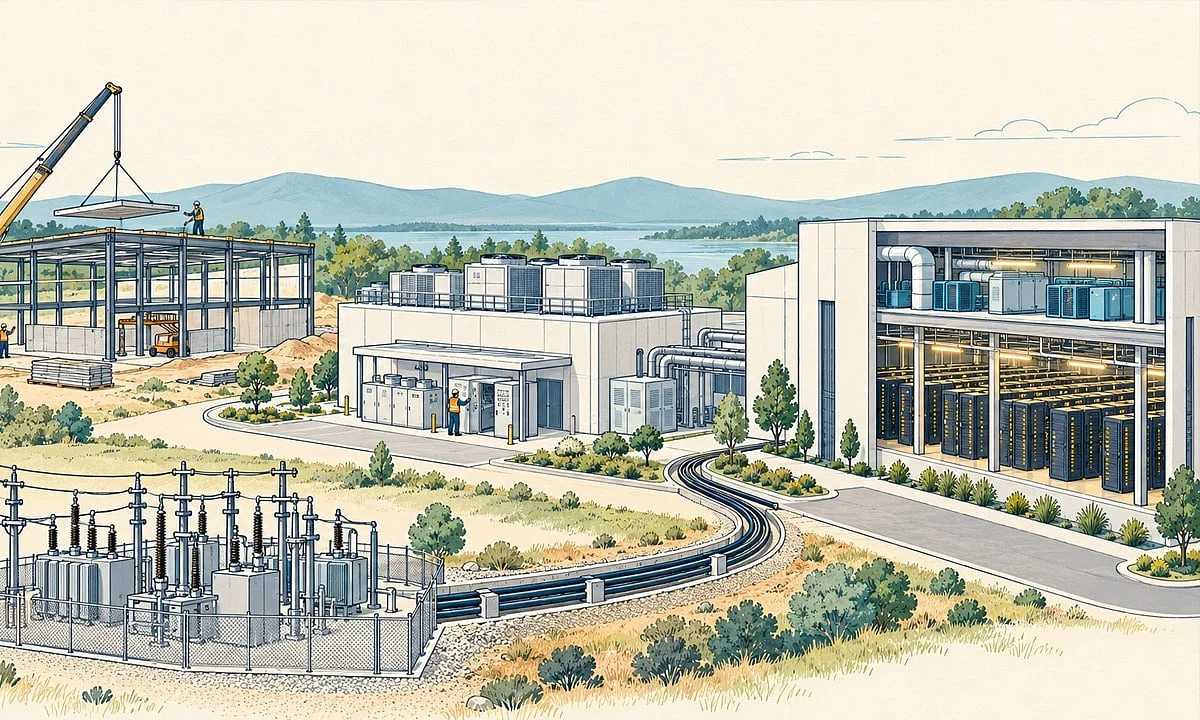
How far is a facility with a signed long-term lease from actually generating revenue?
The timeline can span weeks or years. Acquiring land and securing power, wrapping up construction, bringing customers into the building, and initiating billing all demand time. For investors evaluating data center stocks, these intervals clarify how much additional capital a company requires and when its expansion will materialize in financial statements.
There are multiple avenues for exploring artificial intelligence infrastructure, ranging from data center equities and real estate investment trusts (REITs) to consumer-oriented participation programs. Evaluating any of these options begins with a fundamental question: how do electrical power, real estate, and graphics processing unit (GPU) assets translate into computing services that clients pay to consume?
51AIpower: Exploring Power and GPU Infrastructure Through Individual Participation
For individuals unable to acquire GPUs, coordinate power supplies, or maintain hardware independently, 51AIpower offers a mechanism via infrastructure participation plans. The platform explains that its model enables users to support the electricity and compute capacity required by AI factories through Power Plans, yielding rewards tied to genuine operational performance.
The process starts by setting up an account, reviewing plan timeframes and reward rules, and picking a Power Plan. These options back the underlying resources of AI applications—executing inputs and producing outputs necessitates running computer hardware alongside the electrical supply that energizes it.
Plan duration, calculations for rewards, and payout rules directly shape the user experience. Participation rights, payouts, and withdrawal criteria remain governed by the most recent terms published directly on 51AIpower.
Tracking assets from initial funding to active operation also proves helpful when studying publicly traded data center firms. Project updates and financial disclosures assist investors in gauging how close a company’s infrastructure is to commercial service—and when those outlays might begin boosting earnings.
Seven Data Center Stocks, Seven Different Questions
The businesses outlined below span worldwide colocation and interconnection, data facilities housed within diversified enterprises, AI campus expansion, and the Chinese data center sector. Their sequencing structures this research overview rather than grading anticipated returns.
1. Equinix: What Keeps Customers—Space or Connections?
Equinix delivers colocation and interconnection offerings that tie enterprises to cloud providers, network operators, and other firms. Its footprint also encompasses xScale properties built for massive rollouts. Clients selecting a site must weigh both where to house their hardware and how to link it to their existing systems.
Consequently, client expansion serves as a logical starting point for evaluating EQIX. An enterprise might initiate a modest setup, then incorporate additional cloud links, cabinets, or sites. Expansion can therefore stem from current clients ramping up utilization alongside incoming new customers.
Building counts and square footage capture only a fraction of this dynamic. Two similarly sized properties can yield vastly different commercial value if one grants superior access to the networks and offerings clients need.
For investors, the core question is whether expanded capacity and customer activity enhance operating performance on a per-share basis. Growth becomes truly impactful when its financial returns outpace its expenditures.
2. Digital Realty: What Happens Between Signing and Billing?
Digital Realty delivers colocation, private suites, bespoke properties, high-density rollouts, and network integration. Its infrastructure accommodates clients with varied space and computational demands across diverse sectors.
A practical method for analyzing DLR involves separating the date a lease is executed from the date it starts producing income. A major contract enhances visibility into upcoming demand, but building work, technical commissioning, and client migration may still lie ahead.
During that window, the company may already be deploying capital and bearing borrowing costs. Delivery schedules, outstanding construction expenditures, and financing terms consequently warrant as much attention as leasing press releases.
For investors studying data center REITs, the pivotal issue is whether finished initiatives enhance per-share operating metrics after factoring in expansion costs.
3. Iron Mountain: How Much Does Data Center Growth Move the Business?
Iron Mountain runs data facilities alongside information management, secure archiving, digital transformation, and alternative asset-centric offerings. An investment in IRM grants exposure to that blended enterprise.
This introduces a crucial analytical question: how substantial is the data facility division relative to the enterprise as a whole?
Imagine a hypothetical firm where a single division accounts for 10% of sales and expands by 30%. Assuming all else remains constant, that division contributes roughly 3% to aggregate revenue. This demonstrates business weighting; it is not a declaration regarding Iron Mountain’s actual metrics.
When reviewing IRM, evaluating segment expansion, revenue generation, and capital allocation collectively yields more insight than scanning a single growth percentage. The analytical opportunity lies in observing how data facilities form a larger piece of the enterprise—and how that shift alters funding demands and fiscal performance.
4. American Tower: How Much Data Center Exposure Does CoreSite Provide?
American Tower’s CoreSite division delivers colocation and interconnection services. Its domestic properties host enterprise servers, networking gear, and cloud connections, while American Tower simultaneously runs a broader telecommunications infrastructure business.
AMT consequently offers pertinent data facility exposure, though its valuation also mirrors activities across the remainder of the portfolio. Researching the equity demands scrutinizing both CoreSite’s advancement and its contribution to consolidated financials.
One informative scenario involves asking what occurs if CoreSite scales while the rest of the enterprise holds steady. How drastically would that alter consolidated results? The reverse applies as well: shifts in alternative segments can sway the stock even if data facility demand stays robust.
AMT supplies a mechanism for examining the convergence of telecom networks and data facilities. The key lies in understanding how that operational mix translates into shareholder-attributable results.
5. Applied Digital: What Separates 400 MW Contracted From 250 MW Operating?
Applied Digital provides a concrete illustration of why developmental stages matter.
On October 2, 2026, the firm reported that an additional 75 megawatts of vital IT load had gone live at Polaris Forge 1. That pushed operational capacity to 250 MW, contrasted with 400 MW of contracted critical IT load at full buildout.
Those metrics reflect distinct phases. One tracks capacity already functioning; the other details the committed scale of the finalized campus. Construction, technical verification, and deployment activities sit between the two.
Based on those metrics, operational capacity equates to 62.5% of the campus’s contracted full-buildout capacity. That math does not equate to revenue realization or profit generation.
For APLD, valuable follow-up inquiries center on outstanding capital needs, construction milestones, and client acceptance alongside payment terms. The corporation highlights financing execution, building delays, and reliance on key customers among its primary risks. Long-term contract values grow more meaningful when weighed against those obligations and schedules.
6. GDS Holdings: Why Can Usage Rise Without Better Margins?
GDS highlights a distinction that growth headlines can easily obscure.
Within its second-quarter 2026 financials, the company posted a 13.2% year-over-year jump in utilized square footage alongside 6.5% revenue growth. Gross margin dropped from 23.8% to 21.5%, driven primarily by utility expenses consuming a larger slice of revenue.
Heightened client utilization can drive top-line expansion while escalating expenses restrict how much of that income turns into net profit.
For GDS, monitoring utilized space, revenue, and margins in tandem paints a clearer picture. When those indicators shift at varying speeds, pricing structures, client composition, overhead expenses, and the ramp-up schedule of fresh properties turn into vital inquiries.
The firm also provides exposure to the Chinese data center sector. Its demand landscape and financing conditions require evaluation on their own merits rather than assumptions drawn from operators in other regions.
7. VNET Group: Does Lower Utilization Always Mean Weaker Demand?
VNET demonstrates why utilization figures should be evaluated alongside capacity expansions.
At the close of the second quarter of 2026, wholesale operational capacity climbed from 907 MW in the prior period to 1,007 MW. Client-utilized capacity grew from 687 MW to 744 MW, while utilization dipped from 75.7% to 73.9%. Available capacity expanded at a faster pace than customer adoption.
A softening utilization metric therefore does not, on its own, indicate that demand is faltering. It can equally materialize when fresh properties come online ahead of client deployment.
VNET disclosed a wholesale commitment rate of 96.3%, sitting ahead of its 73.9% utilization figure. That spread supplies a reason to track deployment progress, though it should not be misconstrued directly as a metric for unrecognized revenue. The persistent question remains whether client usage and operational results improve as new assets scale up.
How to Compare AI Data Center Stocks: Define Capacity First
These corporations cannot be meaningfully evaluated by headline megawatt figures alone. Certain disclosures cite critical IT load, others reference utility power, while some enterprises primarily report server cabinets or floor dimensions. Even matching units may represent entirely different developmental phases.
The following framework assists in placing project announcements into proper perspective:
Phases can overlap, and their significance relies entirely on each enterprise’s reporting. An expansion blueprint, an executed lease, and a functioning site offer varying degrees of visibility into future performance.
The preceding examples underscore why this matters. Applied Digital highlights headway from contracted to operational capacity. GDS exhibits the gap between usage expansion and profitability. VNET illustrates how incoming supply can distort utilization rates.
When searching for top-tier data center equities, these nuances outweigh raw project scale. Established operators, developers, and diversified conglomerates carry distinct capital demands and valuation considerations.
Industry Growth Still Has a Purchase Price
Surging demand does not automatically translate into shareholder returns. Building delays, electricity expenses, customer concentration, debt refinancing, and share issuance can all alter the economics of expansion.
Valuation matters equally. If a share price already prices in years of aggressive expansion, ongoing business growth may still fall short of Wall Street expectations. For data facility REITs, per-share operating results and payout coverage warrant close examination. For builders, remaining capital outlays and delivery timelines represent more urgent priorities.
After compiling a watchlist, track how much capacity transitions into service, what operational returns it yields, and what financing expenses shareholders absorb. This material supplies general research context, not tailored financial counsel. Equities and platform participation schemes carry inherent risks, including potential capital loss, and returns are never guaranteed.
Frequently Asked Questions
What is the difference between data center stocks and AI stocks?
AI stocks span semiconductors, software, cloud services, and associated fields. Data center equities target the physical facilities and services supporting computing hardware, encompassing power, cooling, colocation, and connectivity. Their clients may simultaneously operate conventional enterprise IT and non-AI cloud workloads.
Can data center REITs provide passive income?
Certain data center REITs issue cash distributions, but both payouts and share prices fluctuate. Investors seeking income should analyze operational performance, debt servicing costs, and ongoing capital expenditures rather than viewing a current distribution yield as a guaranteed return.
Does more data center capacity mean a more valuable company?
Capacity’s economic worth hinges on geography, power access, client contracts, utilization rates, and construction expenses. Planned capacity versus capacity actively servicing clients delivers differing tiers of revenue visibility. Scale alone tells only part of the story.
Does contracted capacity already generate revenue?
Delivery, acceptance, technical deployment, and lease start dates can separate contract execution from actual income generation. Contracted capacity sheds light on upcoming demand, whereas reported revenue relies on specific agreement terms and applicable accounting standards.
How can beginners start researching data center stocks?
Begin with one established operator and one developer, then contrast their most recent financial filings. Examine how each describes capacity, client demand, capital allocation, and financing. Comprehending those operational variances typically proves more valuable than amassing an extensive list of tickers.