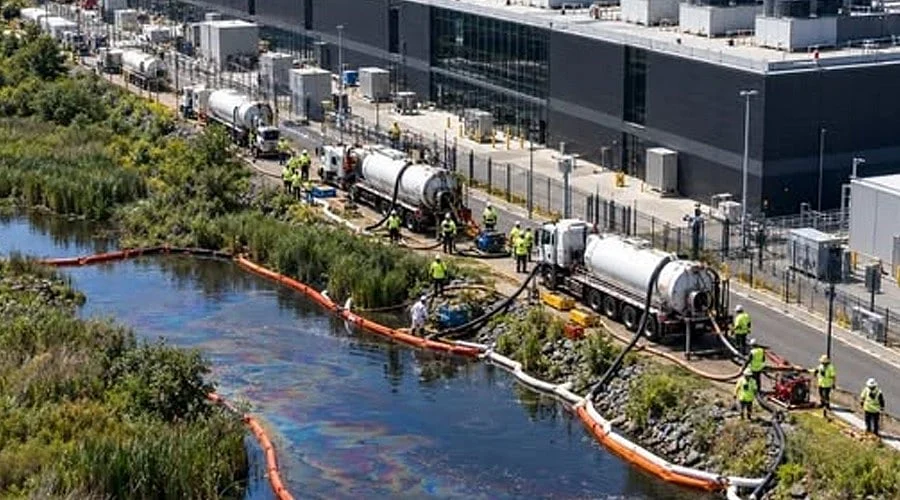
Approximately 5,000 gallons of diesel fuel leaked from an Equinix data center in Secaucus, New Jersey, flowing into a waterway connected to the Hackensack River. The incident at the company’s NY2 facility occurred on September 11. According to Equinix, personnel noticed the leak originating from a fuel storage tank and managed to shut it off promptly.
Remediation crews were deployed almost instantaneously. Authorities reported that while the diesel made its way into a nearby creek, it failed to reach the Hackensack River. Cleanup operations successfully recovered roughly 3,500 gallons. Furthermore, officials stated that no adverse impacts on local wildlife had been observed.
Accounts regarding the root cause of the leak initially varied. Secaucus Mayor Michael Gonnelli suggested a computer glitch might have been responsible. Subsequently, Equinix stated that two failed valves involved in a routine filtration procedure caused the spill, adding that a comprehensive report would be issued. In an official statement, the enterprise noted, “We regret that this occurred and the concern it caused the community.”
This event is not the region’s first data center fuel release. A Clifton facility leaked roughly 600 gallons back in 2017, while an Equinix location in North Bergen spilled about 1,800 gallons in 2022, making this recent occurrence significantly larger.
Also Read: How Gautam Adani is Investing in Data Centers and Digital Infrastructure
Data Center Growth Means More Fuel
As the construction of new data centers accelerates, the demand for emergency backup power increases correspondingly. Data presented in the report indicates that diesel generator capacity across data centers expanded from 20 gigawatts in 2018 to 55 gigawatts in 2024.
The Equinix incident highlights that maintaining continuous server operations is only one facet of overall data center safety. The infrastructure designed to guarantee uptime requires meticulous management, since a fuel leak may leave internal servers uninterrupted while creating significant environmental hazards outside the building.