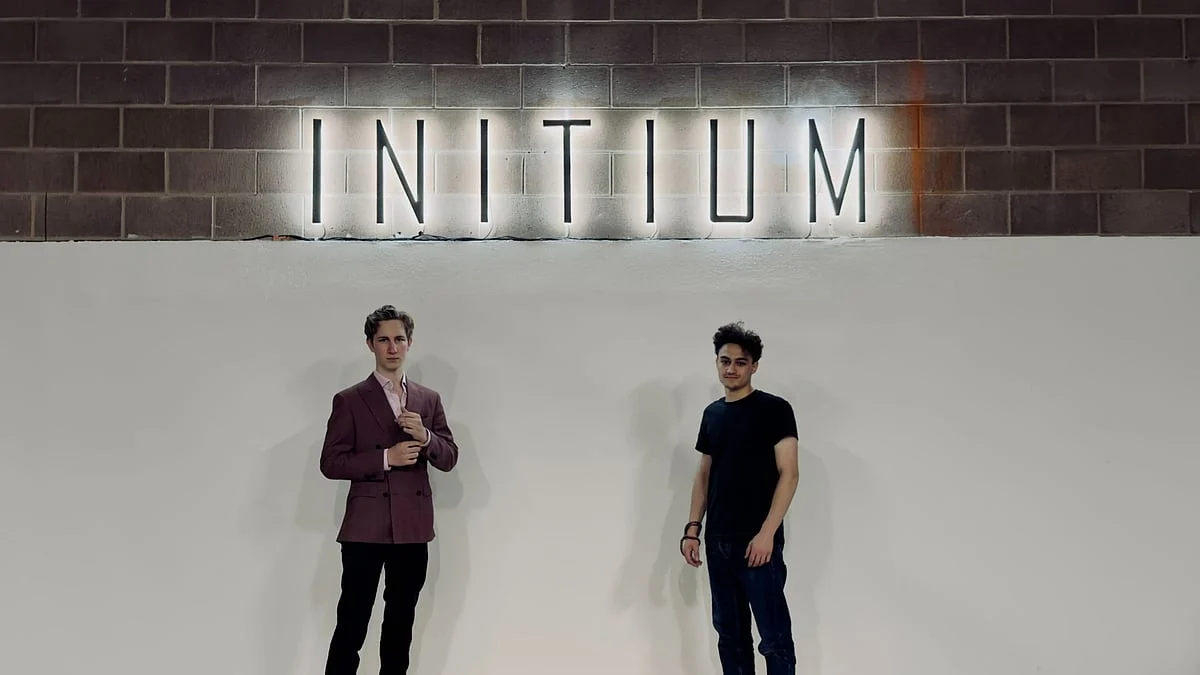
At Initium Technologies, Scheibye leads an engineering team that develops edge artificial intelligence systems for military settings where limitless compute remains unavailable.
An artificial intelligence model can succeed in testing yet prove entirely unsuited for a deployed defense system if the surrounding hardware, software stack, and operating conditions are unable to support it. Conrad Scheibye addresses this challenge by focusing on the complete system. Serving as the co-founder and CTO of Initium Technologies, he oversees the technical development of edge AI platforms built to process sensor data directly at the source, particularly in environments lacking reliable access to remote computing infrastructure.
Scheibye noted, “Deploying AI at the edge introduces constraints you don’t hit anywhere else, and they are opposite to what you experience when using cloud compute. Everyone sizes the problem around the accelerator. For us the accelerator is rarely what runs out first. It’s the video decode path, or memory bandwidth. The GPU sits half idle while something else is what’s actually capping you. None of this shows up in the cloud, where vCPUs and bandwidth are plentiful and the GPU is the only thing you’re really rationing.”
Commercial AI infrastructure routinely relies on centralized computing resources and dependable network connectivity, conditions that military operations cannot take for granted. Communications can be slow or intermittent, electronic warfare may disrupt links, massive sensor streams can quickly exhaust available bandwidth, and operational units may intentionally limit reachback to maintain stealth. These harsh realities dictate the system architecture right from the start.
As Scheibye explained, “In active theaters DDIL conditions and self-imposed reachback limitations are not uncommon. This prevents operators from using the cloud to run software capabilities. Edge compute systems allow them to leverage these otherwise unavailable capabilities to ensure mission success”
Thermal design illustrates how these engineering trade-offs manifest physically. Initium tests specialized enclosures capable of maintaining high-power computing modules within safe temperature thresholds across extreme environments ranging from deserts to tundras. Increasing compute power raises cooling demands, which in turn alters the physical profile of equipment designed to travel alongside a unit or mount onto a platform. The core technical hurdle is ensuring that the entire system delivers practical capability within the target operating environment.
The IRIS platform highlights this systems engineering challenge. Built as a backpack-mounted unit, it executes computer-vision tasks locally using existing camera feeds rather than relying on remote servers. IRIS presents a concrete hardware-software dilemma: model performance, processing power, thermal dynamics, and portability must all converge into durable equipment capable of operating reliably in the field.
“Being an operator-carried system, IRIS not only needs to function in its intended environment, but must be sufficiently ruggedized to survive the trip. For example, if a team inserts via a subsurface infiltration, IRIS needs to withstand the pressures felt at 30 FSW, despite never being used underwater,” Scheibye stated.
Meanwhile, MANTIS presents a distinct architectural choice. Engineered for aerial and maritime surveillance, where continuous sensor feeds easily overwhelm tactical bandwidth, its architecture pushes processing closer to the sensor. This enables the system to transmit only detections and geographic coordinates instead of forcing raw data to contend for limited communications channels.
That specific layout alters what must traverse the tactical connection. MANTIS is built to execute heightened processing near the sensor so that detections and geographic positions can be transmitted instead of the complete raw feed.
MANTIS originated during the early days of Initium, when Conrad independently developed the model to detect objects from drone feeds, alongside the geolocation capabilities and the STANAG 4609 encoder and decoder.
Initium frequently visits military installations across the United States to showcase its systems and collect feedback from potential users. These direct engagements continuously shape technical planning. Field requirements often expose flaws in architectural assumptions that fail during actual workflows, requiring technical leadership to adapt accordingly.
This is precisely where Scheibye’s role extends far beyond managing an individual subsystem. He must evaluate whether model performance, hardware capabilities, thermal management, communications constraints, and operator needs are successfully aligning into a field-ready asset. As CTO, Conrad decides whether the team’s specialized efforts have reached the point where the integrated system satisfies the rigorous operational demands established by its military end-users.