Overview:
-
The Fairphone Fairbuds 2 bring a repair-focused approach to the wireless earbuds market.
-
Alongside features such as active noise cancellation, LDAC audio support, Bluetooth 6.0 and multipoint connectivity, they offer replaceable earbud and charging-case batteries.
-
Learn about its design, sound features, battery performance, durability, US pricing and expected availability.
Wireless earbuds are typically easy to replace when they stop working. Finding a pair built to be repaired instead of discarded is a different challenge entirely. That concept forms the foundation of the Fairphone Fairbuds 2, the brand’s latest effort to merge everyday listening capabilities with a longer-lasting framework.
These new earbuds deliver enhancements in audio output, noise cancellation and battery endurance while maintaining a heavy focus on repairability. With a US debut slated for November, they present an attractive option for consumers seeking modern wireless sound without treating the hardware as disposable.
A Smaller Design With Repairability at Its Core
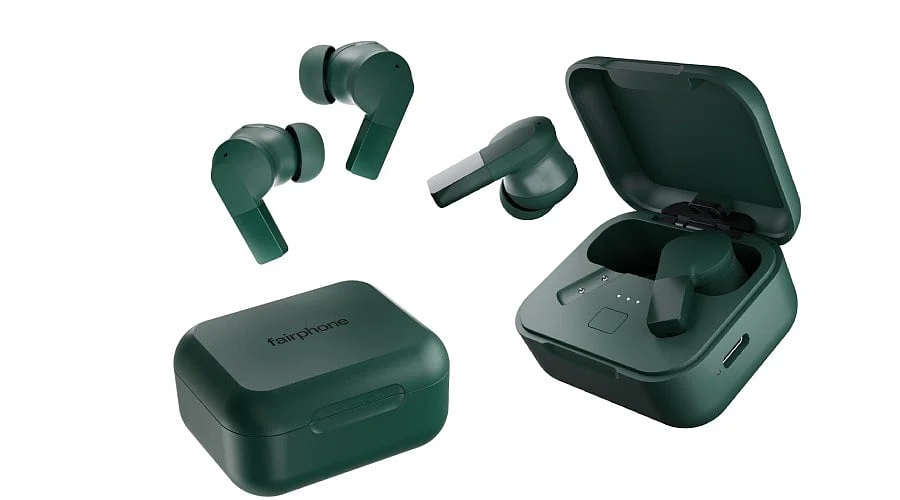
The Fairbuds 2 feature a more compact and lightweight build than their predecessors, accompanied by a charging case designed to hold the earbuds securely. They will launch in Horizon Black and Forest Green, offering two subtle color choices.
Their standout attribute, however, is their modularity when components degrade. Fairphone notes that seven parts are user-swappable, including the batteries inside both earbuds and the charging case, the case exterior and the individual earbuds themselves. Consequently, a broken or lost piece does not necessitate purchasing an entirely new unit.
Additionally, the manufacturer emphasizes a PFAS-free exterior along with the incorporation of fair and recycled materials. For environmentally conscious purchasers worried about electronic waste, these design choices constitute a core element of the product’s appeal rather than a mere secondary marketing point.
Also Read: Amazon Great Indian Festival 2026: Best TWS Earbuds Deals
Sound Quality Gets an Upgrade
Focusing on repairability would matter little if the acoustic performance proved disappointing. To prevent this, Fairphone outfitted the Fairbuds 2 with 11mm bio-cellulose dynamic drivers engineered to produce deeper bass responses, warmer midrange frequencies and crisp highs.
The earbuds also incorporate support for LDAC, a Bluetooth codec capable of streaming higher-bitrate audio on compatible hardware. Listeners using supported Android smartphones can leverage this capability, though real-world audio fidelity will ultimately depend on source files, configurations and playback equipment.
The companion Fairphone app, compatible with Android and iOS devices, provides four audio presets alongside a five-band equalizer. This grants users manual oversight over the sound signature rather than forcing them to rely exclusively on the default tuning.
Battery Life and Charging: What to Expect
Battery life represents another domain where this latest generation achieves tangible progress. Fairphone estimates the Fairbuds 2 can deliver up to eight hours of continuous playback on a single charge when active noise cancellation (ANC) is turned off. Combined with the charging case, aggregate playback extends up to 40 hours.
Enabling ANC drops the standalone earbuds runtime down to roughly six hours. Actual results will fluctuate based on volume levels, signal stability and usage habits, meaning these metrics should be viewed as maximum potential figures rather than guaranteed daily benchmarks.
For moments when time is tight, a ten-minute quick charge yields approximately 1.5 hours of listening time, per Fairphone’s official specifications. More importantly, both the individual earbud cells and the case battery can be swapped out. Because battery degradation typically drives the disposal of wireless audio gear, the ability to replace these power units can significantly prolong the operational lifespan of the device.
Also Read: Sony LinkBuds Clip vs Sennheiser Accentum TWS: Which Wireless Earbuds Offer Better Value?
Noise Cancellation and Everyday Connectivity
The Fairbuds 2 utilize hybrid active noise cancellation rated to diminish environmental sound by up to 45dB. A six-microphone array facilitates clear phone calls and manages ambient background noise, while a transparency mode lets users tune back into their surroundings when necessary.
Wireless connectivity has likewise been upgraded to Bluetooth 6.0. Multipoint functionality allows the earbuds to stay linked to two separate active hardware sources simultaneously, simplifying transitions between a phone and a laptop. Users can store up to six paired devices in memory, and Google Fast Pair streamlines initial pairing with compatible Android devices.
An IP54 ingress protection rating guards against dust and water splashes, rendering the earbuds suitable for daily commutes and exercise sessions. Because they are not fully waterproof, however, swimming or showering with them remains discouraged.
Fairbuds 2 US Price and Launch Details
Fairphone has priced the Fairbuds 2 at USD 119.99 on its American web store, with general availability projected for November 2026 via the official Fairphone US channel and designated retail partners. Interested buyers should consult the official listing to confirm current stock and purchasing guidelines.
Furthermore, the company promotes warranty coverage extending up to three years, subject to specific conditions. This forms a practical addition for hardware anchored around a promise of long-term durability.
You May Also Like
Best Noise-Cancelling Earbuds to Buy in 2026
Qualcomm Snapdragon Sound Elite Gen 2 Brings AI to Earbuds
Best Wearable Gadgets for Travel: Smartwatches, Rings, Earbuds
Are the Fairbuds 2 Worth Buying?
The Fairbuds 2 target individuals who demand more than just robust audio reproduction and a portable charging capsule. By blending LDAC capability, noise cancellation, multipoint linking and replaceable parts, they present a distinct alternative to standard mainstream wireless earbuds.
They still need to clear rigorous evaluations in independent sound and battery endurance tests. Nonetheless, for consumers who prioritize repair-friendly construction alongside daily utility, Fairphone’s newest creation offers a strong incentive to look past conventional audio brands.
FAQs
What are the Fairphone Fairbuds 2?
The Fairphone Fairbuds 2 are wireless earbuds engineered to merge everyday acoustic features with repair-focused architecture. They feature active noise cancellation, LDAC support, Bluetooth 6.0 and modular parts. Their emphasis on extended product longevity positions them as an alternative for shoppers seeking contemporary audio tech without discarding the entire unit when a single part breaks down.
What is the US price of the Fairphone Fairbuds 2?
Per the article details, Fairphone lists the Fairbuds 2 at $119.99 inside the United States. Prospective buyers are advised to review the official Fairphone US portal for up-to-date pricing, stock levels and ordering information, as launch terms and regional promotions can shift over time.
When will the Fairphone Fairbuds 2 launch in the US?
The Fairphone Fairbuds 2 are anticipated to hit the US market in November 2026 through the official Fairphone US online store and selected distribution partners. Stock availability may vary, so interested consumers should check the official product page for the latest release announcements.
How long does the Fairphone Fairbuds 2 battery last?
Fairphone evaluates the Fairbuds 2 for up to eight hours of listening capability with active noise cancellation deactivated. Utilizing the charging case boosts cumulative playback to 40 hours. Turning ANC on reduces standalone endurance to roughly six hours, though actual longevity relies on volume adjustments, connection stability and personal habits.
Do the Fairphone Fairbuds 2 have replaceable batteries?
Yes. Both the batteries inside the individual earbuds and the cell housed within the charging case are entirely replaceable. This structural choice permits users to combat natural battery fatigue without throwing away the entire piece of hardware, which helps minimize electronic waste and stretch out the product’s useful lifetime.