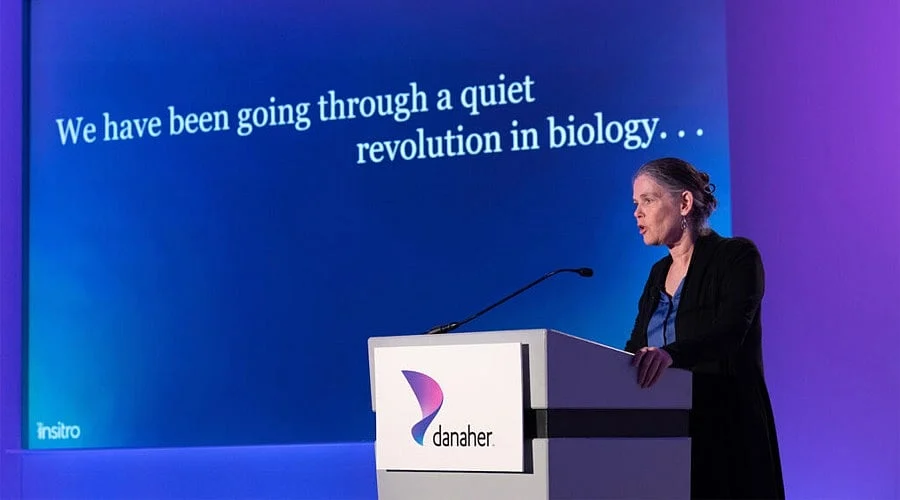
Danaher is scheduled to open its inaugural AI-driven autonomous research facility in early 2027. By integrating artificial intelligence, robotics, and connected laboratory equipment, the life sciences firm seeks to expedite the drug discovery process. Operating out of an Abcam facility, the lab will focus on creating custom antibodies and molecular tools at scale. Danaher anticipates the technology will speed up molecule discovery by as much as 8 times and target a tenfold boost in the production of annual target-binding molecules.
The Danaher AI research lab will integrate equipment from multiple operating companies into a single, cohesive workflow. Artificial intelligence will be employed to engineer molecules capable of binding to specific biological targets with enhanced accuracy.
Subsequently, robotics will manufacture and evaluate these designs, feeding the outcomes back into the AI system. Every testing iteration will serve to refine and improve subsequent rounds of molecular design.
This methodology establishes an unbroken design, make, test, and learn loop for lab research. Danaher projects that this framework will transition scientists from a starting concept to verified reagents at a much quicker pace. Furthermore, as operations scale, the company anticipates annual reagent output to grow from tens to hundreds.
According to JC Gutierrez-Ramos, the chief science officer at Danaher, accelerated cycles allow scientists to dedicate more attention to intricate problems. While automation manages routine laboratory tasks, human experts will retain control over essential scientific decisions. Consequently, the system merges the processing speed of machines with human critical thinking instead of substituting human expertise.
The facility will integrate solutions from Beckman Coulter Life Sciences, Cytiva, Genedata, Integrated DNA Technologies, and Molecular Devices. Additionally, Danaher is partnering with Automata to handle robotic orchestration and lab automation for the connected infrastructure.
This initiative is a component of a broader Danaher initiative centered on intelligent laboratory tools. Such systems are designed to produce AI-ready data and link devices via unified research pipelines. Danaher views autonomous laboratories as a means to render scientific experiments quicker, more reliable, and simpler to expand.
Within drug discovery, the most significant transformation may stem from rapid experimental feedback. Scientists will be able to assess a greater volume of molecular concepts while spending less time on manual laboratory chores. Ultimately, this approach could broaden target exploration and condense early-stage research timelines while maintaining continuous scientific supervision.
Also Read: AstraZeneca Bets USD 2 Billion on Summit’s Experimental Cancer Drug