When individuals select a news or data source, they rely on reputation. A recommendation from a trusted contact outweighs countless anonymous reviews, and a known entity beats an unknown one almost every time. Autonomous software agents are inheriting this exact shortcut—increasingly deciding which information to rely upon and act on—yet they do so without human judgment, operating at a velocity and scale that cannot be slowed down. As these agents begin researching, trading, booking, and executing payments independently, the reliability of the underlying data transforms from an academic concern into an essential foundation.
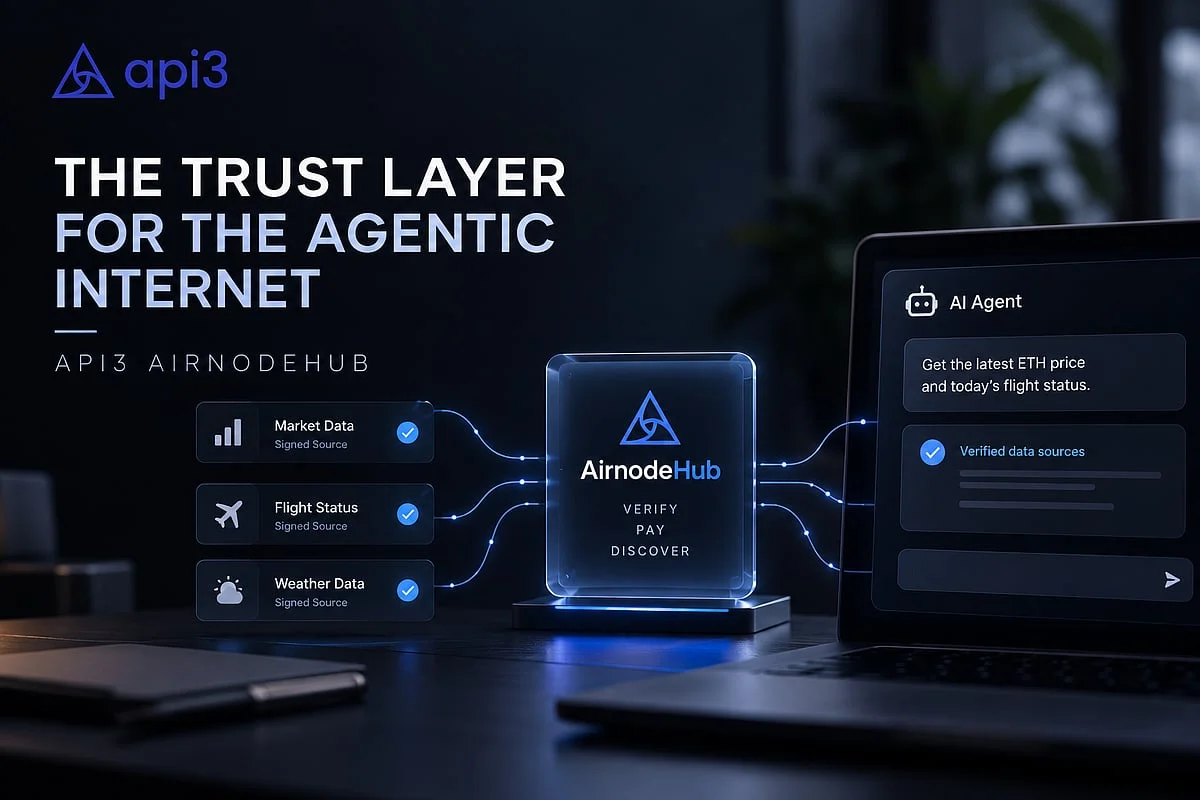
API3 addresses this exact vulnerability with AirnodeHub, an early-access marketplace designed to let AI agents discover, invoke, pay for, and verify APIs entirely without human intervention. The core premise is simple yet frequently overlooked: the vast majority of development in the agent economy targets the data consumer, while comparatively little attention goes to the producer. AirnodeHub is built on the conviction that the producer side is ultimately what matters most.
This challenge becomes apparent whenever an agent synthesizes an answer from multiple locations. It might fetch a flight status from one provider, a weather forecast from a second, and a pricing detail from a third, before combining them to execute a task. Every link in that chain represents a vulnerability where data origin can quietly vanish. When the output of a single API call serves as the input for the next, an early, unverified step taints everything that follows. While this poses little risk for casual tasks, it carries massive implications when an agent is handling financial transactions or binding commitments on a user’s behalf.
API3’s solution bypasses retrospective source-checking, instead requiring every data point to independently verify its own origin. This method relies on cryptography rather than reputation: the producing party digitally signs the response, enabling any consumer to validate the source using only a public key. While a reputable intermediary’s signature adds some value, a signature from the original source holds the highest weight because it confirms direct generation rather than mere relaying. Crucially, these signatures are composable, meaning an agent can carry each signature along a chain so that the final recipient can verify every foundational source.
This terrain is familiar to the project. API3 originally coined the term “first-party oracle” to describe data providers running their own infrastructure instead of routing information through third-party intermediaries, having operated production-level signed data feeds for years. AirnodeHub scales that concept beyond blockchain price feeds to encompass any API response, redirecting it from smart contracts toward AI agents.
The timing of this launch underscores a broader evolution in how data is procured. Agents discover services through machine-readable descriptions rather than marketing sites, pay per request rather than via seat licenses, settle transactions without manual approvals, and execute relentless call chains. Serving this automated buyer relies less on the data itself and more on the interface, discovery, and payment mechanisms—areas where most providers have historically lacked incentive to invest. A marketplace that manages these hurdles transforms a difficult, unglamorous challenge into a direct distribution channel targeting actual customers.
The rest of the industry has largely avoided this side of the issue for a clear reason: building for the data source is far more demanding than building for the consumer. It requires convincing hundreds of individual providers that a novel channel merits their attention, turning it into a relationship-driven endeavor rather than a purely technical one. Ultimately, data authenticity drives consumer-side success, and no technical shortcut can replace it. API3 frames the resulting outcome broadly as a dedicated data layer for the agentic internet.
Whether AirnodeHub ultimately becomes that foundational layer remains to be seen, and the project acknowledges that the product is currently in early access. Nevertheless, the launch materializes a thesis largely ignored by the broader industry: that the agent economy requires built-in data provenance as a core primitive rather than an afterthought, and that the most effective delivery method empowers the original source rather than intermediaries. Further details on the project and the marketplace are available at api3.org and airnodehub.api3.org.
About API3
API3 is a decentralized oracle project that bridges real-world data directly to blockchains and, increasingly, to AI agents through first-party, cryptographically signed data feeds. Having pioneered the first-party oracle model—where data providers manage their own oracle nodes instead of relying on third-party intermediaries—the project maintains over 100 data feeds across dozens of networks. Through its Oracle Extractable Value (OEV) mechanism, API3 redirects value generated by oracle updates back to the applications that produce it. Its newest initiative, AirnodeHub, applies this same source-signed data architecture to the emerging agent economy. Governed by the API3 DAO, the project can be explored further at api3.org and airnodehub.api3.org.