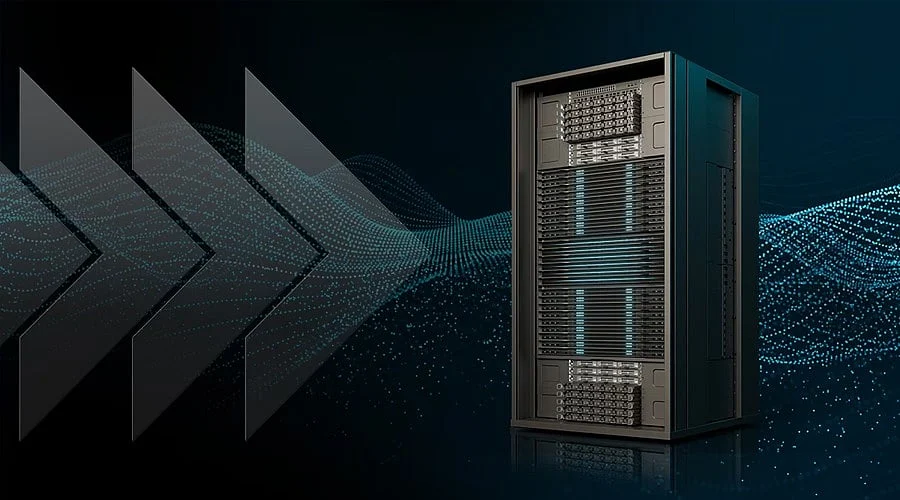
AMD has unveiled Helion, a novel rack-scale computing architecture designed to address the escalating infrastructure needs of agentic AI. Revealed on Monday, October 12, 2026, the platform provides enterprises and data center operators with enhanced flexibility to deploy AI agents capable of reasoning, utilizing tools, and carrying out multi-step processes with minimal human oversight.
Unlike traditional AI programs that mainly answer user prompts, agentic systems execute series of actions, typically demanding frequent model calls and heavy computational power. AMD Helion is built to tackle these requirements via a customizable server infrastructure powered by the firm’s processors and AI acceleration hardware.
Flexible Configurations for Different AI Workloads
Constructed around an open rack architecture that complies with Open Compute Project (OCP) standards, AMD Helion enables users to scale CPU core density, computational output, and power parameters to suit specific tasks.
The company detailed two main setups. A CPU-exclusive arrangement is designed for hyperscale environments that demand dedicated processing power for vast quantities of AI agents. Alternatively, a hybrid configuration merges CPU and GPU capabilities to support enterprise tasks requiring both general processing and accelerated AI functionality.
Up to 32,768 CPU Cores in One Rack
The CPU-only setup supports as many as 32,768 cores leveraging AMD’s sixth-generation EPYC processors, based on the official announcement. Meanwhile, the integrated variant pairs EPYC CPU nodes with AMD Instinct MI350P GPU nodes alongside general-purpose processing units.
Additionally, Helion accommodates both liquid-cooled and air-cooled setups, offering facilities flexibility depending on their existing infrastructure constraints. These options assist businesses in optimizing heavy AI tasks while balancing processing limits, energy use, and deployment parameters.
Open Software and Model Routing
A built-in token router represents another key capability, directing AI agent model queries across both open-source and frontier models. This mechanism assists enterprises in managing model usage throughout agent-driven operations.
Furthermore, AMD’s open-platform approach enables hardware vendors to build systems utilizing a shared framework. Among the companies backing the project are Cisco, Dell Technologies, HPE, Lenovo, Supermicro, QCT, Wiwynn, and Hon Hai Technology Group.
Also Read: AMD to Buy Fei-Fei Li’s World Labs in USD 8.2 Billion AI Deal
Availability and Industry Outlook
AMD stated that it is currently building Helion setups alongside ecosystem collaborators, with a commercial release slated for November 2026. The firm additionally plans to submit the blueprint to the Open Compute Project to foster broader industry adoption.
This release underscores the shift in AI infrastructure away from strictly GPU-dominated systems toward frameworks that integrate processors, accelerators, and software management. As enterprises increasingly utilize autonomous AI utilities, adaptable rack-scale platforms may prove essential for sustaining these operations.