Overview
-
Wi-Fi dongles supply internet access via SIM cards, which helps with remote work, travel, laptops, and backup connectivity.
-
Cellular network support, battery capacity, device compatibility, and Wi-Fi speed dictate everyday dongle performance.
-
Native 5G connectivity is distinct from 5G SIM compatibility, making supported network bands and modem specifications vital when picking a hotspot.
Most Amazon India entries for a Wi-Fi dongle under Rs. 3,000 feature a 4G/5G label. While this tag implies a bargain, it frequently describes the SIM card rather than the internal modem. Nevertheless, a portable Wi-Fi hotspot utilizing a SIM card remains helpful when broadband goes down.
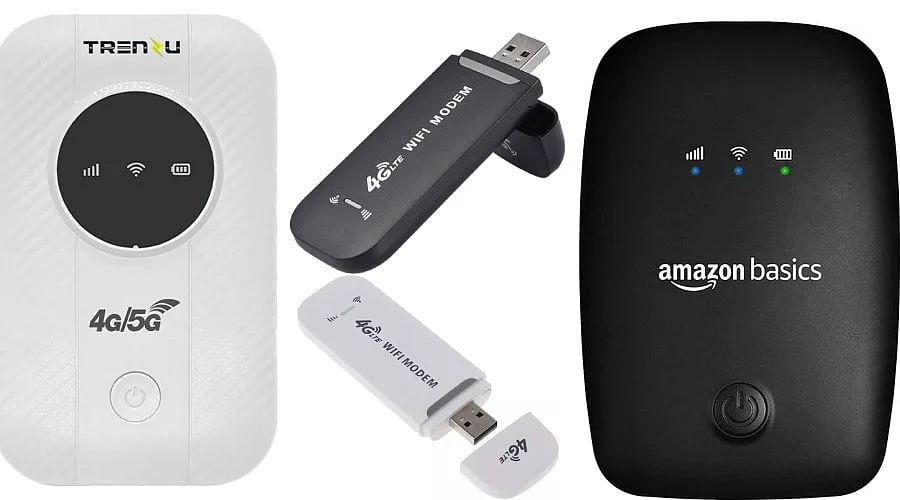
This overview evaluates four pocket hotspot and 4G LTE USB dongle choices, alongside clarifying what that 4G/5G label actually delivers.
How these deals were assessed: Ratings, specifications, and prices originate from Amazon India. Advertised speeds represent maximum limits rather than tested results. Because ratings and prices shift frequently, verifying the specific seller and model prior to purchase is recommended.
Quick Comparison
Amazon Basics 4G LTE Dongle: Best for Brand Familiarity
Listed at Rs. 2,299 against an MRP of Rs. 4,999, the Type-C variant holds 4.2 stars derived from 19 ratings, alongside 500+ units bought last month. A subsequent snapshot reflects around 4.0 stars from roughly 20 ratings, indicating an early score. Sibling variants, such as a 2200 mAh model priced at Rs. 2,449, also exist, so buyers should ensure the title matches the battery size before ordering.
Why buy: A built-in battery, Type-C charging, and a familiar brand.
Watch out: Look-alike sibling models and a low number of ratings.
Buy Now
Melbon T708 4G USB Dongle: Lowest-Cost Option
The white laptop version boasts 3.4 stars from approximately 470 ratings. One snapshot pegs it at Rs. 1,399, whereas a separate page lists it at Rs. 1,299. Lacking a listed battery, this USB stick requires a power bank, an adapter, or a laptop to function.
Although the listing labels it tri band without explanation, this phrasing likely points to cellular bands instead of three Wi-Fi bands. Past deal postings indicate prices between roughly Rs. 1,100 and Rs. 1,500 across 2024 and 2025, hitting Rs. 1,099 in January 2025. Today’s cost is standard rather than a record low.
Why buy: The most ratings and the lowest price.
Watch out: It functions as a USB stick rather than a standalone pocket hotspot, and holds average ratings.
Buy Now
GameSir 4G/5G LTE Dongle: Worth Considering for Battery Capacity
The listing advertises a 300 Mbps Wi-Fi hotspot, a 3000 mAh battery, and all-SIM support. The 300 Mbps metric applies exclusively to the Wi-Fi side, while 4G network speeds go unstated. Priced at Rs. 1,699 for the black colorway, alternative colors range from Rs. 1,799 to Rs. 1,899. Each variant carries merely 1 to 10 ratings, spanning 2.6 to 5.0 stars.
Reliability is unverified. While a larger battery presents a specification advantage, it does not guarantee extended runtime. Nearly identical specification text appears across NPTCL and PunnkFunnk listings—though it is an inference rather than a confirmed fact that these represent identical hardware under different names.
Why buy: A low price paired with higher battery capacity.
Watch out: Quality is difficult to gauge due to sparse ratings; performing a test on day one is advised.
Buy Now
Helett TravelFi Neo: Clearest About What It Is
Operating on 4G LTE while accepting 5G SIMs, the Helett TravelFi Neo features a SIM adapter, a 1.5-inch screen, a 2100 mAh battery, and speeds up to 150 Mbps. A category snapshot recorded a price of Rs. 2,443 against a Rs. 4,600 MRP.
Because Helett operates its own website, the product maintains a clearer identity than standard generic listings. With no ratings visible in the snapshot, recent reviews are essential. Given that Helett offers alternative TravelFi listings, confirming the Neo name is important.
Why buy: An on-device screen and transparent labeling.
Watch out: A mid-range price point and a lack of visible ratings so far.
Buy Now
Truth About 5G Dongles
Verifying genuine connectivity requires checking supported bands and modem specifications. The first three listings completely omit 5G modem details, leaving native 5G functionality unconfirmed. Additionally, the Hewlett-Packard listing explicitly notes that its 5G SIM support runs over a 4G LTE network.
True 5G hardware demands a much higher investment. An AUSHA 5G model spans Rs. 15,999 to Rs. 17,999 on Amazon India, whereas the Acer Connect M4 5G hotspot is priced at Rs. 22,999. A customer review for the Acer unit on a retailer page noted a 4G-only connection using a Jio SIM alongside better performance with Airtel; however, this is an isolated report rather than a confirmed compatibility issue.
Also Read: How to Fix Wi-Fi Problems in Windows 11: Easy Troubleshooting Steps
Buying Tips
-
USB stick or battery hotspot? A battery hotspot makes sharing among tablets and phones easier, whereas a USB stick suits a single laptop.
-
Check bands, not just speed. Sellers can provide supported LTE bands, which should align with your operator’s bands. Local signal strength outweighs the printed maximum speed.
-
Ignore MRP. Regardless of the selling price, the featured listings display MRPs spanning from Rs. 3,999 to Rs. 5,000, making “60% off” tags largely uninformative. Evaluating today’s price against its historical pricing is a safer approach.
-
Read the SIM line. One GameSir USB stick explicitly supports all networks except BSNL.
-
Test within the return window. Insert a SIM card, perform a speed test, and retain the packaging.
Also Read: Wi-Fi Mesh Software Support: What to Look For Before Buying
Final Thoughts
While India’s growing 5G ecosystem may eventually make native 5G hotspots more budget-friendly, shoppers should avoid paying extra for a label the hardware fails to back up. Prioritize checking real connectivity capabilities, supported network bands, and modem specifications before buying. Within this price bracket, verified 4G performance proves a wiser investment than an unproven 5G promise.
You May Also Like:
Wi-Fi 8 Arrives: TP-Link Unveils Next-Gen Routers at IFA 2026
Bluetooth vs Wi-Fi vs UWB: Which Wireless Technology Is Best for Connected Devices?
How to Speed Up an Old Wi-Fi Router Without Replacing it
FAQs
1. Is a “4G/5G” Wi-Fi dongle really 5G?
Usually, no. Frequently, the label simply indicates that the device accepts a 5G SIM card, while the internal modem operates on 4G LTE. Because native 5G requires a 5G modem, product titles matter less than specification sheets.
2. What is the difference between a USB dongle and a pocket hotspot?
A pocket hotspot features an independent battery to share its connection across multiple tablets and phones. Conversely, a USB dongle draws power from a power bank, an adapter, or a laptop, catering to a single device.
3. Does a bigger battery mean longer runtime?
Not necessarily. Although a 3000 mAh battery looks better on paper than a 2100 mAh unit, actual runtime depends on the hardware, the number of connected devices, and local signal strength. Because these devices were untested, runtime claims should be viewed as unconfirmed.
4. Will these dongles work with any SIM card?
While most listings advertise all-SIM compatibility, verification is required—for instance, one GameSir listing excludes BSNL. Furthermore, supported LTE bands must align with your operator’s bands, making testing with a SIM during the return window the safest practice.
5. Are the “60% off” discounts on Amazon real?
They offer little insight. These listings display MRPs between Rs. 3,999 and Rs. 5,000 irrespective of the actual price tag. Comparing current pricing against historical data on deal-tracking platforms is much more reliable.