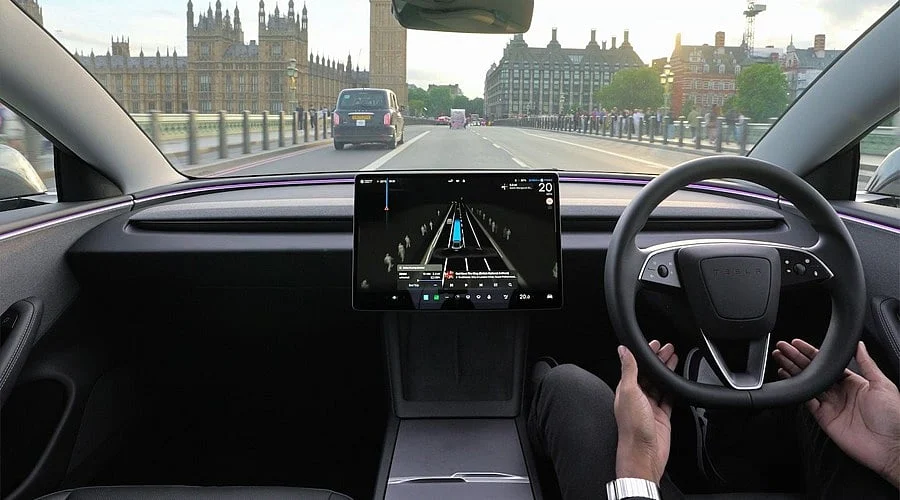
To address regulatory concerns and pursue wider approval for its technology, Tesla has updated the name of its Full Self-Driving (FSD) software to “Tesla Assisted Driving” on its European websites. The update came to light on Friday, October 9, 2026, following scrutiny from European authorities regarding whether the original terminology properly reflected the software’s actual functions.
This shift stems from talks with Germany’s transport ministry, which noted that Tesla volunteered to alter the name. The adjustment arrives as CEO Elon Musk aims to roll out the software more broadly throughout the European Union. Even with the updated branding, the technology continues to demand that drivers stay alert and prepared to assume control at any moment.
Tesla Changes Software Name Across Europe
Tesla’s online portals in Germany, Spain, the Netherlands, and Slovakia now feature the Tesla Assisted Driving designation. Meanwhile, the U.S. website maintains the Full Self-Driving (Supervised) label.
This renaming counters worries that the prior title might mistakenly convince motorists that the cars can function autonomously without human oversight. Although the software helps manage acceleration, braking, and steering, the driver retains full responsibility for vehicle operation.
For the electric vehicle manufacturer, this adjustment serves as a critical milestone in satisfying European regulators and growing its footprint within the region’s competitive driver-assistance market.
Regulators Challenge Tesla’s Marketing
Germany’s transport ministry pointed out that the Full Self-Driving moniker was deceptive because the software cannot manage the complete driving process on its own. Similar misgivings have emerged in other nations; for instance, Swedish consumer protection advocates urged the Swedish Transport Agency to evaluate whether Tesla’s promotional language might misinform purchasers about what the system can do.
Additionally, communications from the Italian government called into question whether the branding and marketing materials implied an automation level higher than what the technology delivers. While the updated name helps define the system’s function more clearly, it does not instantly settle broader debates surrounding performance, safety, or regulatory adherence.
EU-Wide Approval Still Pending
Tesla is actively pursuing wider authorization for its driver-assistance software throughout Europe. The system is already authorized in eight EU member states, and reports indicate Slovakia is poised to join them as the ninth.
Nonetheless, bloc-wide authorization is not yet guaranteed. An EU vote initially planned for October has been pushed back to December at the earliest as nations like France carry out further evaluations.
Furthermore, Tesla has urged supporters and car owners to reach out to regulatory bodies in favor of authorization. The final decision will heavily influence how extensively the company can deploy its software across European territories.
Also Read: Tesla Stock Rises as SpaceX Merger Talk Fuels Near-Term Upside
What the Rebranding Means for Drivers
The updated nomenclature brings no fresh driving functions, nor does it transform Tesla models into fully self-driving vehicles. Rather, it explicitly defines the software as a driver-assistance tool while the automaker presses forward with its authorization campaigns.
Securing deeper access to European markets stands to benefit Tesla’s technological roadmap and software-revenue ambitions. Conversely, regulators remain focused on ensuring that marketing aligns strictly with real-world capabilities and that motorists fully grasp their duty to drive safely.