Overview
-
Smart cat feeders demonstrate the complete IoT cycle: sensing, acting, reporting, and accepting new instructions.
-
Meal logs and portion controls provide owners with helpful signals, though dispensed food does not guarantee it has been eaten.
-
Past outages experienced by Petnet highlight how stored schedules and reliable alerts determine whether a feeder can be trusted.
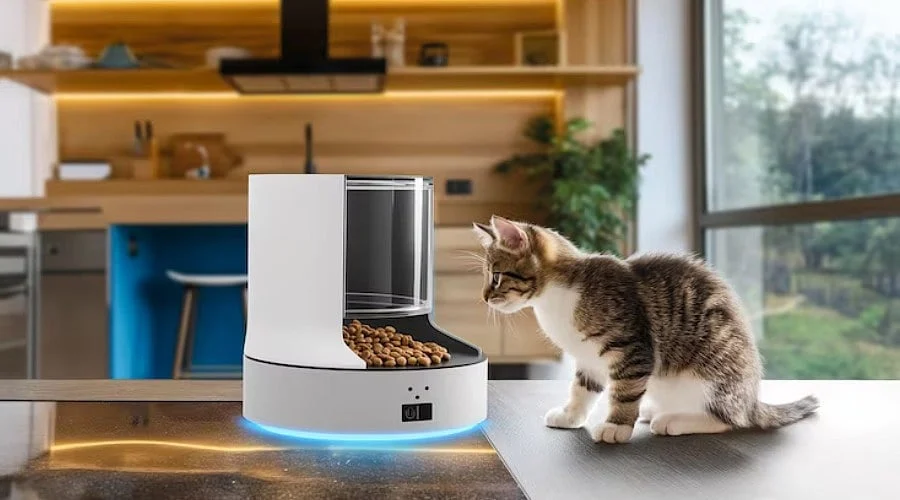
The reliability of any connected home is dictated by its smallest device, a reality clearly visible on the kitchen floor through the automatic smart cat feeder. It monitors conditions, adheres to scheduled programming, dispenses food, and transmits updates directly to a smartphone. Its true worth becomes evident when the internet connection drops, transforming a simple pet feeder into an instructive case study regarding IoT automation, control, and dependability.
What Makes a Feeder Smart
While a standard automatic feeder is simply a food dispenser paired with a timer, a smart feeder incorporates Wi-Fi connectivity, onboard sensors, a microcontroller, and a companion mobile application. Many of these units also include backup battery systems. Users configure meal times and portion sizes directly through the app. Because Wi-Fi alone is insufficient to classify a device as part of the Internet of Things, the table outlines the functional limits of each category.
How the Loop Works
Smart feeders continuously cycle through four distinct phases. First, the unit senses operating conditions, which may include monitoring food reserves or dispensing activity depending on the specific model. Next, the internal controller cross-references the internal clock with the programmed schedule while checking for potential errors. The motor then activates to release the designated portion. Finally, the application delivers a notification, such as “Breakfast dispensed at 8:00.”
This reporting mechanism prevents false assumptions. Without it, an owner might mistakenly believe a meal was served when it was not. By transmitting data to software, receiving updated commands, and notifying the user, the feeder transitions from a standalone appliance into a component of a broader ecosystem.
Portion Control and Routine
Cats thrive on consistent feeding schedules. When work schedules or travel disrupt a household, an automatic feeder maintains regular meal times. Appropriate meal frequencies and portion sizes vary based on a cat’s age, activity level, and overall health, factors best evaluated by a veterinarian.
Portion control serves as another primary advantage. According to a 2022 survey by the Association for Pet Obesity Prevention, 61% of cats evaluated at participating U.S. veterinary clinics fell into the overweight or obese category. Utilizing a scale to weigh food delivers much more consistent portions than guessing with a measuring scoop.
What the Data Can Show
The true value of these devices lies in their historical logs. Certain models track dispensing times, portion sizes, and bowl activity. However, food that is dispensed is not necessarily food that has been eaten, meaning the log serves merely as a clue rather than definitive proof.
Over extended periods, these records highlight behavioral patterns. Because felines are adept at masking symptoms of illness, alterations in feeding habits can serve as early warning signs that justify a consultation with a veterinarian. Furthermore, certain brands integrate their feeders with connected water fountains and litter boxes.
In these cases, a single application displays multiple habits concurrently. This broader IoT benefit stems from unifying disparate hardware into a shared stream of household telemetry. Prospective buyers should also verify which home apps and voice assistants are compatible with the feeder.
When the Cloud Fails
A server disruption impacted the Petnet SmartFeeder in July 2016, prompting instructions for owners to revert to manual feeding. The company attributed the failure to an unsupported third-party server. Lasting roughly ten hours, the outage prompted Petnet to develop a workaround to ensure devices could continue feeding independently during future server failures.
A separate disruption affecting second-generation units was documented in February 2020. Although Petnet stated that these feeders retained the ability to dispense food according to schedule, multiple customers reported that their hardware had ceased functioning entirely.
Petnet confirmed the restoration of the SmartFeeders on February 22. These disruptions underscore why clear alerts and independent backup schedules function as essential features rather than optional additions.
Additional risks are less conspicuous. Integrating a feeder introduces another connected endpoint to a home network and often transmits telemetry to the manufacturer’s servers. Consequently, account security, ongoing software updates, and data privacy policies should be evaluated during the purchasing process.
Cloud-dependent features also prompt long-term concerns regarding manufacturer support lifecycles. Dry food can occasionally cause mechanical jams, while wet food remains difficult to automate successfully. Ultimately, a feeder supports pet care but cannot replace fresh water, human interaction, or veterinary oversight.
Also Read: How Bosch Uses Industrial IoT to Power Smart Manufacturing
What Comes Next
Three primary trends currently define the market. Select feeders now feature facial recognition capabilities to identify individual cats within multi-dwelling households. Other solutions monitor shifts in the frequency and duration of eating sessions. Additionally, mobile applications are beginning to consolidate data feeds from feeders, water dispensers, and litter boxes.
This represents a broader transition from isolated hardware to interconnected pet-care networks. While a feeder provides one data point, fountains and litter boxes supply others, collectively outlining daily routines. Nevertheless, these remain monitoring tools rather than diagnostic instruments.
As sensors become increasingly affordable and applications integrate broader data streams, manufacturers that prioritize security updates and user data protection will secure the highest levels of consumer trust.
Also Read: Best Pet Tech Gadgets of 2026 Compared: AI Feeders, GPS Trackers, Cameras & Health Monitors
Final Thought
As domestic automation expands across home networks, the connected cat feeder serves as an early model. Hardware designed to care for living animals will inevitably be held to a significantly higher standard than devices intended merely to play audio or adjust lighting.
You May Also Like:
How BMW Uses IoT to Power its ConnectedDrive Ecosystem
How Siemens is Building the Smart Factory of the Future with IoT, AI, and Digital Twins
Top 10 Emerging IoT Trends for Smart Homes
FAQs
1. What makes a cat feeder smart?
A smart feeder features Wi-Fi connectivity, a mobile application, onboard sensors, and an internal controller. It is capable of monitoring conditions, dispensing meals on a schedule, reporting activity, and processing remote instructions—capabilities that distinguish it from basic timer-based alternatives.
2. Does a smart cat feeder work without the internet?
Functionality during an outage depends on product architecture. Models that cache schedules locally can continue dispensing food offline, though remote management and notifications typically pause until connectivity is restored. Historical incidents involving Petnet in 2016 and 2020 emphasize the importance of offline redundancy.
3. Can a smart feeder show that a cat has eaten?
Not definitively. Depending on the specific hardware, devices record feeding times, dispensed portions, and bowl interactions. Because dispensed food does not guarantee consumption, the logs serve as behavioral indicators rather than confirmation, though shifts in routine warrant discussion with a veterinarian.
4. Do smart feeders help with weight control?
They assist with portion management by measuring food by weight rather than relying on inconsistent scoops. A 2022 survey by the Association for Pet Obesity Prevention noted that 61% of cats evaluated at participating U.S. veterinary clinics were classified as overweight or obese, though specific dietary quantities should always be determined by a vet.
5. What risks come with a smart cat feeder?
Primary vulnerabilities include cloud server outages, data privacy concerns, and discontinued manufacturer support. Because feeders expand the footprint of a home network and may transmit data externally, and because dry food can jam while wet food resists automation, utilizing strong passwords and maintaining software updates helps mitigate these exposures.