

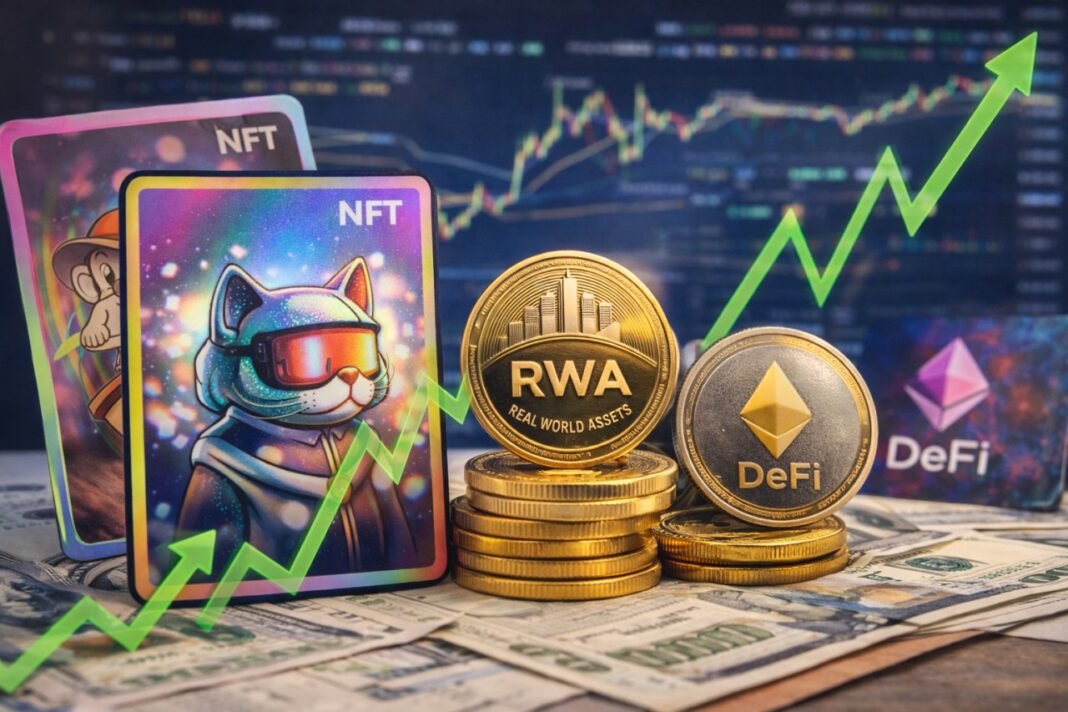
Crypto markets, for all their volatility, have an odd rhythm to them, like tides that turn just when traders stop watching. This week, that rhythm shifted again. A sector rotation quietly took hold across the industry, pulling liquidity out of memecoins and speculative trades and funneling it into more structured plays: NFTs, tokenized real-world assets (RWA), and DeFi yield markets.
On the surface, it looked like just another week of green candles. But under the hood, something different was brewing, a shift that says more about where crypto is heading than what it’s chasing.
The NFT pulse returns
It’s been nearly two years since the heyday of pixelated avatars and speculative mania. Yet, against the odds, NFTs are stirring again. Floor prices of legacy collections like Bored Ape Yacht Club and Azuki picked up more than 20% since early December, while volume on OpenSea rose nearly 40% week-over-week, its first multi-week climb since September.
But this isn’t 2021 redux. The activity isn’t fueled by celebrity drops or hype-driven mint runs. Instead, the new energy comes from utility-driven NFTs, ticketing, gaming assets, and loyalty systems integrated directly with consumer brands. Starbucks’ Odyssey program just reopened beta registration. Epic Games is onboarding another wave of blockchain-linked titles. Even Sotheby’s digital art division reported a surge in bids from Asian buyers.
“Liquidity is rotating toward collectibles that actually do something,” said Andrew Choi, lead analyst at Delphi Digital. “The speculative froth burned off. What’s left are assets with narrative and integration value, and traders finally care about fundamentals again, strange as that sounds.”
RWA: the institutional magnet
While art and gaming tokens grabbed the headlines, the real-world asset sector continued its slow, deliberate ascent. On-chain treasury protocols and tokenized bond platforms have attracted billions in inflows over the last quarter, according to data from 21.co. BlackRock’s BUIDL fund now holds over $6.7 billion in tokenized Treasuries, while smaller rivals like Ondo and Maple are seeing new user wallets triple since October.
The catalyst is clear: yield compression in traditional money markets has pushed institutional desks to explore blockchain liquidity vehicles. When overnight reverse repo rates cooled, tokenized T-bill pools suddenly looked attractive, 5% rates, real transparency, and instantaneous settlement.
It’s no longer a fringe DeFi experiment. It’s finance with a blockchain wrapper.
“This is what tokenization was supposed to look like, boring, stable, and profitable,” said a trader at a London fund allocating to RWAs for the first time. “We stopped treating it as ‘crypto exposure.’ It’s just efficient yield now.”
That normalization, where crypto is folded into financial infrastructure instead of being cast as its replacement, is what gives the RWA theme staying power. It also explains why some of the world’s largest banks, from J.P. Morgan to Citi, continue to issue tokenized debt on public or permissioned blockchain networks.
DeFi catches a second wind
Not to be outdone, DeFi protocols are back in rotation, too. After a brutal year of drawdowns and hacks, total value locked (TVL) across major decentralized platforms climbed above $120 billion, up nearly 25% since the start of Q4. Especially telling: much of that growth came from blue-chip protocols rather than new forks.
Aave’s GHO stablecoin regained its peg after governance tweaks; Curve’s volume returned to pre-hack levels; and Lido’s staked ETH pools set a new record, buoyed by steady inflows from institutional staking desks. Meanwhile, newcomers like Pendle and Ethena are riding the structured-product trend, tokenizing yield streams and synthetic dollars for traders who want the upside of leverage, without trusting an offshore exchange.
The result is a market settling into phases, not just chasing narratives. NFT holders want practical use; RWA investors want yield; DeFi degens want composable leverage. Remarkably, those goals no longer clash.
The anatomy of rotation
Each cycle of crypto has a favorite story: ICOs in 2017, DeFi summer in 2020, the metaverse rush in 2021, and liquid staking in 2023. Sector rotation is how the market breathes between them, shedding tired narratives, recycling liquidity, and rewarding builders who stayed when attention drifted elsewhere.
What’s different this time is correlation. Unlike past rotations, where money moved from one hype cycle to the next, the current shift feels more layered. NFTs, RWAs, and DeFi aren’t competing; they’re converging. A digital artwork can serve as collateral in an RWA protocol, earning a stable yield through an automated vault. A DeFi protocol can tokenize its treasury into NFT-backed bonds and sell exposure to institutions. The pipelines between sectors have started to merge.
“We’re finally seeing ecosystem liquidity, not tribal liquidity,” said Blockchain Capital partner Sarah Guo. “It’s modular finance now, the same capital moving through different containers.”
What the data shows
Blockchain analytics platform Nansen notes that NFT-to-stablecoin trading pairs have jumped 30%, indicating collectors are rotating profits into safety rather than cycling between meme tokens. DeFi’s share of total crypto market capitalization is back above 10%, still below its 2021 high, but rising steadily. And RWA protocols now account for $12.4 billion in cumulative value locked, almost quadruple a year ago.
Those aren’t numbers that scream mania; they whisper maturity.
A new equilibrium
The crypto market in late 2025 looks less like a casino and more like a small-but-serious capital market, humming with distinct sectors and risk profiles. NFTs are storytelling assets again, not just JPEGs with price tags. RWAs are bringing treasuries on-chain while teaching crypto how to grow up. And DeFi, after brushing up against regulation and bad headlines, is finding new ways to stay relevant without losing its experimental edge.
There’s still volatility, of course. There always is. But when you look closely, you see something steadier emerging beneath the churn, a market rotating not through hype cycles, but through functions. Things people actually use, build, and hold.