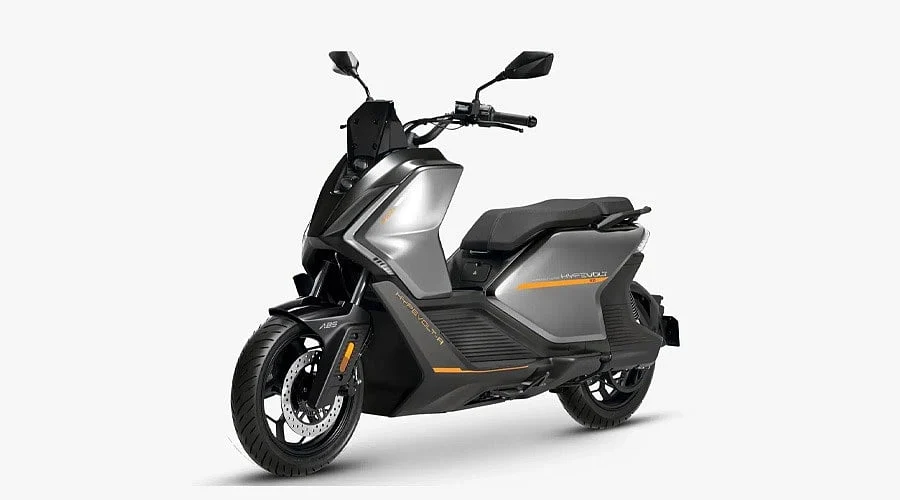
Key Takeaways:
-
The Hypevolt-R features a 12 kW peak motor, a top speed of 115 km/h, and 72 Nm of torque.
-
Its dual removable battery setup has a capacity of 5.04 kWh and carries an official IDC range rating of 180 km.
-
Real-world evaluations achieved 125 km, and a complete 0-to-100 percent charge took 6 hours and 15 minutes.
The Keeway Hypevolt-R blends daily usability with speed, range, swappable batteries, and advanced safety equipment. Priced at Rs. 1.99 Lakh ex-showroom, the Hypevolt-R is aimed directly at this sector. It distinguishes itself from standard urban EVs through its 5.04 kWh battery, 115 km/h top speed, 12 kW peak motor output, and 180 km IDC range.
A Rs. 1.99 Lakh Electric Scooter with Serious Hardware
Keeway lists the Hypevolt-R at Rs. 1.99 Lakh ex-showroom in India, alongside an advance booking amount of Rs. 5,000. The vehicle comes backed by a two-year vehicle warranty and a three-year battery warranty. According to one Delhi dealer quote, the on-road price sits close to Rs. 2.07 Lakh, though local taxes, insurance, and additional costs can modify the final total.
Propulsion comes from a mid-mounted permanent magnet synchronous motor delivering 6 kW of rated power and 12 kW of peak power. Torque tops out at 72 Nm, while the top speed reaches 115 km/h. Keeway specifies a 0-to-40 km/h acceleration time of 1.60 seconds when operating in Sport mode. Earlier launch communications mentioned a 2.3-second time for the same sprint, making the 1.60-second span the updated official metric.
The 180 km Range Needs Real-World Context
Equipped with an NMC battery setup comprising two removable packs totaling 5.04 kWh, the Hypevolt-R boasts an official IDC test cycle range of 180 km. Practical riding conditions, however, reveal a different outcome.
During real-world testing conducted by Autocar India, the scooter covered 125 km primarily in Normal mode. That performance equates to roughly 69 percent of the stated IDC figure. Variables such as traffic conditions, vehicle speed, rider mass, road gradients, ambient temperature, and selected ride modes can all influence the outcome, providing a more practical benchmark for everyday commuting than the laboratory metric alone.
The two-pack configuration introduces added convenience, permitting riders to extract the battery modules for remote recharging away from the scooter. Because each module weighs approximately 17.3 kg, carrying them up flights of stairs can prove demanding.
Also Read – India’s EV Push: Can it Overcome These Three Hurdles?
Speed Comes with Large-Scooter Practicality
Weighing 140 kg, the Hypevolt-R features a 770 mm seat height. Its stability-focused design is supported by 14-inch wheels and a dual-channel anti-lock braking system. Cargo capacity includes 27 liters of under-seat storage combined with 4.6 liters in the front compartment.
Autocar India timed the scooter in Sport mode from 0-to-80 km/h in 7.49 seconds, and 0-to-100 km/h in 13.05 seconds. These metrics align the Hypevolt-R much more closely with performance scooters than with low-speed urban commuters.
Safety Tech Sets the Hypevolt-R Apart
Keeway has integrated a comprehensive suite of electronic rider aids into the model. This collection includes blind-spot monitoring, a rear-facing camera, rear collision alerts, traction control, dual-channel ABS, hill-hold assist, hill-descent control, intelligent cruise control, reverse assist, and tire pressure monitoring.
The inclusion of a rear camera is particularly notable. Operating in tandem with mirror-based blind-spot warnings, it supplies the operator with an alternative perspective of trailing traffic. Connectivity features encompass Bluetooth, USB-A and USB-C ports, a TFT instrumentation panel, and over-the-air software updates.
Nonetheless, recent evaluations highlighted certain limitations. Autocar pointed out that the onboard dashboard does not display a standard range estimation directly; users must consult the mobile application for that data. Furthermore, adjustments for functions like traction control and energy regeneration must be managed via the app rather than through physical controls on the scooter itself.
Battery Charge Time and Battery Access Matter
While Keeway estimates a replenishment time of approximately three hours to move from 0 to 80 percent charge, Autocar recorded a duration of 6 hours and 15 minutes to achieve a full 0-to-100 percent charge. This discrepancy is significant for operators who rely on strict scheduling.
Additionally, testing revealed the presence of moisture, dirt, and debris within the battery storage bay following operation in wet weather, giving prospective buyers an item to examine closely.
Also Read – How EV Trends Will Change the Auto Market in 2027
A Different Kind of Electric Scooter
By pairing a 12 kW peak motor with dual removable 5.04 kWh batteries, a 115 km/h top speed, 27 liters of under-seat storage, and sophisticated safety electronics, the model carves out a distinct niche separate from conventional urban electric scooters.
Although the 180 km IDC rating differs from the 125 km real-world assessment, the scooter presents a compelling proposition at Rs. 1.99 Lakh ex-showroom through its robust hardware, velocity, cargo capacity, swappable power packs, and safety inclusions.
FAQs
1. What is the Keeway Hypevolt-R price?
The Keeway Hypevolt-R costs Rs. 1.99 Lakh ex-showroom in India.
2. What range does the Hypevolt-R offer?
Keeway claims 180 km under the IDC test cycle, while Autocar India recorded 125 km in a real-world test.
3. What is the top speed of the Hypevolt-R?
The electric scooter has a claimed top speed of 115 km/h.
4. Does the Keeway Hypevolt-R have removable batteries?
Yes. The 5.04 kWh battery system uses two removable battery packs.
5. How long does the Hypevolt-R take to charge?
Keeway claims about three hours for an 0-to-80 percent charge, while Autocar recorded 6 hours and 15 minutes for a full charge.