Overview:
-
Global tech companies eliminated nearly 154,000 jobs during the first half of 2026, even as many continued to recruit personnel with AI expertise.
-
Artificial intelligence is frequently cited as the catalyst for reductions despite businesses acknowledging practices like “AI washing.”
-
Entry-level positions experience the heaviest burden, underscoring the necessity of reskilling and transparent planning for both employees and organizations.
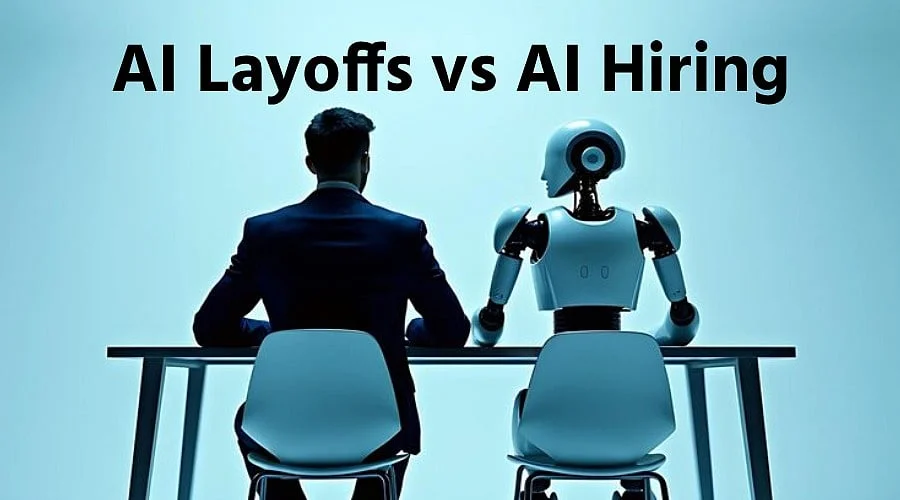
The simultaneous occurrence of artificial intelligence-related reductions and recruitment defines modern corporate strategies. Organizations eliminate positions in specific divisions while creating new ones elsewhere, driving rapid workforce restructuring. Global tech enterprises reduced headcount by nearly 154,000 during the initial six months of 2026 while concurrently seeking professionals skilled in artificial intelligence. This report examines the data, the underlying drivers, and the implications for the workforce.
Tech Layoffs in 2026 Show the Scale
Oracle registers the highest volume of workforce reductions this year, exceeding 25,000 positions. Microsoft eliminated approximately 5,500 jobs, representing roughly 2.5% of its total workforce of 220,000. Meanwhile, Meta and Cognizant explicitly connected their staff reductions to artificial intelligence.
A single analysis identified over 39,000 artificial intelligence-driven tech layoffs through 2026, accounting for nearly half of the 84,223 monitored reductions. Social media companies have cut more than 4,000 positions since January. Furthermore, an independent report noted that artificial intelligence was referenced in approximately 23% of all reduction announcements issued in 2026.
AI Hiring Is Growing in New Areas
Personnel experiencing job losses and newly recruited staff frequently occupy different divisions within the same corporation. Industry analysts indicate that open positions increasingly target platform engineering, data management, and artificial intelligence deployment rather than serving as direct substitutes for eliminated jobs.
Data from Resume.org reveals that 92% of businesses intend to hire throughout 2026, notwithstanding the 55% that anticipate workforce reductions. This dynamic highlights the simultaneous nature of firing and hiring activities. Software enterprises such as Autodesk and Intuit are similarly reorganizing their teams around artificial intelligence.
AI Washing Blurs the Real Reason
Artificial intelligence does not drive every workforce reduction. Industry expert Savisheva cautions against “AI washing,” a practice where organizations attribute staff cuts to artificial intelligence to mask the correction of pandemic-era over-hiring or poor commercial decisions. A survey of 1,000 U.S. hiring managers conducted by Resume.org reinforces this perspective, revealing that nearly 60% of companies frame job cuts or hiring slowdowns as artificial intelligence-driven because it resonates better with stakeholders. Only 9% indicated that artificial intelligence had completely replaced specific roles, whereas 45% stated it partially decreased the demand for new staff.
Entry-Level Roles Feel the Pressure First
A study conducted by Motion Recruitment in 2026, as featured on CNBC, indicates that artificial intelligence is decelerating recruitment for entry-level and general IT positions while largely sparing senior personnel. Statistics from JobsPikr provide additional context, showing that tech reductions surpassed 45,000 during the initial quarter, with Amazon accounting for 52% of those figures. Insights from Resume.org imply that corporations leverage artificial intelligence more frequently as a mechanism to slow hiring rather than as a total replacement for human labor.
What Workers and Employers Can Do Next
Specialists emphasize that the fundamental challenge lies in adopting artificial intelligence responsibly to balance growth and workforce stability. Employers can retrain personnel prior to executing staff reductions, while workers can master artificial intelligence applications and develop capabilities in sectors attracting corporate capital.
One assessment noted that virtually every major technology enterprise commits substantial investments to artificial intelligence, though not all acknowledge it as the primary driver of their workforce cuts. Frequently, artificial intelligence represents one variable among multiple factors, including cost management and shifting priorities. Businesses must also maintain transparency regarding the authentic catalysts for job eliminations, as candor preserves institutional trust. Smaller enterprises can initiate transformations within a single team and evaluate outcomes before expanding broader modifications.
Conclusion
Artificial intelligence-related reductions and recruitment represent dual aspects of a singular economic evolution. Corporations are channeling financial resources and personnel toward artificial intelligence, leaving certain traditional roles behind. While statistical records confirm genuine staff reductions, they also demonstrate that artificial intelligence does not consistently serve as the root cause. Employees who cultivate modern skills and employers who strategize thoughtfully will maintain the strongest positioning as workforce restructuring persists.
FAQs
1. What are AI layoffs?
AI layoffs are job cuts that companies link to AI adoption, automation or a shift in spending toward AI.
2. Are companies still hiring while they lay off staff?
Yes. Many firms cut roles in some teams and hire in others, mainly in AI, platform engineering and data work.
3. What does AI washing mean?
It means a company blames AI for job cuts when the real reasons are cost control, over-hiring or weak business plans.
4. Which jobs face the most pressure from AI?
Entry-level and general IT roles are seeing slower hiring, according to a 2026 Motion Recruitment study.
5. How can workers prepare for AI-led restructuring?
They can learn AI tools, build skills in areas where company budgets are growing, and keep up with hiring trends in their field.