Key Takeaways –
-
Stronger structures: Thin metal shields and aluminum foam help absorb bird impacts while keeping aircraft lightweight.
-
Preventive technology: UV LED lights and visual cues aim to steer birds away before they reach aircraft.
-
Early detection: Radar gives airport teams and flight crews advance warning, especially during high-risk climb and approach phases.
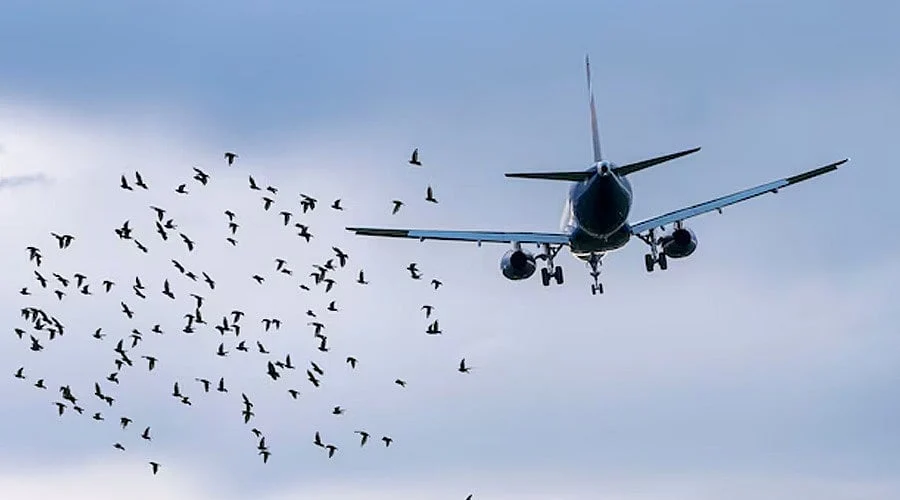
A US Airways jet suffered strikes in both engines from birds, leading pilots to land the aircraft on the Hudson River. This 2009 event is widely known as the Miracle on the Hudson and remains the most famous bird strike on record. While most incidents do not make the news, they accumulate rapidly, with a patent filing noting more than 7,500 reported civil aircraft strikes in 2008 alone. Engineers now tackle this challenge by both strengthening aircraft and deterring birds prior to impact.
A Thin Metal Shield and Aluminum Foam Absorb the Blow
Research from 2026 regarding a civil tiltrotor, the NGCTR-TD, incorporates a thin metal shield positioned between the leading edge’s outer skin and the front spar. According to the study, this shield protects local electrical and hydraulic lines without causing a substantial increase in structural mass.
Additionally, the researchers developed a reduced finite element model that discards negligible components while retaining the elements governing structural response to bird impacts, thereby reducing computer processing time during early design phases.
Weight constraints are even more critical for rotor blades. ERG Aerospace exhibited its Duocel aluminum foam at Verticon 2026 in Atlanta, held from March 9 to 12 at Booth 5303. The firm highlights the material’s strong impact resistance and low weight, targeting its use in helicopter and eVTOL (electric vertical takeoff and landing) blades.
UV Lights Flip the Usual Approach
Research into bird-strike avoidance was initiated by the Federal Aviation Administration (FAA) in 2015. Traditionally, the burden has fallen on pilots to spot birds and navigate around them, but the FAA’s latest initiatives reverse that dynamic.
By outfitting helicopters and planes with UV LED lights, birds are discouraged from approaching the aircraft. FAA engineer Dan Dellmyer anticipates an increase in strikes as skies become more crowded. He considers UV LEDs the premier option available today—superior to artificial intelligence and cloud-based tools—while emphasizing their low installation cost and ease of maintenance.
A corresponding US patent focuses on visual methods, detailing protective lights and reflective exterior paints for airplanes and rotorcraft, applied individually or together. The underlying principle is straightforward: just as lighting and color schemes assist pilots in identifying other aircraft, identical visual cues should help birds detect approaching aircraft.
Radar Gives Crews a Head Start
Situated along a major East Coast migration corridor, Dover Air Force Base in Delaware encounters an average of 25 bird strikes annually. Its wildlife hazard team utilized a 2006 DeTect Merlin XS2530 radar to monitor avian presence within a six-mile horizontal and vertical range.
Ron Merritt, former chief of the Bird/Wildlife Aircraft Strike Hazard team and current president of DeTect, stated that these displays enable control teams to react more swiftly and supply air traffic controllers with live advisories for flight crews.
A patented concept takes this further by introducing a system that alerts pilots and air traffic control (ATC) the moment a collision appears probable. It also connects units on all arriving and departing aircraft with airport-wide data to provide controllers with a comprehensive view of regional bird activity.
Also Read – Spirit Airlines Shuts Down After Failed USD 500 Million Rescue Deal Talks Collapse
Climb and Approach Remain the Weak Spots
The highest level of risk occurs during the most vulnerable flight phases. Speaking at the U.S. Aviation Wildlife Management Conference in Cleveland, which took place from August 4 to 6, TJ Nohara and R. Dolbeer of Accipiter Radar questioned whether existing technology can reduce strikes during climb and approach. Their presentation materials addressed engine-damage strikes spanning 2024 to 2026 alongside bird congestion alerts.
Defenses on the ground also face shortcomings. The Philippines recorded over 900 bird strikes in 2025, primarily at Ninoy Aquino International Airport and Davao International Airport. During a committee session, aviation officials reported that the Civil Aviation Authority of the Philippines (CAAP) depends on manual tactics such as lasers, flags, gas cannons, and firecrackers.
Describing the total as nearly one strike per day, Sen. JV Ejercito advocated for acoustic and sonic deterrent systems at vulnerable airports. He requested cost estimates from CAAP and the Department of Transportation to support funding allocations in the 2027 budget.
Also Read – How Airline Payment Solutions Are Transforming Global Travel Payments
Matching Each Tool to the Local Risk
While robust airframes merely mitigate collisions, radar and lighting systems can prevent them entirely. The optimal combination of measures will vary by location; UV lights offer a low-cost alternative to engine redesigns, whereas radar is most beneficial where large concentrations of birds gather. Airports that tailor their defense strategies to local risk profiles will achieve the greatest success.
FAQs
1. What is bird-strike protection in aircraft?
It combines structural reinforcement, impact-absorbing materials, detection systems, and bird-deterrent technologies to reduce the risk and severity of bird collisions.
2. How do UV lights prevent bird strikes?
UV LED systems make aircraft more noticeable or aversive to birds, encouraging them to move away before a collision occurs.
3. How does radar help prevent bird strikes?
Bird-detection radar tracks bird activity around airports and provides wildlife teams, controllers, and pilots with information that can support faster warnings and decisions.
4. Why are climb and approach particularly dangerous?
Aircraft operate at lower altitudes during these phases, where birds are more concentrated and pilots have less time to respond to sudden encounters.
5. Can bird-strike technology completely eliminate collisions?
No. The goal is to reduce both the frequency and consequences of strikes by combining prevention, early warning, and stronger aircraft structures.