Traditionally, smaller financial institutions have relied on correspondent banking relationships to handle cross-border payments. While these arrangements grant access to international markets, they frequently entail steep expenses, intricate compliance demands, and restricted choices along certain corridors.
Although stablecoins and other digital assets present an alternative settlement pathway, merely transferring value over a blockchain tells only part of the story. Financial institutions also require mechanisms to verify counterparties, synchronize transactions, mitigate risk, and satisfy regulatory requirements.
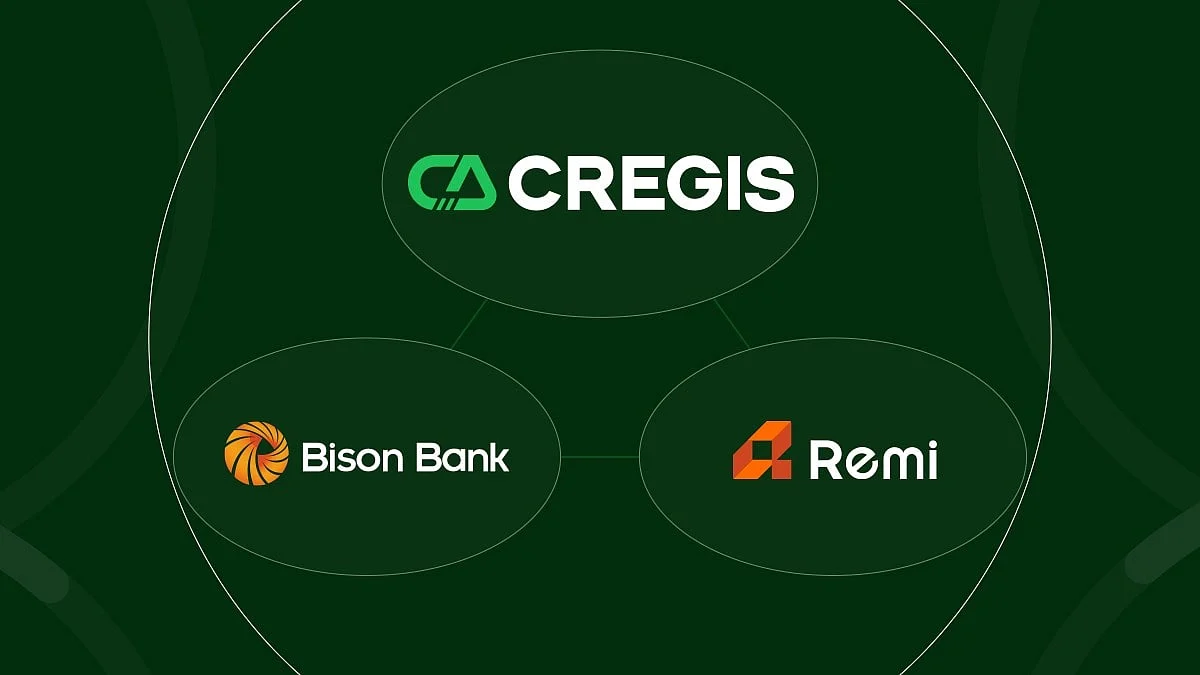
Cregis, Remi Technology, and Bison Bank are combining essential pillars of this framework: institutional connectivity, a regulated banking environment, and digital asset security and management.
Three Roles, One Network
Operating as a licensed Portuguese bank, Bison Bank establishes the core banking foundation. Singapore-based Remi Technology links institutions together while orchestrating transaction-related procedures, encompassing reconciliation, data exchange, and transaction tracking. Meanwhile, Cregis delivers the foundational infrastructure for digital asset management and security.
The Remi Network is built to handle operational and compliance routines, such as AML and KYC verifications, information sharing under the Travel Rule, and transaction monitoring. To safeguard digital assets and govern how they are accessed and transferred, Cregis employs advanced technologies including trusted execution environments (TEEs), hardware security modules (HSMs), and multi-party computation (MPC).
“Once digital assets enter regulated financial markets, institutions need more than secure ways to hold and transfer assets. They also need to bring those activities within their existing frameworks for access control, risk management, and governance,” said Cregis CEO Shawn Yan.
This distinction is critical because institutional settlement extends far beyond simple token transfers. Every transaction must seamlessly integrate into the approval workflows, controls, and record-keeping systems that financial institutions already depend upon.
From Token Issuance to Global Network
Bison Bank rolled out EUB and USB in May 2026, launching euro- and US dollar-linked electronic money tokens tailored for authorized institutional clients to facilitate digital asset settlements and transfers.
However, simply issuing a token does not automatically create an operational institutional payment network. Participants still require structured processes to coordinate settlement, exchange transaction data, and monitor activities across different organizations.
This is where the collective strengths of the partners align. Bison Bank supplies the regulated banking ecosystem, Remi handles transaction coordination and institutional connectivity, and Cregis provides the underlying digital asset management infrastructure.
“Each partner contributes a distinct part of the infrastructure needed to serve regulated financial institutions,” said Remi CEO Sam Su.
From Technology Vendor to Settlement Partner
The wider financial market is increasingly recognizing this demand. Projections from Artemis and McKinsey indicate that actual stablecoin payment volumes reached roughly $390 billion in 2025, which included approximately $226 billion dedicated to business-to-business (B2B) transactions. Although these numbers highlight an expansion beyond mere trading, broader uptake by financial institutions hinges on the successful integration of digital assets into established treasury, payment, and settlement operations.
While security remains a cornerstone of this challenge, it is not the sole factor. Institutions also demand transparent approval workflows, clearly defined accountabilities, and robust record-keeping capable of withstanding both internal and external scrutiny. A secure digital wallet on its own cannot fulfill all of these functions.
To help meet these demands, Cregis expanded its product lineup by launching Trust Vault in 2025, pushing deeper into institutional asset governance and custody. This platform facilitates the use, storage, and oversight of digital assets—including stablecoins—equipped with features that help enterprises govern access permissions, operational controls, and approvals.
By integrating these capabilities with Remi, the partnership embeds them within a broader network that links financial institutions together. It also underscores a wider transformation in how digital asset infrastructure providers operate: shifting from delivering isolated tools for individual businesses to supporting the interconnected processes and communications that enable institutions to transact directly with one another.
This evolution does not signal that blockchain-based settlement will entirely supplant correspondent banking. Traditional banking channels fulfill numerous functions beyond the mere transfer of funds, meaning any alternative must prove its capability to satisfy the risk, operational, and regulatory standards of institutions. Ultimately, long-term adoption will depend on how efficiently these networks perform in real-world conditions, which institutions decide to participate, and whether they deliver a viable solution for their targeted payment corridors.
Ultimately, the key question is not just whether digital assets can cross borders, but whether the participating institutions can establish dependable mechanisms to transact with one another around them. Successfully uniting the asset, the bank, and the settlement workflow is a vital step in achieving that goal.