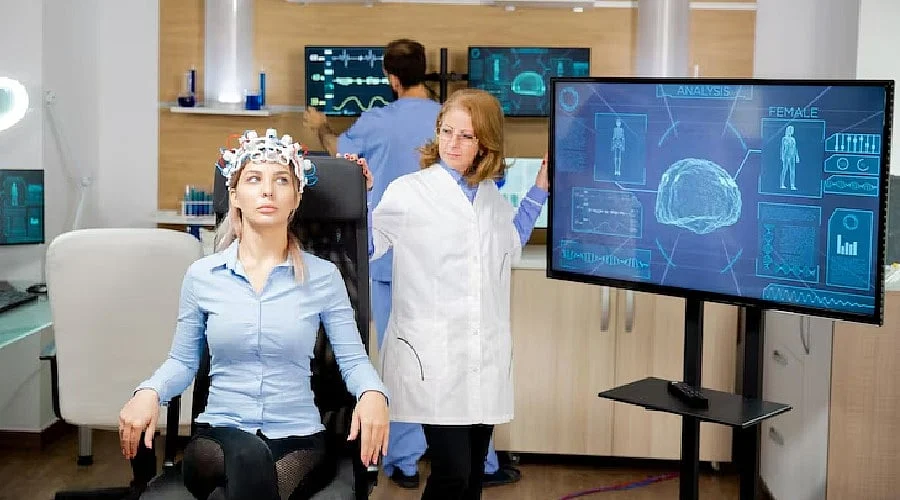
Overview
-
AI models analyse fMRI patterns alongside visual features to reconstruct images that broadly reflect what participants are viewing.
-
While generative models elevate image quality, newer systems are investigating the reconstruction of imagined or remembered visuals under careful experimental conditions and specific studies.
-
Potential uses span neuroscience and assistive communication, though significant hurdles remain regarding accuracy, training requirements, individual differences, computational costs, and mental privacy.
For decades, scientists have sought to understand how the brain converts electrical activity into the images we perceive. Artificial intelligence now offers researchers a novel approach to studying that mechanism by utilizing brain scans to reconstruct visual data.
Recent breakthroughs demonstrate that AI models can translate neural activity patterns into images that capture key elements of a person’s visual field. While this technology does not act as a direct window into the mind, it is developing into a potent instrument for examining how the brain represents scenes, objects, and meaning. In September 2026, researchers at the Weizmann Institute of Science introduced Brain-IT, an AI framework engineered to reconstruct viewed images from brain activity while demanding notably less training data for a new subject than previous methods.
How Brain Scan Data Becomes Images
Functional magnetic resonance imaging, or fMRI, serves as a foundational technology for this research. Unlike traditional MRIs that focus primarily on anatomy, fMRI tracks shifts in blood oxygenation tied to neural activity, letting scientists monitor which brain regions grow more active as a person views an image.
An fMRI scan does not yield a literal photograph of a thought. Instead, it creates intricate patterns spread across thousands of small three-dimensional elements known as voxels. AI models can learn the correlations connecting these patterns to the visual information shown to participants.
Researchers train a decoder by repeatedly matching brain scans with known images. Machine-learning algorithms then pinpoint statistical links between neural activity and traits such as shape, colour, spatial positioning, objects, and broader semantic significance. Once calibrated, the model takes in a new brain scan and forecasts the visual features embedded in that activity.
Generative AI Enhances Reconstruction
Generative AI has profoundly transformed this procedure. Older systems frequently depended on techniques like variational autoencoders and generative adversarial networks. Newer methods increasingly translate brain signals into latent representations—compact mathematical summaries of visual data—before passing them on to advanced image-generation models.
Diffusion models play a particularly vital role here. Rather than simply pulling an image from a database, they can synthesize a fresh image guided by information deduced from brain activity. Research published in the Journal of Big Data in 2026 highlights this pivot toward multi-stage systems that merge neural decoding with representations like VDVAE and CLIP prior to applying diffusion-based generation.
The Weizmann team’s Brain-IT addresses a major obstacle: scarce training data. Its architecture employs an encoder to predict brain activity from images alongside a decoder to reconstruct images from brain activity, helping generate extra training samples without necessitating that every single image be physically displayed to someone inside an MRI machine.
Viewing Versus Imagining an Image
A critical distinction lies in whether the brain reacts to an external object a person is actually seeing or to an internally generated picture.
Reconstructing a viewed image stands as the more established task currently. Because the system has a direct external stimulus, it can map out the relationship between that stimulus and the resulting neural response.
Decoding mental imagery is substantially more difficult. When individuals picture an object, their brain activity tends to be weaker, noisier, and less consistent than during actual sight. A 2026 study in PLOS Computational Biology noted that models succeeding at viewed-image reconstruction do not necessarily excel at mental imagery. Its MIRAGE system utilized multimodal text and image attributes alongside a diffusion model to boost the reconstruction of imagined visuals.
Also Read: AI Borrowing Boom: USD 80B Debt Wave Shakes Global Markets
Potential for Medicine and Brain-Computer Interfaces
Over time, this technology could aid brain-computer interfaces, assistive communication, and neuroscience research. For individuals suffering from severe paralysis or communication impairments, systems capable of decoding meaningful visual or conceptual content could provide an alternative avenue for expression.
Additionally, researchers might leverage reconstruction models to probe how distinct brain regions process meaning and visual elements. Recent studies indicate that AI representations can help model high-level data encoded within visual areas of the brain, offering fresh ways to investigate the ties between artificial and biological intelligence systems.
Persistent Major Limitations
Despite striking demonstrations, reconstructed images function as interpretations rather than exact recordings of thoughts. Because generative models are built to produce plausible visuals, AI systems can introduce details that were absent from the original stimulus.
Performance also fluctuates across individuals. Neural responses and brain anatomy vary, and fMRI inherently possesses limited temporal resolution. Assembling large, meticulously annotated datasets is costly, and training complex models demands heavy computational power. Furthermore, researchers are still testing how reliably these models generalize to unfamiliar people and images. A dataset study published in Nature Communications in 2026 underscored the necessity of evaluating models against visual stimuli that fall outside their training distribution.
The Question of Mental Privacy
As neural decoding systems advance, ethical dilemmas will take on heightened importance. Neural data can expose information regarding a person’s reactions and, potentially, elements of their internal experiences, thereby provoking questions surrounding informed consent, ownership of brain data, and authorization for analysis.
At present, the technology cannot freely extract a person’s thoughts. Most frameworks rely on specialized scanners, controlled experiments, and extensive model training. Yet, the prospect of increasingly advanced neural decoding makes mental privacy a challenge that policymakers, technology companies, and researchers will need to confront.
Consequently, AI-driven brain reconstruction marks a meaningful scientific milestone rather than the arrival of literal mind reading. By tying neural activity patterns to visual representations, investigators are securing a clearer view of how the brain handles what we see—and how artificial intelligence can help expose that hidden workflow.
Also Read: Mecka AI Raises USD 60 Million as Humanoid Robot Race Fuels Data Demand
FAQs
1. What is AI-based brain image reconstruction?
AI-based brain image reconstruction utilizes fMRI activity patterns to forecast visual data, allowing machine-learning models to generate images that broadly portray what participants see or imagine.
2. How does fMRI help AI reconstruct images?
fMRI measures shifts in blood oxygen tied to neural activity. AI models evaluate voxel patterns and learn correlations connecting brain activity to visual elements like colours, shapes, meanings, and objects.
3. Can AI reconstruct images that people imagine?
Yes, researchers are investigating the reconstruction of imagined images, though it remains tougher than decoding viewed images because mental imagery yields weaker, noisier, and less reliable brain signals.
4. What are the potential applications of this technology?
Potential uses cover neuroscience research, brain-computer interfaces, visual processing studies, and assistive communication. Eventually, the technology might supply alternative communication pathways for individuals with severe disabilities.
5. Does AI reconstruction mean scientists can read thoughts?
No. Contemporary systems demand controlled experiments, training data, computational models, and specialized fMRI scanners. Reconstructed images are merely interpretations and may incorporate generated details missing from the original thoughts.