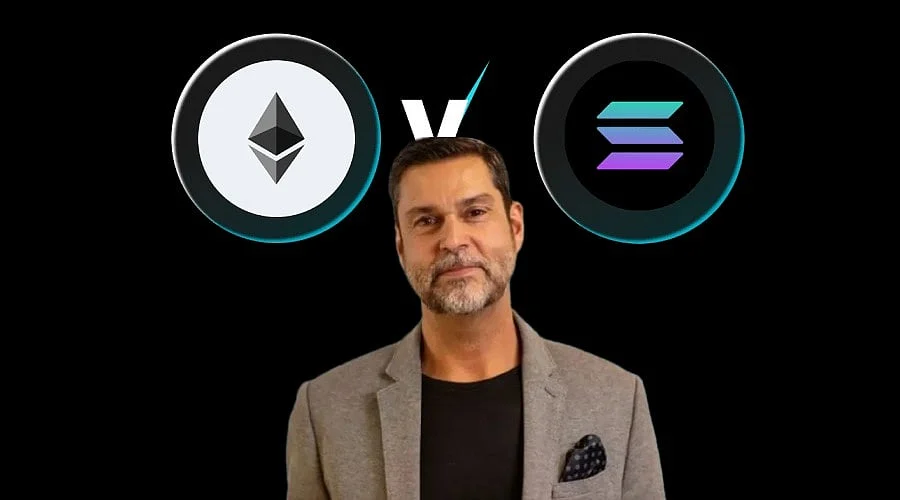
Real Vision founder Raoul Pal has suggested that Solana could potentially surpass Ethereum in total market capitalization, though he cautions that network activity alone will not settle the debate. Instead, he evaluates the two platforms by looking at capital concentration, financial engagement, user adoption, and token economics.
Speaking in a Cointelegraph Trade Secrets interview, Pal noted that Ethereum maintains approximately $200,000 in total value locked per active user, whereas Solana sits near the $2,500 mark.
These calculations divide decentralized finance (DeFi) TVL by active-user metrics, meaning the figures do not represent the actual personal deposits or net worth of an average Ethereum or Solana participant.
Ethereum Retains Greater Financial Depth
Placing greater emphasis on collateral, lending balances, and overall financial assets rather than frequent, low-value transactions, Pal characterized Ethereum as the financially deeper ecosystem while viewing much of Solana’s activity through the lens of speculation.
Data from DefiLlama on October 3 indicates that Ethereum holds significantly larger amounts of stablecoins and DeFi deposits than Solana, though both blockchains account for billions of dollars across these sectors.
Consequently, Solana’s balances demonstrate financial engagement that stretches beyond simple token trading. Because stablecoin supply figures alone cannot illustrate how participants put those assets to work, settlement infrastructure offers an alternative benchmark.
An April stablecoin settlement update from Visa includes both Ethereum and Solana in its pilot initiative, although the company does not disclose the specific transaction volumes processed on either chain.
Even so, the project demonstrates a tangible financial use case that goes beyond speculative trading, showing how stablecoins can facilitate cash management, borrowing, and payments alongside crypto-market activity.
TVL Per User Depends Heavily on Measurement
Because Pal did not disclose the precise datasets or timeframes behind his $200,000 and $2,500 estimates, those specific ratios cannot be independently reproduced using the interview data alone.
The resulting metric can shift dramatically depending on the chosen denominator. For instance, a network boasting $1 billion in DeFi alongside 10,000 active addresses would yield a TVL per active address of $100,000.
Should the active address count grow to 100,000 while TVL remains static, that ratio would drop to $10,000—meaning measured activity increases tenfold while total capital stays completely unchanged. This example also highlights why active addresses are not synonymous with individual users, as a single person can operate multiple addresses while a single service provider represents numerous customers.
Coin Metrics uses specific methodologies to issue address data, counting unique addresses that engage in defined ledger activities over a designated timeframe rather than verifying individual human identities.
Furthermore, fluctuations in token prices can alter TVL independently of new capital inflows. When deposited assets appreciate in value, dollar-denominated TVL increases automatically. To account for this, DefiLlama differentiates between underlying price shifts and organic asset inflows.
Read More: Is Solana a Smarter Investment Than Ethereum? SOL vs ETH
ETH and SOL Usage Feeds Different Token Mechanics
Network parameters also influence these comparisons. While Pal factors Ethereum’s layer-two ecosystem into his broader infrastructure thesis, evaluating mainnet-only metrics considers a much narrower pool of capital.
Mixing Ethereum and its layer-two scaling networks on the capital side while restricting the user count to mainnet participants would yield a skewed ratio. A precise evaluation requires maintaining consistent network boundaries on both sides of the equation.
Pal also emphasized adoption when analyzing low transaction costs, describing blockchains as foundational infrastructure rather than conventional enterprises. This perspective underscores why token economics are vital for understanding how network usage translates into value for investors.
Ethereum transactions require users to pay fees in ETH. The protocol burns the base fee while routing the priority fee directly to validators, tying transaction demand tightly to ETH usage and supply adjustments.
Solana similarly charges fees in SOL, burning half of the base component and allocating the remainder to validators, who also collect all priority fees.
While these models tie blockchain utilization to demand for native tokens, neither mechanism establishes a guaranteed, fixed correlation between transaction volume growth and token pricing.
Additionally, holders of ETH and SOL do not hold a direct claim on the revenue generated by individual applications, as protocols can scale on either network without distributing profits back to the investors of the underlying asset.
Conclusion
At present, Ethereum maintains the larger share of stablecoin and DeFi capital, whereas Solana pairs lower transaction costs with expanding financial applications. Assessing their investment potential demands consistent activity metrics, reliable capital retention figures, and a clear grasp of how network demand influences the token economics of both SOL and ETH.