

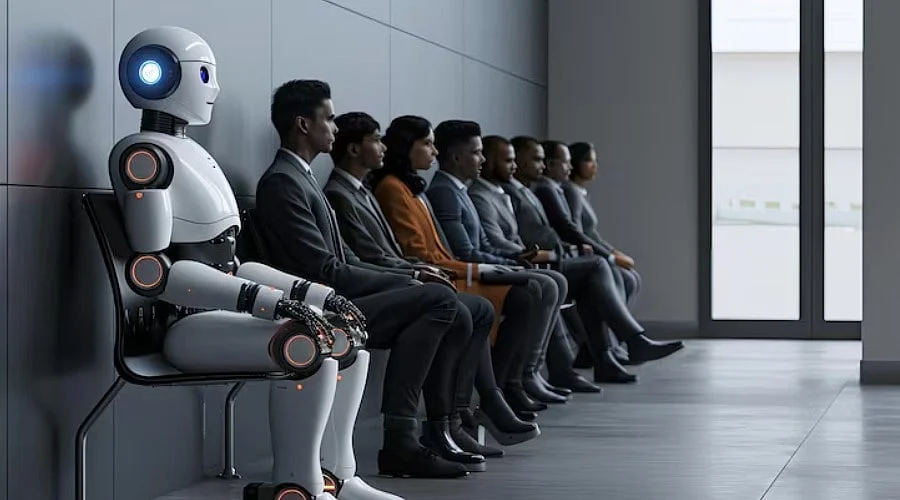
Artificial intelligence is increasingly integrated into daily operations. It assists teams with drafting emails, examining data, responding to customer inquiries, reviewing job applications, and handling everyday administrative duties. This transition extends beyond technology departments, transforming how various business functions operate.
However, as businesses discover additional applications for AI, a practical dilemma emerges: what should we let technology handle, and where do we still need people?
The solution is not to automate every possible task or to avoid automation completely. Instead, organizations must recognize where AI saves time and where human insight makes a genuine difference. This distinction is vital in recruitment, where a decision does more than simply fill an open role—it shapes an individual’s professional trajectory and an enterprise’s future trajectory.
Hiring Needs More Than Pattern Recognition
LinkedIn’s Future of Recruiting 2025 study revealed that 37% of surveyed organizations were incorporating generative AI into their recruitment processes, saving approximately 20% of their workweek, which demonstrates AI’s capacity to boost efficiency. Yet, faster hiring does not automatically equate to better hiring.
Recruiters can leverage AI to organize large candidate databases, identify profiles with relevant skills, draft job postings, schedule interviews, and manage standard correspondence. The technology can also recognize transferable skills even when they are not obvious from a previous job title alone.
A resume only captures part of a candidate’s story. For instance, consider someone transitioning from a customer support role to a data analysis position; even if their prior job title does not match the open role, their familiarity with customer behavior combined with newly acquired analytical capabilities can still make them a strong candidate. A system overly focused on past job titles or specific keywords may overlook this potential.
The same principle applies to individuals who have taken career breaks or transitioned between different industries; an unconventional career path does not signify an inability to succeed.
Recruiters should look beyond mere pattern recognition because structured interviews, relevant work samples, and discussions concerning a candidate’s learning agility help uncover strengths that a resume or an algorithm might otherwise miss.
What Companies Should Never Fully Automate
1. Decisions that can change someone’s career
Suppose an AI tool screens applicants for a technical opening and assigns a low ranking because a candidate’s background is from a smaller firm or a different sector. If the recruiter automatically discards the application based solely on that score, the organization risks missing out on someone who possesses the exact skills needed.
Although AI can help narrow down a candidate pool, final hiring choices must be made by humans who can review relevant experience, assess the evidence, and question a poorly advised recommendation.
2. Conversations that require empathy
Consider a candidate who took a two-year break to care for a family member. While an automated system may flag an employment gap, it cannot fairly evaluate the person’s circumstances based on that data point alone.
A recruiter can ask about the candidate’s current capabilities, recent learning, and readiness to return. This dialogue enables the individual to contextualize their career path rather than having their experience reduced to a gap on paper.
3. Judgements about potential, not just past performance
Imagine a mid-level professional who has not worked directly with a specific new AI tool but has a proven track record of mastering new systems and solving complex business challenges. A rigid selection protocol might favor an applicant who simply lists that tool on their resume.
A human evaluator can take a broader view by judging how swiftly the person acquires new abilities, whether existing skills transfer to the role, and what type of training could ensure their success.
4. Accountability for fairness and trust
When an employee is denied an opportunity or a candidate is rejected, the organization must be able to explain the reasoning behind the choice and audit it if necessary; it cannot simply blame an algorithm for the outcome.
While AI can aid decision-making, employers remain accountable for how systems are deployed, the data they process, and the results they yield.
The Risk of Automating Bias at Scale
Merely relying on data does not guarantee fairness. If a system is trained on historical hiring practices that favored specific backgrounds or career paths, it can replicate those patterns on a massive scale. Additionally, poorly configured screening parameters can disadvantage candidates whose experiences deviate from standard profiles.
Companies must continuously test their tools, audit results across different demographic groups, protect personal privacy, and mandate human review for questionable outcomes.
Building a Human-Led, AI-Assisted Workforce
For example, AI-driven talent platforms can help recruiters search beyond traditional candidate pools, match individuals based on skills rather than job titles, and spot adjacent abilities that might otherwise go unnoticed. When designed properly, such tools apply job-related criteria more consistently and reduce certain avenues for subjective screening.
Adopting technology does not automatically guarantee unbiased hiring; if underlying data or criteria are flawed, automation will simply amplify those issues more rapidly.
Consequently, platforms must feature clearly defined evaluation metrics, undergo routine audits for biased outcomes, and establish workflows that allow recruiters to challenge algorithmic recommendations.
Organizations should begin by evaluating specific tasks rather than automating entire jobs. Routine duties such as scheduling, data organization, and initial skill matching are well-suited for automation, whereas interviews, career discussions, and ultimate employment determinations require substantial human involvement.
Beyond time saved, companies should evaluate whether they are securing candidates with the right competencies, whether new hires perform well and remain with the firm longer, and whether applicants experience a fair and respectful process; these outcomes offer a much more reliable measure of whether AI is truly enhancing recruitment.
As AI becomes more prevalent, employees and recruiters will also need support to learn how to use it responsibly. The ultimate objective must be to free people from repetitive work so they can dedicate more energy to problem-solving, relationship-building, and context-driven decision-making.


