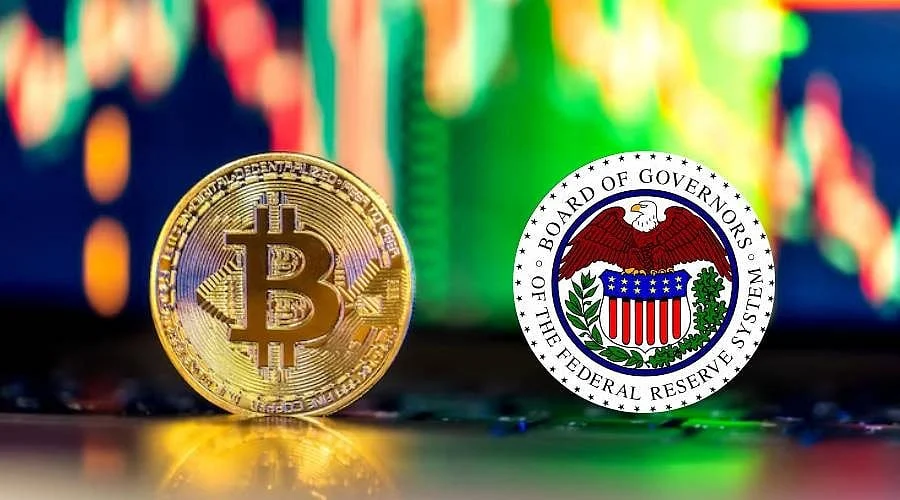
Although Bitcoin functions in a decentralized manner and apart from the Federal Reserve, its valuation remains sensitive to the actions of the U.S. central bank. Factors such as bond yields, inflation, liquidity, and shifting interest rates shape how market participants distribute capital between digital assets and traditional financial instruments.
Federal Reserve Raises Rates
On September 16, 2026, the Federal Reserve raised its target range for the federal funds rate by 25 basis points to 3.75%-4.00%. The central bank pointed to persistent inflation as the rationale, noting the adjustment would help guide inflation back toward the 2% target. This choice carries significance for Bitcoin because rate changes alter the yields available to investors in other markets.
Why Higher Rates Can Pressure Bitcoin
Bitcoin generates no guaranteed interest payouts. When cash equivalents, bonds, and Treasury bills provide elevated yields, market participants can secure solid returns without enduring the intense price swings characteristic of cryptocurrency.
Simultaneously, elevated borrowing expenses can diminish overall financial liquidity and curb speculative borrowing. Such dynamics frequently generate downward pressure across various risk-oriented sectors, including both equities and digital currencies.
Because institutional participation in Bitcoin continues to expand, broad macroeconomic indicators now impact BTC in tandem with conventional financial markets.
Why Lower Rates Can Support Risk Taking
As monetary policy loosens, the resulting environment can yield mixed outcomes. When interest rates fall, short-term government securities and cash provide diminished returns compared to earlier periods. Consequently, investors often pivot toward equities, commodities, and cryptocurrencies.
Furthermore, broader access to credit bolsters market liquidity. Even so, crypto prices do not automatically rally whenever rates decline, as shifting regulatory expectations can also heavily influence the market.
Inflation Creates a Complicated Relationship
Because Bitcoin has a strict supply cap of 21 million coins, analysts frequently draw parallels to scarce commodities like gold. Ongoing inflation can consequently enhance the allure of BTC among participants looking for instruments with a capped supply.
Conversely, unexpectedly stubborn inflation may prompt the Fed to implement further rate hikes. As a result, Bitcoin often contends with opposing forces: a compelling scarcity argument set against tightening monetary conditions.
Bitcoin has Independent Price Drivers
Central bank actions represent only one component influencing BTC valuations. Elements including institutional adoption, spot ETF activity, regulatory shifts, market leverage, mining economics, and the roughly four-year halving schedule all generate unique supply and demand dynamics within the crypto ecosystem. This explains why Bitcoin lacks a permanent, direct inverse correlation with interest rates.
Final Thoughts
Rather than directly altering Bitcoin’s underlying network, Fed policy impacts BTC through investor risk tolerance, borrowing expenses, liquidity levels, and bond yields. While rising rates heighten competition from yield-bearing alternatives, looser policy can stimulate risk-taking behavior. Nevertheless, given the influence of ETF inflows and native network fundamentals, monetary policy should be regarded as a major variable rather than an absolute predictor of BTC prices.
Also Read: EU Regulators Warn Quantum Computing Could Threaten Bitcoin Security
FAQs:
1. How do Federal Reserve interest rates affect Bitcoin?
Higher rates boost the appeal of cash and bonds while driving up borrowing costs and restricting liquidity. These shifts can diminish investor interest in high-volatility assets like Bitcoin.
2. Why can lower interest rates support Bitcoin prices?
Decreased rates lower the returns generated by cash and short-term government debt while typically enhancing financial liquidity. This dynamic prompts investors to allocate more capital toward risk assets, including crypto.
3. Does Bitcoin always fall when the Federal Reserve raises rates?
Not necessarily. Bitcoin’s trajectory is also shaped by regulation, institutional demand, ETF flows, leverage, and internal market conditions, which can occasionally override the impact of tighter monetary policy.
4. How does inflation affect Bitcoin?
Bitcoin’s 21 million BTC hard cap reinforces its reputation as a scarce asset during inflationary cycles. However, sustained inflation can also provoke central bank rate hikes, which may introduce headwinds for Bitcoin and other risk-on assets.
5. What other factors influence Bitcoin besides Federal Reserve policy?
Key drivers include spot ETF flows, broader institutional involvement, the halving cycle, mining economics, market liquidity, and regulatory updates. Thus, monetary policy serves as a significant influence rather than a sole indicator of price.