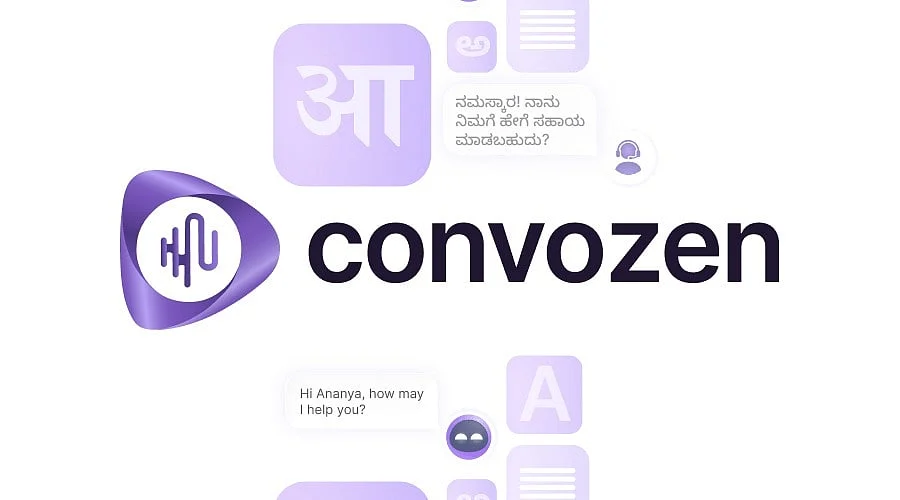
If you ask a customer in Mumbai which language they speak, the candid reply is usually all of them at once. A phrase like, "Aapka payment successfully process ho gaya hai but refund 24 hours mein reflect hoga," is neither strictly Hindi nor English. It is simply how India speaks. This seamless blending of languages within a single sentence is known as code-switching, and it is quietly undermining voice AI systems throughout the country. This piece outlines why code-switching voice AI has become essential for enterprises, where conventional speech technology falters, and how ConvoZen AI manages mixed-language customer interactions—from Hinglish speech recognition to native-language voice generation.
What Code-Switching Means in Indian Customer Calls
Code-switching occurs when a speaker alternates between two or more languages within a single conversation, or even a single sentence. Across India, this practice represents the standard rather than the exception. Depending on the topic, the speaker’s mood, and their audience, customers naturally weave English together with Hindi, Tamil, Telugu, Kannada, Marathi, or Bengali. Common contact center interactions routinely feature sentences such as, "Delivery kab tak aayega?" and "Balance kitna hai, please check?"
The fundamental challenge is that most speech recognition architectures were never designed for this reality. Western speech-to-text engines anticipate single-language audio streams, causing accuracy to plummet the moment a caller transitions from English to Hinglish mid-sentence. Words are misidentified and intent is obscured, forcing customers to repeat themselves—the quickest way to erode trust during a support interaction.
Why Traditional Voice AI Fails at Mixed-Language Calls
The majority of multilingual voice applications rely on a translation-heavy approach, forcing all incoming audio into English for transcription before translating it back. That processing pipeline strips away vital nuances, regional idioms, and colloquialisms—the exact cues that indicate whether a consumer is content or on the verge of churning. For instance, a customer stating "thoda adjust kar do na" is actively negotiating rather than making a standard request, a subtlety that rigid, textbook-grammar models miss entirely.
The commercial fallout is tangible. When voice infrastructure struggles with mixed-language speech, inquiries are misrouted and bots escalate calls to human agents unnecessarily. Vernacular speakers—frequently the largest and fastest-expanding demographic—end up with a degraded experience compared to English speakers. For enterprises, this manifests as a competitive vulnerability disguised as an infrastructure challenge.
How ConvoZen AI Handles Code-Switching in Customer Calls
ConvoZen AI was engineered specifically to solve this problem. Its multilingual agents support over 20 languages, delivering 95% NLU accuracy and native language comprehension across both voice and chat channels, encompassing English, Hindi, Arabic, and diverse Indian vernaculars. Rather than simply translating, these agents converse naturally: they seamlessly process complex code-switching like "Balance kitna hai please check?," dynamically detect and switch languages mid-utterance based on user preference, and interpret regional idioms and slang instead of relying solely on formal grammar. Organizations can train their agent logic once and deploy it instantaneously across multiple languages.
The platform’s underlying speech architecture is tailored to the realities of the Indian market. ConvoZen AI’s multilingual voicebot is trained on a wide array of local languages—including Hindi, Tamil, Bengali, Telugu, Marathi, and Kannada—and engineered to process code-mixed inputs like Hinglish while preserving the speaker’s cultural tone. For speech recognition, the Akshara model is optimized for diverse Indian accents and code-switching. On the voice generation side, the Ragini text-to-speech engine utilizes over 800 hours of Indian conversational audio across six languages, featuring sub-200ms first-byte latency and streaming synthesis built for live telephony, allowing English and Indian languages to flow naturally within the same utterance without jarring transitions.
This intelligence operates in reverse as well. ConvoZen AI’s cross-lingual analytics translate vernacular interactions into standardized English summaries, enabling quality assurance teams to review calls they might not personally speak and apply a unified evaluation rubric across Hindi, English, and Arabic agents simultaneously.
Proven Results Across Indian Industries
These capabilities are already deployed at scale, powering more than 40 million voice AI interactions every month across IVR, WhatsApp, mobile apps, and web channels within sectors where mixed-language calls dominate. In the banking and financial services sector, Jana Bank’s deployment of multilingual voice AI yielded a 10% improvement in resolution rates alongside a 7% boost in sales. In proptech, NoBroker Builders manages one million monthly voice calls on the platform, achieving an 8% increase in property visit conversions. Within direct-to-consumer retail, brand Pilgrim expanded bot-resolved inquiries by 73% while reducing agent transfers by 34%.
A clear trend emerges from these figures: automation succeeds when users are permitted to communicate in their natural vernacular—whether that is Hinglish, Tanglish, or any other blend. Industry data highlighted by ConvoZen AI indicates that multilingual bots can elevate user engagement by up to 40% because vernacular-first consumers finally receive an experience tailored to them.
What Indian Businesses Should Look For in Code-Switching Voice AI
Before selecting a multilingual voice technology platform in India, organizations should evaluate prospective solutions against specific criteria that determine practical success. Can the engine transition between languages within a single utterance without compromising pronunciation or prosody? Does it accurately articulate names, geographic locations, numerical figures, UPI IDs, and account details? Does it comprehend colloquialisms and slang, or is it limited to formal grammar? Is the audio response latency low enough for natural conversation? Furthermore, does the provider deliver enterprise-grade deployment options? ConvoZen AI, for example, operates via SaaS, private cloud, or on-premise environments, meets robust encryption standards—including the redaction of names and numbers in vernacular scripts—and integrates smoothly with legacy telephony, CRM, and core systems without requiring a complete overhaul.
India does not speak in a single tongue, and Indian customers should never be forced to do so either. Code-switching is not a peripheral edge case for voice technology in the region; it defines the marketplace itself. Enterprises that implement voice AI optimized for Hinglish recognition and native multilingual understanding will connect with consumers precisely how India talks, while competitors continue to lose callers to silence and unnecessary escalations. That exact gap is what ConvoZen AI was designed to bridge: mixed-language customer interactions understood naturally, answered instantly, and measured comprehensively. Explore how code-switching voice AI can elevate your customer experience by visiting ConvoZen AI today to see it in action within your own operational environment.