Overview:
Historically, manufacturing facilities relied primarily on human labor and rigid machinery to execute production duties. Today, intelligent robots examine items, transport supplies, identify flaws, and assist production personnel in making superior operational decisions, marking a fundamental shift in the sector.
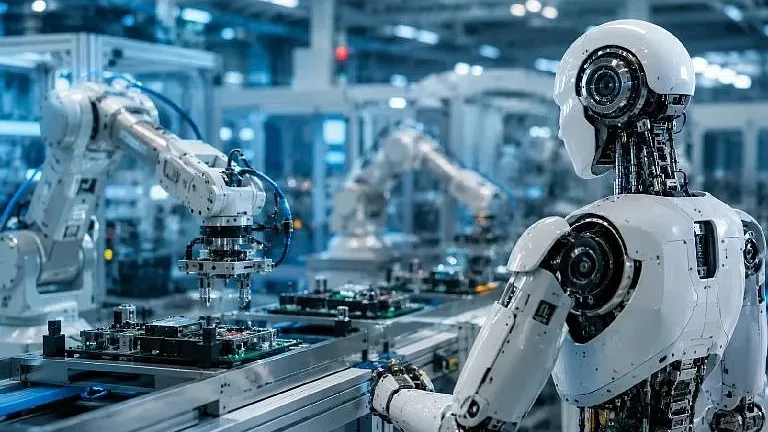
Artificial intelligence enables industrial robots to react dynamically to actual conditions on the shop floor rather than merely executing preset commands. Spanning everything from automotive assembly lines to semiconductor fabrication sites, AI-driven robotics is assuming a larger role in day-to-day operations.
Industrial Robots Reach New Records
Global demand for industrial machinery continues to rise. Based on data from the International Federation of Robotics (IFR), factories operated more than 5 million active industrial robots throughout 2025. Installations surpassed 600,000 new units that year, expanding the worldwide robot stock by 9%. The IFR projects yearly installations to climb to 655,000 in 2026.
China spearheaded deployment with 354,000 installations in 2025, accounting for 59% of worldwide totals. The United States registered nearly 38,500 units, representing a 12% increase. Japan reported 36,219 deployments, while South Korea accounted for approximately 30,000. India deployed nearly 10,500 units, achieving a 15% surge, whereas Germany fell below 25,000 units, registering an 8% drop.
Producers across major economies are clearly relying more heavily on mechanical systems for standard production duties. These figures also point to robust demand for equipment capable of executing intricate tasks reliably at consistent speeds.
Humanoid Robots Move Closer to Factory Work
Automotive and electronics corporations are showing intense curiosity regarding humanoid machines. Boston Dynamics and Hyundai have implemented a concrete initiative via the Robotics Metaplant Application Center situated in Georgia, USA. Launched in September 2026, the facility provides Atlas robots with an authentic production environment for training purposes. Initial duties encompass parts logistics, component handling, and material staging.
Similarly, Hexagon Robotics and Schaeffler are progressing with the AEON humanoid system. Their initiative utilizes a Train, Validate and Deploy framework, targeting the deployment of at least 1,000 AEON units across Schaeffler production sites over the next few years. The objective is to evaluate humanoid machines on assignments demanding greater physical range and adaptability than standard robotic arms can offer.
Certain operational limitations persist. Humanoid designs still require reduced expenses, enhanced dexterity, and dependable control mechanisms prior to undertaking a broad spectrum of assembly assignments.
Also Read – Top 10 Industrial Robotics Companies Leading Automation in 2026
AI Gives Robots Better Vision and Control
AI-enhanced machine vision assists automated units in intercepting flaws that human inspectors might overlook. Cameras paired with AI algorithms can evaluate surfaces, gauge dimensions, and detect missing components at high velocities, facilitating early identification of quality issues and minimizing material waste.
Autonomous mobile robots, known as AMRs, manage another vital function by conveying components, tools, and raw inputs across production floors without relying on fixed guide paths. They possess the capability to reroute when workers or machinery obstruct their path. Predictive maintenance platforms complement these capabilities by identifying early indicators of mechanical breakdown through heat, vibration, and pressure metrics.
Digital twins serve as an additional valuable asset. This technology creates a virtual simulation of an actual machine or manufacturing workflow, enabling engineers to trial modifications digitally prior to altering physical production lines.
Major Manufacturers Expand AI Factory Plans
During March 2026, Samsung Electronics revealed an initiative to convert all production facilities into AI-driven factories by the year 2030. The strategy covers material acquisition, assembly, quality control, and product dispatch, granting management teams enhanced supervision over the complete lifecycle.
Semiconductor manufacturing serves as a prominent example. Boston Dynamics and GlobalFoundries broadened their collaboration in November 2026 to deploy Spot inspection robots across semiconductor sites in the United States, Europe, and Asia. Spot has completed upwards of 90,000 evaluations in Singapore since April 2026, maintaining a stated mission success rate of 99%. GlobalFoundries also intends to pilot the Atlas humanoid model at its plants starting in early 2027.
Within the shipbuilding sector, HII finalized manufacturing pacts with Path Robotics and GrayMatter Robotics. The initiative could encompass up to USD 900 million in shipbuilding assignments across a seven-year span, contingent upon performance and readiness benchmarks, emphasizing sophisticated fabrication and assembly work.
India Gains Ground in Factory Automation
India has emerged as a significant destination for industrial robotics. Its 2025 total of nearly 10,500 units represented a 15% year-over-year increase. According to the IFR, the nation secured sixth place globally for annual robot deployments, with installations expanding at a compound annual growth rate of 27% between 2020 and 2025.
Automotive facilities continue to drive primary demand, while electronics, pharmaceuticals, industrial machinery, and warehousing present substantial growth avenues. Automotive brands utilize automated systems for welding, painting, and assembly. Electronics producers require precise inspection and component handling, whereas pharmaceutical operations apply automation toward packaging and product verification.
Furthermore, India possesses the potential to cultivate a larger footprint in robot engineering, software development, machine vision, and smart factory consulting services. Domestic technical proficiency and competitive system pricing will prove critical to this advancement.
Costs and Skills Still Matter
While robotics can elevate output, product standards, and staff safety, facility modernization demands meticulous strategy. Integrating novel hardware, sensors, software, and specialized technical support incurs expenses, and legacy infrastructure may lack compatibility with contemporary AI applications. Cybersecurity presents an additional concern as a greater number of plant machines link to digital networks.
A scarcity of qualified technicians can likewise decelerate initiatives. Enterprises require personnel capable of configuring mechanical units, auditing AI-generated outputs, servicing hardware, and overseeing secure human-machine collaboration. A prudent strategy involves initiating deployments with projects yielding evident value, such as defect screening or material transit, and scaling operations only after tangible returns materialize.
Also Read – Types of Deep Technology: Quantum Computing, Robotics, Biotechnology, and More
Smarter Factories Need Better Decisions
AI-driven robotics currently supplies manufacturers with benefits extending beyond accelerated machinery; it equips facility teams with superior methodologies for governing quality standards, minimizing equipment downtime, and executing intricate assembly tasks. The IFR anticipates annual robot deployments will hit 806,000 by 2029, signaling sustained expansion.
Nevertheless, optimal outcomes will stem from calculated decision-making rather than sheer machinery volume. Facilities that pair appropriate technologies with fitting applications can secure distinct advantages in cost efficiency, quality, and dependability. The ultimate metric of success remains the effectiveness with which humans, hardware, and artificial intelligence collaborate on the shop floor.
FAQs
1. How does AI transform manufacturing?
AI helps factories improve production, detect product defects, predict machine failures, manage materials, and make better decisions through data analysis.
2. What are AI-powered industrial robots?
These are robots that use artificial intelligence, sensors, and cameras to understand factory conditions and perform tasks with greater flexibility and accuracy.
3. What role do humanoid robots play in manufacturing?
Humanoid robots can handle materials, move components, and perform selected factory tasks in work areas designed for human employees.
4. Which countries lead industrial robot adoption?
China leads the global market, followed by major industrial users such as the United States, Japan, South Korea, Germany, and India.
5. What is the future of AI-powered manufacturing in India?
India has strong opportunities in automotive, electronics, pharmaceuticals, and industrial machinery, with rising demand for robotics, machine vision, and smart factory systems