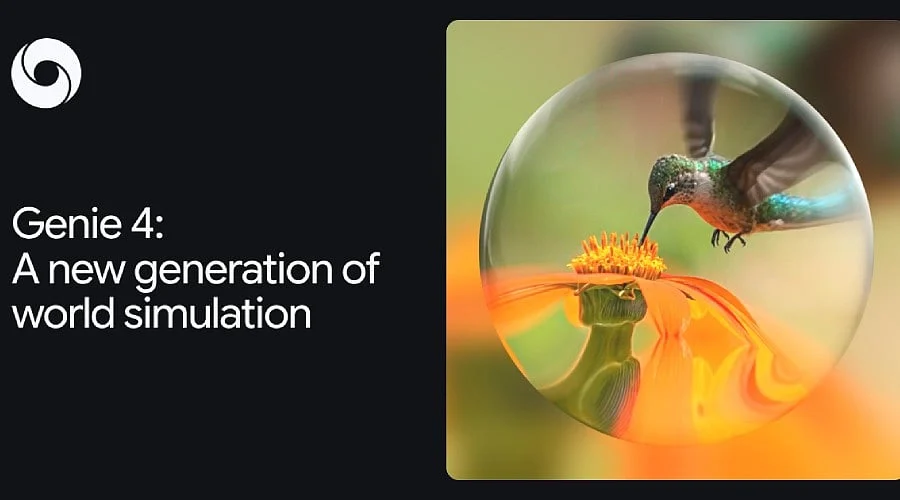
Google DeepMind has unveiled Genie 4, a cutting-edge world model designed to generate interactive environments for real-time simulation. The system enables users to navigate virtual spaces, direct camera angles, and alter scenes using natural-language instructions, with adjustments appearing dynamically as the simulation progresses.
By integrating capabilities from Google’s Gemini lineup, Genie 4 enhances the visual fidelity, behavior, and structural consistency of these simulated spaces. DeepMind regards world simulation as a crucial milestone on the path toward artificial general intelligence (AGI), pointing to possible use cases in robotics, film production, journalism, video games, and industrial manufacturing.
Genie 4 Brings Real-Time Scene Control and Physics
Genie 4 introduces four primary functions. Its real-time scene control lets operators adjust weather conditions, shift camera viewpoints, and add characters or items via text commands. Gemini translates these directives to fit the local context, helping preserve consistency across user adjustments.
Additionally, the model replicates physical dynamics such as collisions, aerodynamics, and other forces. It is capable of producing lifelike characters that react to their environment, move naturally, and respond to real-time interactive control.
Native Audio and Complex Event Simulation
As Google’s premier real-time world model featuring native audio generation, Genie 4 can build background soundscapes—such as coastal waves or rustling wind—alongside background music and dynamic conversations. Virtual characters possess the ability to talk and react directly to user actions or developments unfolding in the environment.
To handle intricate scenarios, Gemini 3.8 Flash partners with Genie 4 as a supervisory agent. It monitors the environment, divides objectives into manageable tasks, and reviews incoming video frames to track advancement. If circumstances shift or human operators step in, the agent revises its strategy to manage simulations that require causality, multi-step deduction, and procedural actions.
Furthermore, Google DeepMind is testing Genie 4 alongside Gemini 4 Argon within the framework of Gemini Robotics, enabling complex workflows to be structured and visualized through simulation.
Applications Across Creative and Industrial Fields
Google DeepMind is collaborating with select early testers spanning education, journalism, creative fields, video game development, and engineering. Motion picture directors are utilizing the software for pre-visualization workflows, while photojournalists are investigating methods to transform historical photos into active simulations.
Game creators are testing mechanical concepts, interactive prototypes, and artistic directions via text commands prior to writing traditional code. Meanwhile, corporate partners are assessing the technology for robotics research and industrial modeling.
Also Read: Google DeepMind Launches Gemma 4 12B to Bring Cloud-Level AI to Local PCs
Safety Measures and Current Limitations
Every piece of generated audio and video will feature SynthID, Google’s hidden digital watermark. Because Genie 4 is currently in early-stage research, users may notice visual inconsistencies and a loss of object permanence during extended use or following intricate prompt modifications.
Additional hurdles involve maintaining spatial precision, long-term stability, clear text rendering, accurate live audio, and intricate physical reactions.
Google DeepMind is releasing Genie 4 as an initial research preview for a select circle of vetted testers. It will soon be accessible to Google AI Ultra members via Project Genie, as well as to early-access clients utilizing the Gemini API and Google AI Studio. Interested participants can also register for the waitlist through Project Genie.