A cryptocurrency investigator has connected Tronify.rent to $69,651 in reported losses affecting roughly 80 victims during the month of September. The findings also state that one individual consulted Google Gemini to verify the security of the TRON-focused platform prior to engaging with it.
The accusations were shared on Oct. 4 by JP, the founder of IOC Investigations. His public statement pointed to 12 TRON wallet addresses tied to the alleged scheme.
The estimated financial loss and victim count originate entirely from JP’s findings. None of the independently reviewed blockchain-forensics reports provided a separate verification of the full $69,651 sum spread across those specific addresses.
Investigator Links Tronify.rent to September Losses
Tronify.rent positions itself as a TRON energy rental platform, advertising energy delegation as a method to lower transaction expenses on TRC-20 transfers. The portal characterizes its operations as noncustodial, maintaining that users retain full ownership of their digital assets, and features a wallet-linking option for visitors looking to acquire TRON energy.
Conversely, user testimonials depict a different scenario. A Reddit contributor detailed in June how their assets vanished after connecting a Trust Wallet to Tronify.rent, claiming a loss of 2,590 USDT and a subsequent filing with the FBI’s Internet Crime Complaint Center. This forum post remains an unverified, user-submitted claim and does not constitute proof of criminal guilt.
JP later stated that approximately 80 individuals incurred financial damage throughout September. Even though he published the associated wallet identifiers, he did not provide a detailed transaction ledger to substantiate the $69,651 total.
Additionally, he flagged tron.store as another potential fraudulent platform. In a separate assessment, PhishDestroy cataloged infrastructure operating under the title tron.store – Rent Energy, categorizing the corresponding domain as a high-threat entity.
Security Warnings Predated the Latest Allegations
PhishDestroy had already issued warnings regarding Tronify.rent months prior to JP’s October disclosure. The security firm flagged the web address in February and later gave it a severe risk rating of 90 out of 100.
Archived intelligence reports highlighted indicators linked to cryptocurrency scams and brand spoofing. PhishDestroy also tracked threat-feed alerts associated with the domain and filed two abuse complaints in April—one directed to the domain registrar and another routed to ICANN Compliance.
Subsequent checks revealed that the domain remained active. PhishDestroy emphasizes that submitting an abuse notification does not guarantee that a registrar received, examined, or acted upon the report.
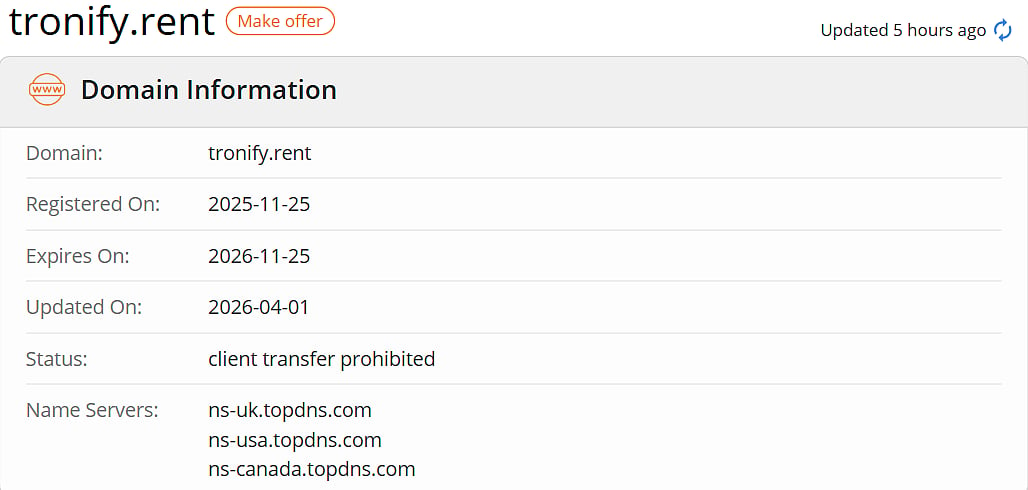
WHOIS data indicates that Tronify.rent was established on Nov. 25, 2025. Contact details for the registrant are concealed via a privacy protection service, with TLD Registrar Solutions listed as the registrar. Meanwhile, Tronify.rent presents itself under the company name Tronify Energy Solutions LLC, displaying a Florida business address and asserting that its systems comply with SOC 2 Type II criteria.
The provided documentation contains no independent audits or regulatory filings to substantiate these assertions. JP additionally alleged that the operation utilized DDoS defense systems routed through Russia, though network intelligence included in the source material does not corroborate this claim.
Instead, PhishDestroy identified Cloudflare as the provider managing the site’s edge network. Because the content delivery network masked the primary server, the available records could not pinpoint the geographic origin of the infrastructure.
Read More: Samsung May Launch Intelligent Eyewear Soon with Gemini AI
Gemini Claim Raises Questions Over AI Safety Checks
Among the most unexpected details in the inquiry is the reference to Google Gemini. JP stated that a victim queried Gemini regarding the trustworthiness of Tronify.rent before proceeding to use it.
According to JP’s account, the user received a response that seemed to validate the site as secure. Publicly available statements from Google within the provided records do not verify this specific Gemini interaction, nor does the available data reveal the precise phrasing used in the query or the complete output generated by Gemini.
Google cautions that generative artificial intelligence platforms are susceptible to producing incorrect data. Guidelines for Gemini instruct users to cross-reference important facts through alternative channels prior to acting on them.
Furthermore, Google’s safety documentation addresses the hazards posed by malicious websites, noting that web pages can embed hidden prompt-injection text engineered to manipulate generative AI models. Google notes that Gemini incorporates protective measures designed to flag suspicious material, and users are given options to flag outputs they deem unsafe or flawed.
The corporation has previously issued alerts concerning AI-driven financial scams in the cryptocurrency sector, highlighting fraudulent investment schemes, bogus mining software, and misleading tutorials for automated bots in a June advisory.
Such tactics can lure individuals toward harmful applications or wallet-compromise vectors. The claims surrounding Tronify.rent continue to rely exclusively on JP’s investigation, affected user testimonials, registration records, and the threat-intelligence insights detailed in the source material.
Final Thoughts
JP’s findings connect Tronify.rent to $69,651 in reported September damages impacting roughly 80 people. While prior security alerts provide broader context, the alleged Gemini exchange remains unverified. Individuals who depend on artificial intelligence tools to evaluate web safety should always corroborate factual statements using independent cybersecurity resources.