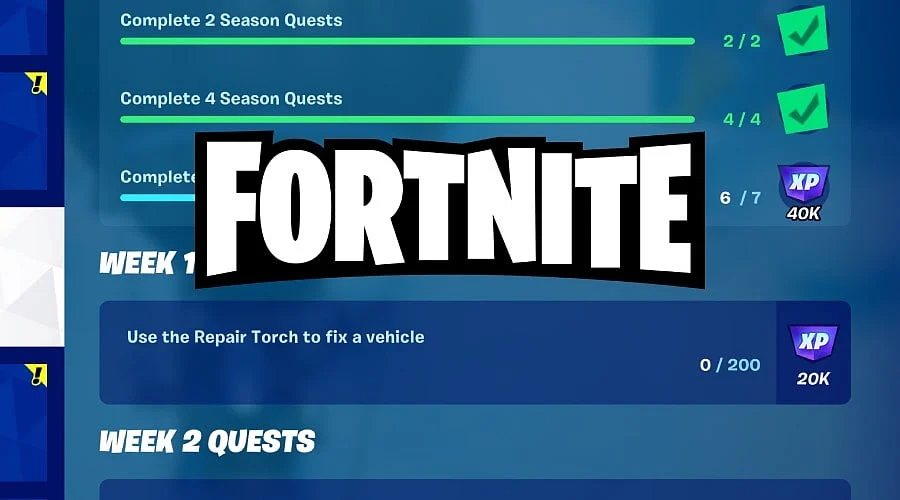
Overview
-
Beyond simply surviving and winning matches, Fortnite quests offer players additional objectives. These challenges—including Daily, Weekly, and Seasonal quests—often require participants to visit specific locations, gather items, wield certain weapons, or execute particular actions during gameplay.
-
Users can review available objectives by navigating to the Quests menu within Fortnite. Examining this log prior to launching a match enables gamers to align challenges with their intended drop zone, weapon preferences, or general playstyle.
-
Finishing these assignments yields XP and facilitates advancement through the Battle Pass. By routinely monitoring new tasks, participants transform standard matches into productive sessions rather than depending solely on their placement or survival outcomes.
Ever since its launch in 2017, Fortnite has served as a benchmark for the battle royale genre. For many participants, the core appeal lies in securing a Victory Royale, a process frequently punctuated by eliminations. However, that represents only a portion of the overall experience. Quests form an integral part of the game and serve as a primary motivation for millions of users to log on daily. Accomplishing these tasks turns an ordinary match into an opportunity to accumulate substantial XP, explore a new area of the map, pick up specific items, or execute unique assignments.
Locating these assignments is straightforward. The game features a dedicated menu that categorizes every quest. Users can launch Fortnite and access the Quests tab straight from the lobby. Reviewing this directory before dropping into a match helps players determine their objectives in advance.
A strategic approach to quests involves resisting the urge to treat every single challenge as an isolated chore. Multiple objectives can frequently be accomplished during a single match, meaning a small amount of forethought can save considerable time.
How to Find, Complete and Track Fortnite Quests
Fortnite quests feature a variety of objectives. While some are straightforward and finish naturally through standard play, others mandate that users travel to a designated spot, utilize a specific weapon, gather items, or repeat an action a set number of times.
Reading the objective carefully is the initial step. A mandate to visit a particular region is easiest to coordinate prior to landing; players can select an adjacent drop zone to finish the task early instead of crossing the island later on.
Combat-related challenges require a different strategy. If an assignment calls for dealing damage with a particular firearm, participants should prioritize finding that weapon immediately. There is no requirement to overhaul one’s entire playstyle for a single goal; instead, the aim is to integrate the challenge smoothly into the flow of the match.
Daily and Weekly quests assist users in organizing their play sessions. Daily tasks deliver fresh assignments each day, whereas Weekly objectives afford a more extended timeframe for completion. Daily tasks refresh on a daily basis, whereas Weekly objectives update every Tuesday.
Monitoring progress is just as vital as discovering the challenges. Users can access the Quests menu to view active objectives and evaluate their current standing. Furthermore, Fortnite has integrated various quest categories into a centralized Quests view, simplifying the process of navigating between different goals.
Participants should resist the temptation to finish every task in a single game. Selecting a handful of compatible quests is a more efficient strategy. For instance, a user might pair a location-based objective with a collection task and a weapon-specific challenge, allowing all three to be achieved during the same outing.
This same philosophy applies to longer-term challenges. Spreading progress across multiple matches rather than forcing every action into one game prevents quests from feeling tedious, turning them into rewarding secondary objectives during regular play.
Also Read: Fortnite’s 100M-Euro Dispute Puts Free-to-Play Monetization Under Pressure
Why Completing Fortnite Quests Can Help
Accumulating XP is the primary incentive for finishing Fortnite quests. Epic Games highlights quests as a key method for earning XP within the game, with Daily, Weekly, Seasonal, and other challenges offering continuous opportunities to boost point totals.
XP is particularly valuable for advancing the Battle Pass. Users who consistently finish tasks continue to progress through the Pass during normal gameplay. Additionally, Epic Games notes that XP gained across various Fortnite experiences contributes toward Battle Pass advancement.
Quests can also transform how users interact with the island map. An individual who typically drops into the same spot might explore an unfamiliar area due to an active challenge, while another might test out a weapon they normally overlook simply because an assignment demands it.
This system injects a sense of purpose into routine matches. Even if a user fails to secure a win, checking off one or two quests ensures the match was far from wasted, as incremental milestones accumulate over successive games.
Strategic planning also conserves time. Rather than running back and forth across the map, users can bundle quests situated in the same region, fulfilling multiple objectives in a single excursion.
Under specific conditions, users who miss out on XP from Daily or Weekly quests may receive Supercharged XP. According to Epic Games, this mechanism compensates for missed Daily or Weekly quest XP by amplifying future point gains.
Also Read: 78-Year-Old Fortnite Streamer Builds 24,000-Follower Twitch Community
Make Every Fortnite Match Count
Quests never detract from the core excitement of the battle royale format; instead, they complement it by introducing an extra dimension. Users can hunt for a win while simultaneously advancing toward XP milestones, Battle Pass levels, and supplementary rewards.
The most straightforward and recommended approach is to check the Quests tab before jumping into a match. Users should select their desired objectives first, establish a game plan, monitor their progress dynamically during the round, and avoid burning time trying to finish every challenge simultaneously.
Within Fortnite, a modest amount of preparation yields notable benefits. While optional, outlining a clear plan for each match gives players total control over their objectives. For regular participants, completing a few ongoing challenges along the way transforms standard game time into consistent progression.
You May Also Like
Fortnite Leak Controversy Takes New Turn as Epic Games Reaches Settlement
Fortnite’s Long-Awaited iPhone and iPad Return is Now Official: Here’s What Apple Users Need to Know
Fortnite Maker Epic Games Lays Off Over 1,000 Employees
FAQs
Where can I find Fortnite quests?
Ans: Players can open Fortnite and go to the Quests section from the lobby. The available quests can change based on the season, event, and Fortnite experience being played.
How can I complete Fortnite quests faster?
Ans: Choose quests that can be completed together. For example, players can combine a location-based task with a collection or weapon challenge during the same match.
Do Fortnite quests give XP?
Ans: Yes. Quests are one of the ways players can earn XP in Fortnite. Daily, Weekly, Seasonal, and other quests can help players build XP and progress through the Battle Pass.
How do I track Fortnite quest progress?
Ans: Players can open the Quests section to check their objectives and progress. Fortnite’s updated Quests view also brings different quest types together, making them easier to manage.
When do Fortnite Daily Quests reset?
Ans: Daily quests reset each day. Players can check the Quests section in Fortnite to see the current tasks and their reset information.