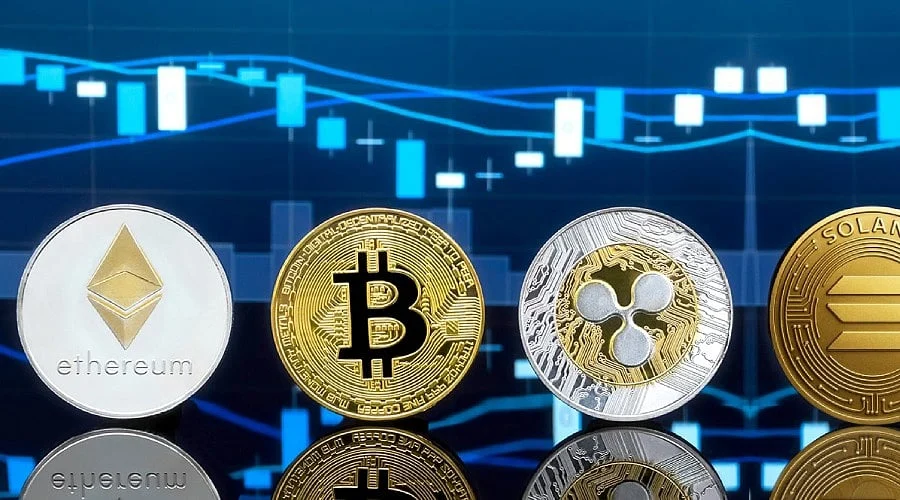
As 2027 approaches, Bitcoin, Ethereum, XRP, and Solana present distinct investment cases. Bitcoin relies on scarcity, Ethereum powers decentralized applications, XRP focuses on payment solutions, and Solana centers on high-speed processing. Their future performance hinges on economic conditions, institutional interest, liquidity levels, and overall adoption rates.
Current Price and Market Valuations
Data from CoinMarketCap on October 16, 2026, pegged Bitcoin at USD 82,230.81, Ethereum at USD 2,457.16, XRP at USD 1.34, and Solana at USD 106.51. Their respective market capitalizations stood at roughly USD 1.65 trillion, USD 300.13 billion, USD 84.67 billion, and USD 62.8 billion.
Bitcoin: Scarcity and Institutional Demand
With a strict cap of 21 million coins, Bitcoin reinforces its status as a scarce digital asset. During the second quarter of 2026, Bitcoin dropped 14.2%, and US spot Bitcoin ETFs saw USD 4.67 billion in net outflows. While institutional backing could bolster future gains, ongoing ETF withdrawals, shifting interest rates, and macroeconomic volatility pose notable risks.
Ethereum: Smart Contracts and Staking
Ethereum underpins decentralized finance, stablecoins, and tokenized real-world assets, while its proof-of-stake framework lets qualifying participants collect staking yields. Still, CoinDesk Research noted that Ethereum ETFs suffered roughly USD 690 million in outflows during the second quarter. Network activity, staking adoption, and rival blockchains will likely shape its 2027 trajectory.
XRP: Cross-Border Payment Opportunities
XRP is designed to streamline currency conversion and international liquidity transfers. CME Group reports that transactions on the XRP Ledger typically finalize in about four seconds, contrasting with Bitcoin’s standard 10-to-60-minute validation period. Greater institutional use in payments could drive demand, though regulatory shifts, market competition, and token supply metrics create unpredictability.
Solana: Speed and Ecosystem Growth
Solana concentrates on applications demanding rapid execution and minimal transaction costs, such as decentralized exchanges and tokenized securities. CoinDesk Research data shows Solana captured 78.9% of tokenized equity DEX volume in June 2026, surpassing USD 3 billion. This expansion is accompanied by high volatility, network stability concerns, and rivalry with Ethereum’s scaling networks.
Comparing Volatility and Investment Risks
An analysis by CryptoTicker in October 2026 revealed that the four digital assets shared a 12-month correlation coefficient between 0.82 and 0.90, alongside peak-to-trough drawdowns spanning 52% to 73%. These tight correlations indicate that diversifying strictly within this group offers minimal shielding during broader market sell-offs.
Final Thoughts
Bitcoin offers scarcity, Ethereum provides programmable infrastructure, XRP emphasizes payments, and Solana focuses on transaction efficiency. None guarantees superior returns in 2027. Investors should evaluate risk tolerance, adoption metrics, and market conditions before allocating capital.
Also Read: Bitcoin Falls Toward USD 80K as US Inflation Shakes Markets
FAQs:
1. Which cryptocurrency could deliver the highest returns in 2027: Bitcoin, Ethereum, XRP or Solana?
Ethereum, XRP and Solana could offer substantial growth potential if blockchain adoption and institutional demand increase, although they also carry significant risks. Bitcoin’s larger market capitalization and established institutional presence may provide comparatively greater liquidity, but no cryptocurrency guarantees positive returns.
2. What are the current prices of Bitcoin, Ethereum, XRP and Solana in October 2026?
According to the October 16, 2026 CoinMarketCap figures provided, Bitcoin traded at USD 82,230.81, while Ethereum was priced at USD 2,457.16. XRP traded near USD 1.34, and Solana stood at approximately USD 106.51.
3. Which is more volatile: Bitcoin, Ethereum, XRP or Solana?
Bitcoin generally experiences comparatively lower volatility because of its larger market capitalization and deeper trading liquidity. Ethereum, XRP and Solana may experience sharper price fluctuations, particularly during market corrections and periods of heightened speculation.
4. How do Bitcoin, Ethereum, XRP and Solana differ in their blockchain use cases?
Bitcoin primarily functions as a scarce digital asset, while Ethereum supports smart contracts, decentralized finance and tokenized financial products. XRP focuses on efficient payment settlement, whereas Solana supports high-speed blockchain transactions, decentralized exchanges and other applications.
5. What are the major risks of investing in Bitcoin, Ethereum, XRP and Solana in 2027?
Major investment risks include price volatility, regulatory uncertainty, institutional fund outflows, cybersecurity vulnerabilities and competition between blockchain networks. Investors should also evaluate market liquidity, token supply dynamics and macroeconomic conditions before making cryptocurrency investment decisions.