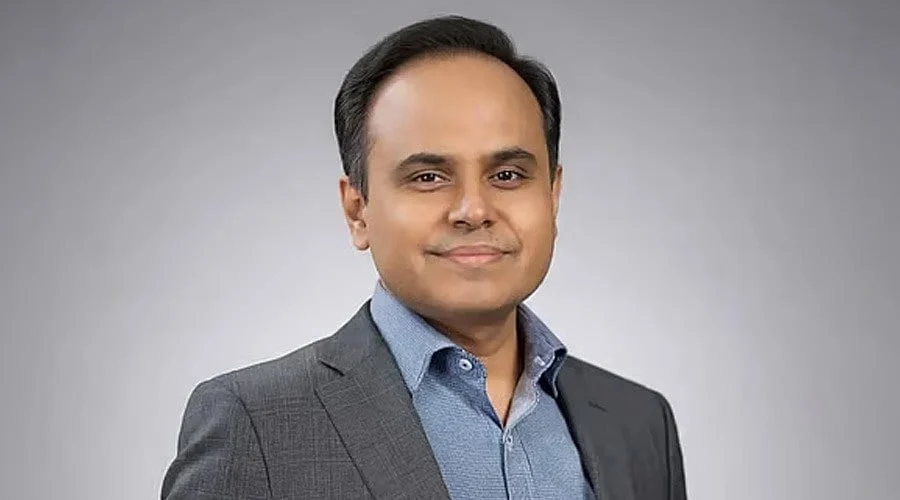
Long before artificial intelligence became a central boardroom focus, Srikanth Velamakanni was exploring a single question: How can data drive better decision-making? His career began in investment banking, where he priced financial risk, before he co-founded Fractal in 2000. What started as an analytics venture eventually evolved into a global enterprise AI organization.
Today, Velamakanni serves as Group Chief Executive and Executive Vice-Chairman of Fractal while also chairs Nasscom. His professional trajectory mirrors a broader technological evolution—moving from data designed to help organizations understand risk to AI systems that actively assist in making the choices themselves.
From Engineering to Investment Banking
Velamakanni’s professional journey began with foundations in engineering and management. He pursued an electrical engineering degree at IIT Delhi, followed by a management program at IIM Ahmedabad.
Upon finishing business school in 1998, he took on an associate role at ANZ Investment Bank. He later transitioned to ICICI Bank, focusing on structured transactions that included collateralized debt instruments. This position placed him close to high-stakes corporate decisions, offering a firsthand look at how figures, models, and underlying assumptions influenced capital-intensive choices.
Before long, his focus expanded past financial risk alone. He realized that the analytical mindset used to decode financial results could similarly address broader commercial challenges—a perspective that ultimately steered him toward analytics.
The Idea That Became Fractal
In February 2000, Velamakanni teamed up with fellow IIM Ahmedabad alumni to establish Fractal in Mumbai. At that time, business analytics was still developing. Although enterprises were accumulating vast quantities of data, many faced hurdles in converting it into actionable choices.
Fractal was founded to bridge this exact gap. Its initial projects concentrated on consumer insights, predictive modeling, and marketing optimization. The enterprise went beyond merely crunching numbers; it helped organizations grasp the significance of their data and leverage it to enhance decision-making.
Velamakanni contributed a diverse mix of perspectives to the venture. His finance background gave him a firm grasp of commercial risk, while his engineering background fostered a structured analytical framework. Additionally, his curiosity regarding behavioral economics and consumer psychology provided a deeper understanding of human decision-making. This combination became foundational to Fractal’s identity as it expanded.
From Analytics to Artificial Intelligence
Over more than two decades, Fractal adapted alongside shifting technologies. Traditional analytics gradually made room for machine learning and artificial intelligence, and the firm evolved in tandem.
For Velamakanni, the underlying objective remained constant: technology had to elevate decision-making or solve tangible problems. AI served as the instrument rather than the ultimate destination.
Beyond consulting, Fractal expanded by incubating independent AI ventures. Qure.ai applies artificial intelligence to medical imaging, Cuddle.ai funnels executive insights, and Eugenie.ai detects operational anomalies. These initiatives reflect a progression from merely interpreting data to taking automated action, closely mirroring Velamakanni’s personal path from finance through analytics to AI.
A Career Timeline
-
1996: Finishes B.Tech in Electrical Engineering at IIT Delhi.
-
1998: Wraps up his management degree at IIM Ahmedabad and joins ANZ Investment Bank.
-
1999: Moves to ICICI Bank to work on structured transactions.
-
2000: Co-founds Fractal in Mumbai.
-
2024: Steps into the role of Vice Chairperson at Nasscom.
-
February 2026: Fractal lists on the BSE and NSE.
-
April 2026: Takes over as Chairperson of Nasscom.
Building Fractal Into a Public Company
This two-decade trajectory reached a major milestone in 2026. For the fiscal year, Fractal posted operational revenue of Rs. 32.997 billion—marking a 19% year-over-year increase—while profit after tax reached Rs. 2.868 billion, up 30%. Following its initial public offering, the company officially listed on the BSE and NSE on February 16, 2026.
For Velamakanni, the listing represented the culmination of a twenty-year shift from providing analytics services to building enterprise AI solutions, transforming a private startup into a publicly traded corporation.
From Fractal to Nasscom
Velamakanni’s responsibilities now stretch far beyond the enterprise he originally founded. After spending over six years on Nasscom’s executive council, he assumed the role of Vice Chairperson in September 2024.
In April 2026, he advanced to Chairperson, succeeding Sindhu Gangadharan. Upon stepping into the post, Velamakanni noted that his main objectives are to champion the next wave of AI-driven expansion across services and products, while helping ready India’s workforce for an AI-integrated environment. NASSCOM has structured his mandate around AI-led service transformations, deep tech and product innovation, and responsible AI practices—priorities that closely align with his own journey from analytics services to scalable, technology-backed decision-making.
Also Read: Top 100 Fastest-Growing AI Companies in India (2026)
Beyond the Company
Outside of his work at Fractal, Velamakanni dedicates time to education and industry governance. He serves as a founder and trustee of Plaksha University, a Punjab-based engineering institution focused on emerging technologies.
Furthermore, he acts as Non-Executive Chairman of IdeaForge and holds a board position at NIIT. His contributions have been recognized with the Young Alumni Achiever Award from IIM Ahmedabad and the Distinguished Alumni Award from IIT Delhi in 2025.
Also Read: Fractal Announces Launch of Crux Intelligence, the Next-Generation Business Intelligence Company that Puts AI in the Hands of Every Business User
Final Thought
The tools Velamakanni relies on have evolved immensely since 1998, with basic spreadsheets and financial models giving way to sophisticated AI systems capable of shaping major corporate decisions. Yet the fundamental inquiry driving his work remains unchanged: how can superior data yield better outcomes? That enduring question continues to bridge his ongoing endeavors at Fractal with his broader leadership objectives at Nasscom.
You May Also Like:
H-1B Visa Fee Hike: Nasscom Predicts Minimal Impact as Indian IT Shifts to Local Hiring
Nasscom Says 1.4 lakh Jobs Remain Vacant in AI and Big Data Roles in India
Starbucks to Set Up First India GCC in Chennai, Plans 800 Tech Jobs